Diesel is draining off Korea's oil exchange — and the gap between its two order books isn't a spread
Diesel traded on the KRX oil market fell 23% from 2020 to 2025 while petrol held. And the 'premium' on its negotiated book over its competitive one is a few tenths of a percent that flips sign four days in ten. Not advice.
AI-assisted, human-reviewed sourcing. Figures are pulled programmatically from the official sources listed at the end of this article and checked by an editor before publication.
Korea runs a public spot exchange for refined fuel — the KRX oil market, where diesel, kerosene and petrol change hands each trading day through two separate order books. Six and a half years of its daily records show one clear trend and one thing that looks like a signal but isn’t.
Diesel is leaving the exchange
Add up the litres traded each year and the fuels split apart. Diesel, the largest by volume, has fallen from 3,457 million litres in 2020 to 2,665 million in 2025 — down 22.9%, and the slide is steady rather than a single bad year. Petrol did the opposite, edging up 5.5% (1,707m to 1,801m). Kerosene, the smallest, barely moved (−4.1%).
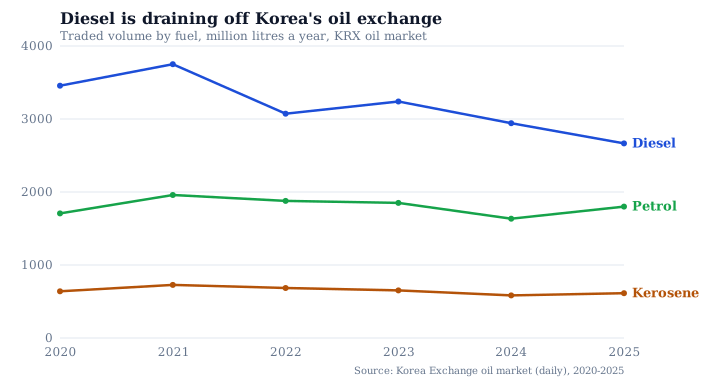
The exchange is not the whole fuel market, so this is not a headcount of every litre burned in Korea. But among the volume that clears on KRX, the shape is plain: the diesel book is thinning while the petrol book holds its ground.
The “spread” that isn’t one
Each fuel trades on two books at once — a competitive auction and a negotiated book — and it is tempting to read the gap between their prices as a spread that means something. It mostly doesn’t. Across six years the negotiated price sat above the competitive one on 62.8% of days for diesel, 55.3% for petrol and 53.8% for kerosene. So there is a faint lean toward the negotiated book being dearer — but only just, and for kerosene it is almost a coin toss.
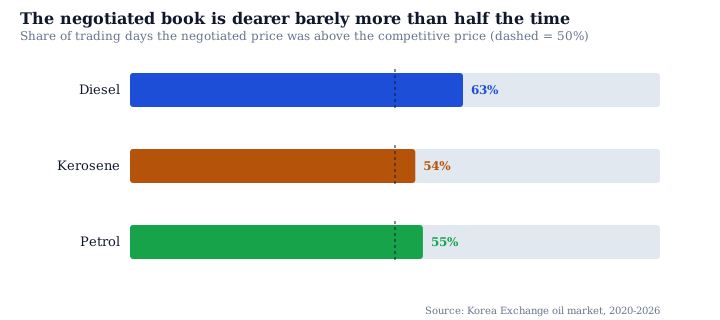
And the size of the gap is tiny. The median difference is 5.0 won a litre for diesel, 1.6 for petrol, 0.9 for kerosene — a few tenths of one percent on a price near 1,300 to 1,800 won. Yet on any single day it swings from about −150 to +130 won, far wider than that median. A gap whose sign flips four days in ten and whose median is a rounding error is not a premium you can trade on — it is noise around two order books pricing the same fuel. One day last month showed exactly +6.73 won on both diesel and petrol; that was a day, not a rule.
Kerosene is the thin book
The one place the structure bites is kerosene. Its competitive auction recorded no trades at all on 16.4% of days — roughly one trading day in six — against just 4.1% for diesel and 5.1% for petrol. On those days the competitive price is simply absent, and only the negotiated book prints. Anyone joining the two series without noticing that would compare a real price against a blank.
This is a reading of the exchange’s own daily record, not a forecast and not investment advice. What it shows is a diesel book quietly shrinking, a gap between order books that is too small and too two-sided to be a signal, and a kerosene auction that goes dark one day in six.
Data & Verification Notes
- Data as of
- Sources
- Korea Exchange (KRX) oil market — Daily weighted-average prices and traded volume by fuel, competitive and negotiated order books, 2020-01 to 2026-08
- Cross-checks
- Diesel traded volume fell from 3,457m litres (2020) to 2,665m (2025), down 22.9%; petrol rose 5.5% (1,707m to 1,801m); kerosene fell 4.1% (640m to 614m)
- The negotiated weighted-average price sat above the competitive one on 62.8% of trading days for diesel, 55.3% for petrol and 53.8% for kerosene — a median gap of just 5.0, 1.6 and 0.9 won per litre
- The daily gap ranged from roughly -150 to +130 won per litre, far wider than the few-won median, so its sign flips constantly
- Kerosene's competitive order book recorded no trades on 16.4% of days, against 4.1% for diesel and 5.1% for petrol
- Excluded figures
- A single day (a diesel/petrol gap of exactly +6.73 won) is not the rule — across six years the gap is small on average and swings both ways; we report the distribution, not one day
- Prices are nominal won per litre as traded and are not adjusted for inflation, fuel tax or grade; the exchange price is not the pump price
- Exchange volume is what clears on KRX, not national fuel consumption — it moves with how much trade routes through the exchange, not only with demand
- Median, not mean: the daily gap has fat tails (down to about -150 won), so the mean is pulled around; the median is the robust representative value. Not investment advice
The full dataset behind these figures — every listed company, every row — is available to license. SeoulMarkets data for licence →
Not investment advice. SMarkets publishes data journalism for general information only. Nothing here is investment advice, a recommendation, or an offer to buy or sell any security — any investment you make is at your own risk and responsibility. Figures are derived from official public data sources and may be revised by the issuing agency. Verify independently before acting.
← More Commodities