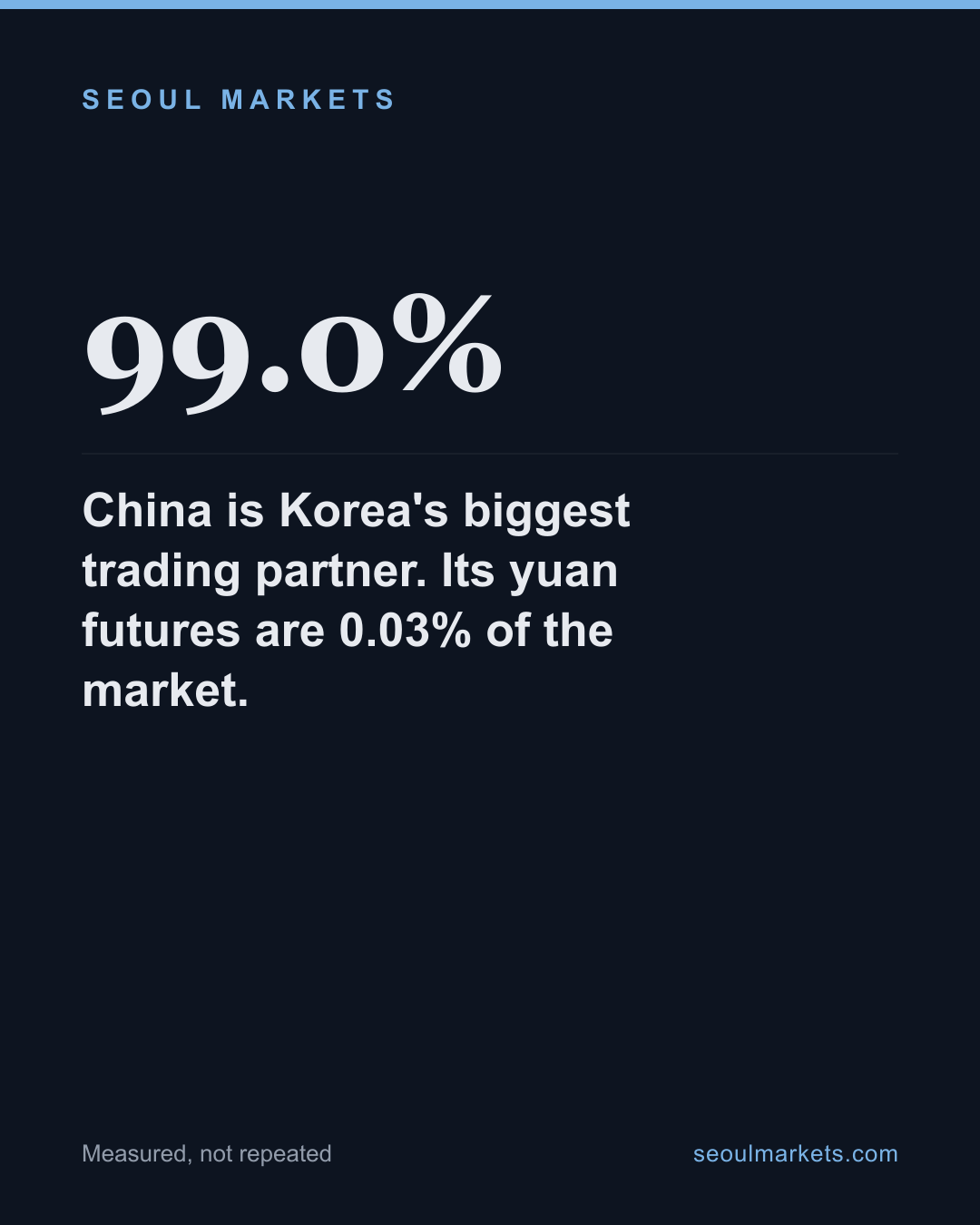
China is Korea's biggest trading partner. Its yuan futures are 0.03% of the market.
Across 629 trading days, 99.0% of Korean currency-futures turnover was one contract: the dollar. The exchange also lists 1,272 flexible-dated dollar futures that have never traded once.
AI-assisted, human-reviewed sourcing. Figures are pulled programmatically from the official sources listed at the end of this article and checked by an editor before publication.
currency futureswonyuanmarket structurekorea exchange
China is Korea’s largest trading partner — that part is not our measurement, and nothing below depends on how large. The Korea Exchange lists a yuan futures contract, and it works: it traded on 531 of the 629 days in this sample.
It is 0.03% of the currency futures market.
The whole market, ranked
| Contract | Turnover | Share | Days traded | Peak open interest |
|---|---|---|---|---|
| US dollar | 5,936.4tn won | 99.03% | 629 of 629 | 1,538,305 |
| Euro | 29.4tn | 0.49% | 626 | 33,938 |
| Yen | 27.3tn | 0.46% | 629 | 40,107 |
| Yuan | 1.5tn | 0.03% | 531 | 275 |
Over two and a half years the dollar contract moved 3,862 times the value of the yuan contract. Peak open interest tells the same story from a different angle: at its busiest the yuan contract had 275 contracts outstanding. The dollar had over 1.5 million.
The euro and yen are small too, but they are small in the ordinary way — a few tenths of a percent, thousands of contracts open, trading nearly every day. The yuan is a different order of magnitude. Its peak open interest would fit in a single dollar-contract trade.
What the dollar contract is actually for
The dollar contract carries 99.0% of the turnover because it is not really a currency market. It is the hedging instrument for everything else — exporters, importers, bond investors, equity investors, anyone with a won balance sheet and a dollar exposure. Korea’s entire foreign-currency risk is expressed through one line.
That is efficient right up until it isn’t. A market with one liquid instrument prices that instrument well and everything else badly. If you need to hedge a yuan receivable — and Korean exporters have a lot of them — the exchange has a contract for you, and 275 contracts of open interest to meet you in it.
The 1,272 contracts that have never traded
The same feed carries something stranger. Alongside the standard dollar futures, the exchange lists flexible-dated dollar futures: contracts with customised expiry dates rather than the standard quarterly cycle.
Across 629 trading days there were 1,272 distinct flex contracts listed, appearing in the price file 119,598 times.
Trades: zero. Open interest: zero.
Not “thin”. Not “occasionally”. In two and a half years of daily files, not one of these contracts has ever recorded a trade or an open position. They are listed, priced at zero, carried in the data every day, and never used.
This is worth knowing for a practical reason. If you count “listed contracts” as a measure of market depth — and league tables sometimes do — Korea’s FX derivatives market looks like it offers 1,300 instruments. It offers four.
Meanwhile, the won had a year
The same records carry the underlying spot rate the exchange publishes against each dollar future. It is the cleanest daily won/dollar series available from an official Korean open-data source.
- 2 January 2024: 1,300.4
- 2 July 2026: 1,555.8 — the weakest point in the sample
- 3 August 2026: 1,429.8
The won lost 10.0% against the dollar over the whole window, but the shape matters more than the endpoint. It fell steadily for two and a half years to 1,555.8, and then in 22 trading days gave back 8.1% of that — from 1,555.8 on 2 July to 1,429.8 on 3 August.
A 126-won round trip in a month, in the one contract that carries 99.0% of the market’s hedging, on 1.5 million open contracts. Whatever happened in July, it happened in a market with nowhere else to go.
How to read a concentration number
There is a temptation to read 99.2% as a failure — a market that should be more balanced. That is not what the data says, and we are not saying it.
What the data says is narrower and more useful: Korean currency risk has one liquid venue. Every hedging decision, every basis, every squeeze runs through the dollar contract. When you read that Korean exporters are hedged, this is the instrument they are hedged in. And when a company’s exposure is to the yuan rather than the dollar, the exchange’s answer is a contract with 275 open positions at its busiest.
Data & Verification Notes
- Data as of
- Sources
- Financial Services Commission (Korea) — Derivative Product Price Information Open API — getStockFuturesPriceInfo (daily close, underlying price, turnover and open interest by contract)
- Cross-checks
- 629 trading days, 2 January 2024 to 3 August 2026, with no missing months — every trading day in the window was fetched individually and checked
- Contracts are assigned to a market by their underlying, following the convention that a currency future is FX and an index future is equities. The assignment was tested against a table of twelve real instrument names before any figure here was computed
- Won per dollar is the underlying price the exchange publishes alongside each dollar future, not a rate we derived from the futures price
- A closing price of zero is treated as 'did not trade', not as a price. On a typical day only about a fifth of listed contracts trade at all
- Excluded figures
- Spot FX turnover. This feed covers exchange-traded futures only; the interbank market is larger and is not reported here
- Non-deliverable forwards and offshore won trading, which are not exchange products
- Why the yuan contract is small. The data shows the size; it contains no explanation
- Options. This operation returns futures only
- Korea's trade shares by country. That China is the largest partner is context taken from general knowledge, not measured here, and no figure in this article rests on it
- Any period before 2024. The archive is being extended backwards and 2022–2023 is still filling
- Corrections
- — Re-derived from the completed archive. Within the same 629-day window, euro and yen turnover were understated at first publication because some of those trading days had not yet been backfilled: yen rose from 18.0tn won (620 days traded) to 27.3tn (629), euro from 28.5tn (623 days) to 29.4tn (626). The dollar's turnover, peak open interest and day count did not change, so its share moved only from 99.20% to 99.03%. Separately, the dollar-to-yuan turnover multiple was published as 2,993×, which did not match the 1.5tn yuan figure in the same table; the correct multiple is 3,862×. The finding — the dollar is essentially the whole market and the yuan is a rounding error — is unchanged.
The full dataset behind these figures — every listed company, every row — is available to license. SeoulMarkets data for licence →
Not investment advice. SMarkets publishes data journalism for general information only. Nothing here is investment advice, a recommendation, or an offer to buy or sell any security — any investment you make is at your own risk and responsibility. Figures are derived from official public data sources and may be revised by the issuing agency. Verify independently before acting.
Take this away — 5 cards
The figures in this article, as images. Free to repost with the address on them.