The won, not the goods, drove much of Korea's imported inflation
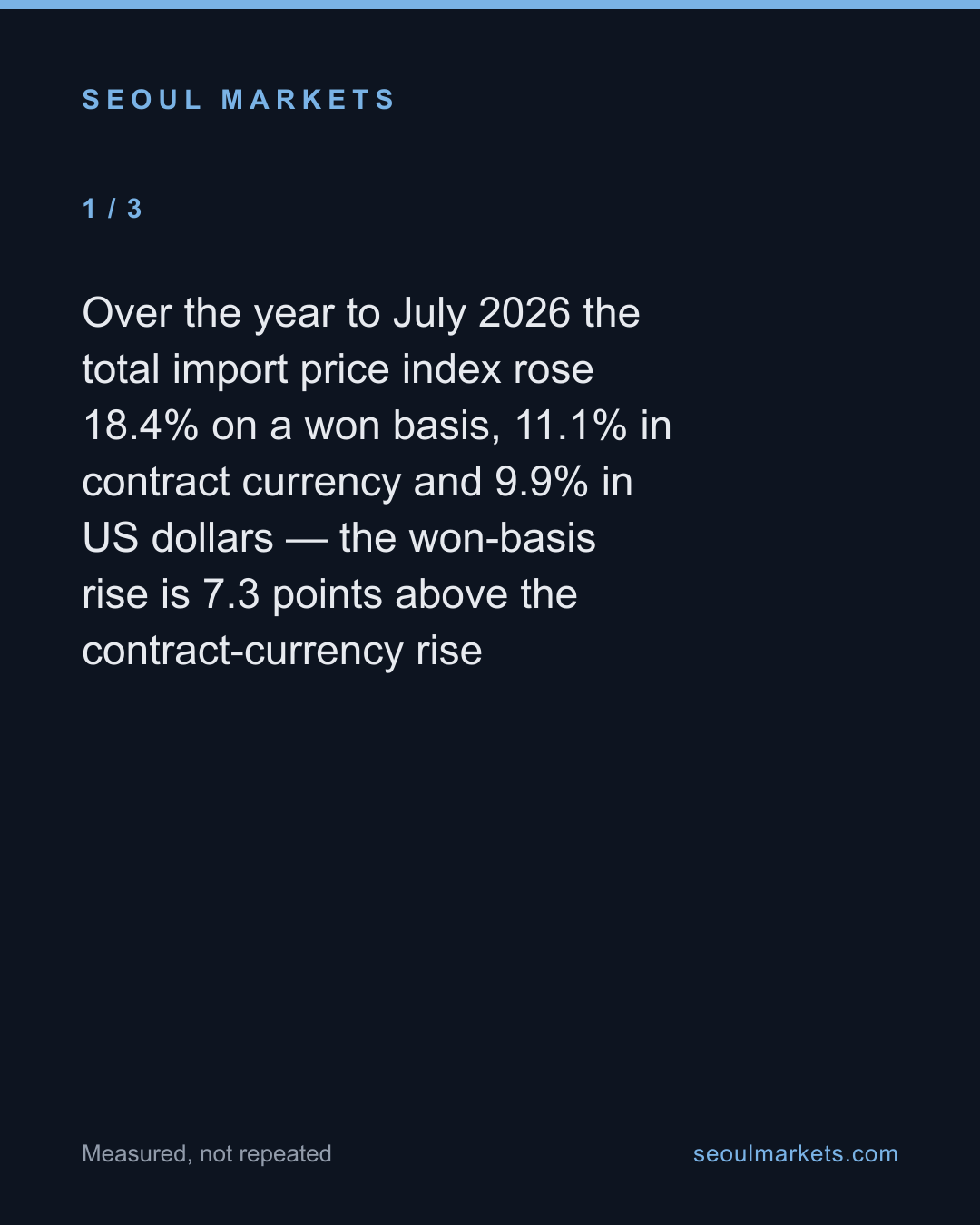
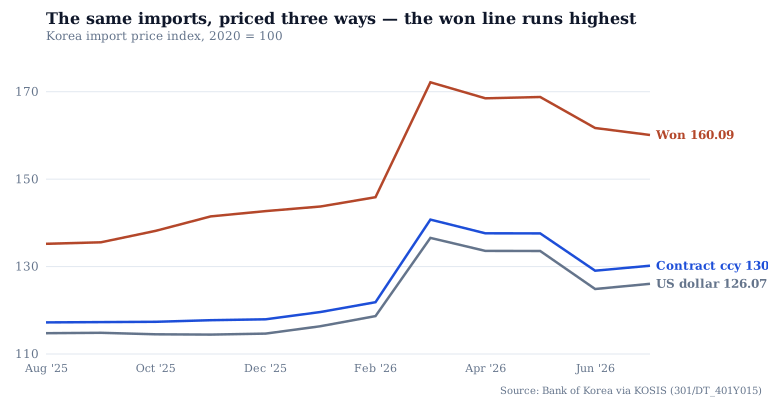
Over the year to July 2026 Korea's import prices rose 18.4% in won but only 11.1% in contract currency. The 7-point gap is the exchange rate, not dearer goods. A March commodity spike lifted all gauges, then partly eased. Not advice.
AI-assisted, human-reviewed sourcing. Figures are pulled programmatically from the official sources listed at the end of this article and checked by an editor before publication.
import-priceswonexchange-rateinflationbank-of-koreakorea
Korea imported the same ships, chips and barrels this year as last. It just paid a lot more won for them — and most of the difference was the won itself, not the price tags on the goods.
The Bank of Korea prices the country’s imports three ways: in won, in the currency each contract was actually written in, and in US dollars. Line them up and the story is in the gap between them.
Seven points of it was the exchange rate
Over the twelve months to July 2026 the total import price index rose 18.4% in won. Measured in the sellers’ own contract currencies it rose only 11.1%, and in dollars 9.9%. The goods did get dearer — but by about eleven percent, not eighteen. The extra seven-plus points is the won: a weaker currency turned an 11% rise in world prices into an 18% rise in what Korean importers actually paid. On this gauge, roughly two-fifths of the year’s imported price increase came from the exchange rate rather than from the goods.
That is the quiet mechanism behind a lot of Korean inflation. When the won softens, the country’s import bill climbs even if nothing abroad has changed — and imports feed straight into the cost of everything made or run on imported inputs.
What actually got dearer
The rise was not spread evenly. Sort the categories by their won-basis change and the top of the list is energy and industrial inputs.
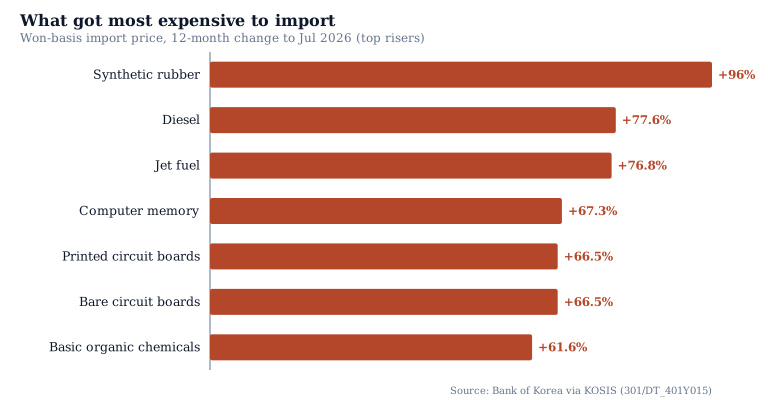
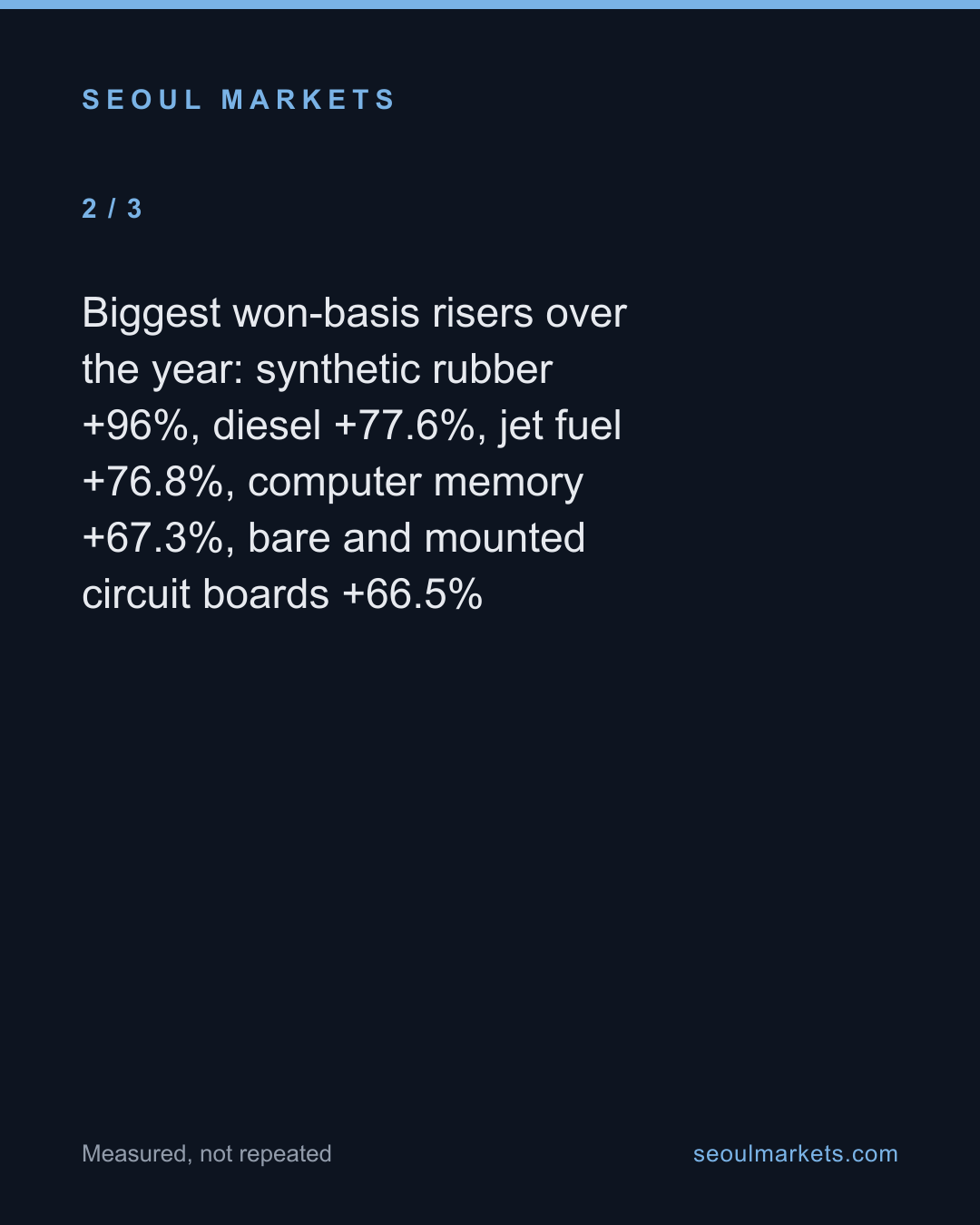
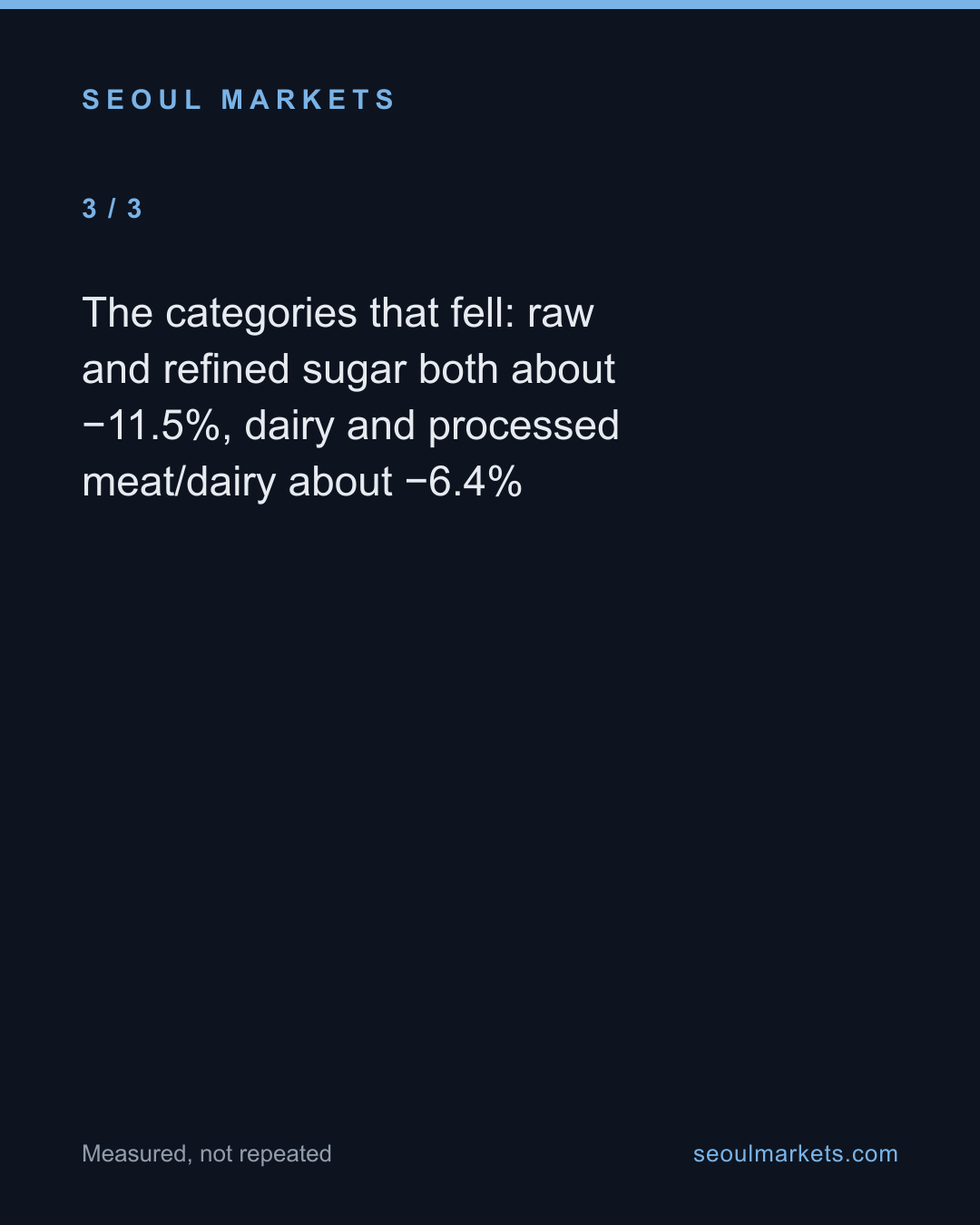
Synthetic rubber nearly doubled (+96%); diesel and jet fuel rose about three-quarters; computer memory and circuit boards climbed roughly two-thirds — the semiconductor supply chain paying up for its own inputs. Not everything rose: raw and refined sugar fell about 11.5%, and dairy about 6%. But the weight of the move was in fuels, rubber and electronics.
Read it carefully
Two cautions. First, the sharp step up in March 2026 — the won line jumps from 146 to 172 in a single month — appears on all three bases, which means it was partly a genuine commodity shock (energy and rubber), not only the currency; and it partly reversed by July. A single month should not be annualised.
Second, this is the price of imports at the border, not the price you pay in a shop. Pass-through to consumer prices is diluted and delayed — importers absorb some, competition eats some, and it arrives over months. So this does not say Korean inflation is 18%; it says the input bill rose that much in won, and that the currency did much of the lifting. This is a reading of the Bank of Korea’s index, not a forecast and not investment advice. What it shows is plain: for a year, the won has been quietly adding to the cost of everything Korea buys from abroad — though not everything moved together: behind the average, synthetic rubber nearly doubled while sugar fell.
Data & Verification Notes
- Data as of
- Sources
- Bank of Korea (via KOSIS) — Import price index (basic classification), 2020=100, on won / contract-currency / USD bases, table DT_401Y015 (org 301), monthly Aug 2025–Jul 2026
- Cross-checks
- Over the year to July 2026 the total import price index rose 18.4% on a won basis, 11.1% in contract currency and 9.9% in US dollars — the won-basis rise is 7.3 points above the contract-currency rise
- Biggest won-basis risers over the year: synthetic rubber +96%, diesel +77.6%, jet fuel +76.8%, computer memory +67.3%, bare and mounted circuit boards +66.5%
- The categories that fell: raw and refined sugar both about −11.5%, dairy and processed meat/dairy about −6.4%
- All three gauges jumped together in March 2026 (won 145.9 to 172.2) and then partly retraced by July
- Excluded figures
- This is an index (2020=100); a reading of 160 means 60% above the 2020 level, not a price. The 18.4% is the change over these twelve months
- The won-versus-contract-currency gap is the exchange rate's effect on the import bill — it is not a full estimate of pass-through to consumer prices, which is diluted and delayed
- The March 2026 jump shows on all three bases, so it is partly a real commodity shock (energy, rubber), not only currency; and it partly reversed afterward
- This is not investment advice
The full dataset behind these figures — every listed company, every row — is available to license. SeoulMarkets data for licence →
Not investment advice. SMarkets publishes data journalism for general information only. Nothing here is investment advice, a recommendation, or an offer to buy or sell any security — any investment you make is at your own risk and responsibility. Figures are derived from official public data sources and may be revised by the issuing agency. Verify independently before acting.
Take this away — 5 cards
The figures in this article, as images. Free to repost with the address on them.