96% of Korean firms pay men more
A census of 2,282 Korean listed companies' own half-year filings: the median company pays men 35.9% more than women. 96.0% pay men more by 5% or more. Only 1.4% pay women more.
AI-assisted, human-reviewed sourcing. Figures are pulled programmatically from the official sources listed at the end of this article and checked by an editor before publication.
gender pay gapwageskoreadartcensus
Every listed company in Korea reports its average pay by gender twice a year, in a filing item called empSttus — a legal disclosure, not a survey. We pulled it directly from all 3,988 listed companies for the half-year report just filed, and built what has not been built from this data before: not a top-10 list of the widest gaps, but a census of where every company sits.
Not an average — a distribution
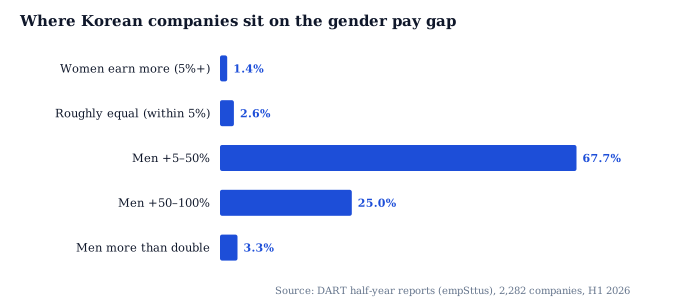
| Where the company sits | Share of 2,282 companies |
|---|---|
| Women earn more (5%+) | 1.4% |
| Roughly equal (within 5%) | 2.6% |
| Men earn 5–50% more | 67.7% |
| Men earn 50–100% more | 25.0% |
| Men earn more than double | 3.3% |
This is a statistic, not a portrait of any one workplace — most companies cluster in the “men earn 5–50% more” band, but the band is wide, and a fifth sit past it.
The number that summarizes it, and the number that doesn’t
If you want one number: the median company in this dataset pays men 35.9% more than women, on average pay. But the more telling number is the 96.0% — the share of companies where men out-earn women by any meaningful margin. A gap this widespread, across companies with completely different industries, sizes, and ownership, is not a story about a handful of outliers. It is closer to the norm than the exception in listed Korea.
The other side confirms it by its absence: only 1.4% of companies — 31 out of 2,282 — pay women more, and by that same 5% threshold. If pay gaps were driven mostly by industry-specific noise rather than a broad pattern, we would expect the two tails to be closer in size. They are not.
What this number can’t tell you
This is an average pay figure per company, by gender — not a same-job comparison. A company where men cluster in senior, longer-tenured roles and women cluster in junior ones will show a large gap here even if every individual role pays equally by gender; DART’s disclosure does not break pay out by title or seniority, so we cannot tell the two apart. We also excluded 359 companies with fewer than 10 of either gender, because at that size one or two individual salaries swing the ratio — the extremes we saw before filtering, like a company with 12 men and 16 women, hit numbers as high as 14x. This is a population-wide measurement, not evidence about any specific company, and it is not investment advice.
A related, narrower piece — the nine highest-paying Korean firms, and how much of their ₩100m-average pay is men’s — found the same direction at the very top of the pay scale. This piece asks the same question of the other 2,270-odd companies.
The debate
96% of measured companies pay men more; 1.4% pay women more. Is a gap this one-sided better explained by broad structural patterns in Korea’s workforce, or by the fact that this measure can’t separate “same job, unequal pay” from “different jobs, different average pay”? What do you think? This is a talking point, not a verdict — argue it out below.
Data & Verification Notes
- Data as of
- Sources
- Financial Supervisory Service (Korea) — DART — OpenDART empSttus (Employee Status, half-year report, reprt_code 11012), all 3,988 listed companies queried directly by corp_code, H1 2026
- Cross-checks
- 2,282 of 3,988 listed companies had usable, gender-split pay data with at least 10 men and 10 women each — the population we measure
- Median company: men's average pay is 1.359x women's, i.e. 35.9% more — computed by us from each company's own reported average pay by gender
- 96.0% of these 2,282 companies pay men 5% or more above women; only 1.4% pay women 5% or more above men; 2.6% are within 5% either way
- Distribution: 67.7% of companies sit in the +5–50% range for men, 25.0% in +50–100%, and 3.3% pay men more than double what they pay women
- Excluded figures
- Why the gap exists — job title, seniority, department, and full/part-time status are not in this disclosure item. DART's empSttus gives one average pay figure per gender per company, not a breakdown by role, so we cannot separate 'different jobs' from 'same job, different pay'
- Non-listed companies — this disclosure is a listed-company legal requirement. Unlisted Korea, which employs most workers, is not measured here
- A company-by-company ranking — 359 companies were excluded for having fewer than 10 of either gender, because small samples produced extreme, unstable ratios (one 12-men/16-women company alone showed 14x). This is a population distribution, not a leaderboard
The full dataset behind these figures — every listed company, every row — is available to license. SeoulMarkets data for licence →
Not investment advice. SMarkets publishes data journalism for general information only. Nothing here is investment advice, a recommendation, or an offer to buy or sell any security — any investment you make is at your own risk and responsibility. Figures are derived from official public data sources and may be revised by the issuing agency. Verify independently before acting.
← More Macro