Korea's ₩107tn offshore filings: mostly new filers
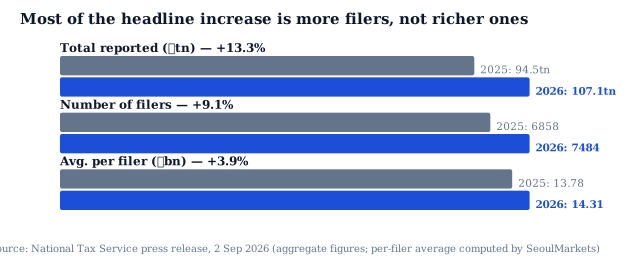
Korea's National Tax Service reported ₩107.1tn in offshore assets this year, up 13.3%. But the filer count rose 9.1% to 7,484 — the average holder reported only 3.9% more than last year.
AI-assisted, human-reviewed sourcing. Figures are pulled programmatically from the official sources listed at the end of this article and checked by an editor before publication.
offshore assetstaxwealthkoreadebate
Korea’s National Tax Service reported this week that residents and domestic corporations declared ₩107.1 trillion in offshore financial assets in 2026, up 13.3% from ₩94.5 trillion the year before. Read as a single number, that looks like a wealthy population moving more money offshore, faster. Split it by who is actually filing, and most of the growth is a different story.
The same total, split two ways
| 2025 | 2026 | Change | |
|---|---|---|---|
| Total reported | ₩94.5tn | ₩107.1tn | +13.3% |
| Number of filers | 6,858 | 7,484 | +9.1% |
| Average per filer | ₩13.78bn | ₩14.31bn | +3.9% |
Total and filer counts are the National Tax Service’s own published figures. The average per filer is ours — total divided by filer count — and is not a figure the agency publishes directly.
Where the growth actually sits
If the total rose 13.3% and the number of people filing rose 9.1%, arithmetic does the rest: most of the increase in reported offshore wealth is more people reporting, not existing filers holding dramatically more. The average holder’s reported total grew 3.9% — a real increase, but roughly a quarter the size of the headline number.
Stock holdings point the same way. Stock-account filers rose 22.2% (1,992 to 2,434) — faster than filers overall — while the stock total rose 27.4% to ₩61.3 trillion, now 57.2% of everything reported. Whatever else changed this year, the biggest single move was more people filing stock accounts, and filing bigger ones.
What a 13.3% headline hides — and what it doesn’t tell us
None of this says whether the new filers are newly wealthy, newly compliant with a reporting rule that already applied to them, or newly caught by better enforcement. The National Tax Service’s release does not say, and dividing two published totals cannot answer it either — we report the split, not the cause.
It also isn’t a claim that offshore wealth is evenly spread: an average across 7,484 filers, all of whom cleared the reporting threshold, says nothing about the distribution among them. This is a size comparison of the reported totals, not a portrait of any individual filer, and it is not investment or tax advice.
The debate
When a national aggregate rises double-digits, how much of that story is “more of the same people” versus “more people, about the same each”? Here the count explains most of it. What do you think? This is a talking point, not a verdict — argue it out below.
A Korean stock-wealth ranking we covered earlier has the same shape — a headline total that moves for reasons the number itself doesn’t show.
Data & Verification Notes
- Data as of
- Sources
- National Tax Service (Korea) — Annual press release on resident/domestic-corporation offshore financial account and asset reporting, published 2 September 2026. Figures (amounts, filer counts) are the agency's own published aggregates.
- Cross-checks
- Total reported offshore assets: ₩64.9tn (2024) → ₩94.5tn (2025) → ₩107.1tn (2026), a 13.3% year-on-year rise most recently
- Number of filers: 6,858 (2025) → 7,484 (2026), a 9.1% rise — computed by us from the agency's own filer counts
- Average amount per filer, computed by us (total ÷ filers): ₩13.78bn (2025) → ₩14.31bn (2026), a 3.9% rise — far below the 13.3% headline growth in the total
- Stock holdings account for ₩61.3tn (57.2%) of the 2026 total, and stock-account filers rose 22.2% (1,992 to 2,434) — the single largest driver of both the amount and filer growth
- Excluded figures
- 2024 filer count — the agency's release did not break it out, so we cannot compute a 2024-to-2025 per-filer average. Shown as unmeasured, not zero
- Any claim about why more people are filing (new wealth, better enforcement, or previously unreported accounts coming into compliance) — the release does not say, and we do not guess
- Individual account-level detail — the agency publishes aggregates only; we did not access or estimate any individual's holdings
The full dataset behind these figures — every listed company, every row — is available to license. SeoulMarkets data for licence →
Not investment advice. SMarkets publishes data journalism for general information only. Nothing here is investment advice, a recommendation, or an offer to buy or sell any security — any investment you make is at your own risk and responsibility. Figures are derived from official public data sources and may be revised by the issuing agency. Verify independently before acting.
What do you think?
This is a talking point, not a verdict — argue it out.
More rankings we take apart in the debate series — where we cite a ranking, then question what it actually measures.