Korea's trade surplus comes from a handful of partners — and drains to a different set
Twelve months of customs data: Korea's goods surplus rests on the U.S., Hong Kong, Vietnam and Taiwan, and drains to where it buys energy and parts — Saudi Arabia, Japan, Australia. China, the biggest partner, nearly balances. Not advice.
AI-assisted, human-reviewed sourcing. Figures are pulled programmatically from the official sources listed at the end of this article and checked by an editor before publication.
tradeexportscustomscurrent-accountkorea
Korea sells the world far more finished goods than it buys, over the year to June 2026. But that surplus is not spread across its trading partners — it is made in a few places and given back in a different few. The customs ledger, read partner by partner, is a map of what the country sells and what it cannot make at home. The dollar figures below are approximate and the structure — who is a surplus, who is a deficit, and the ranking — is the finding, for the reason set out at the end.
Where the surplus is made
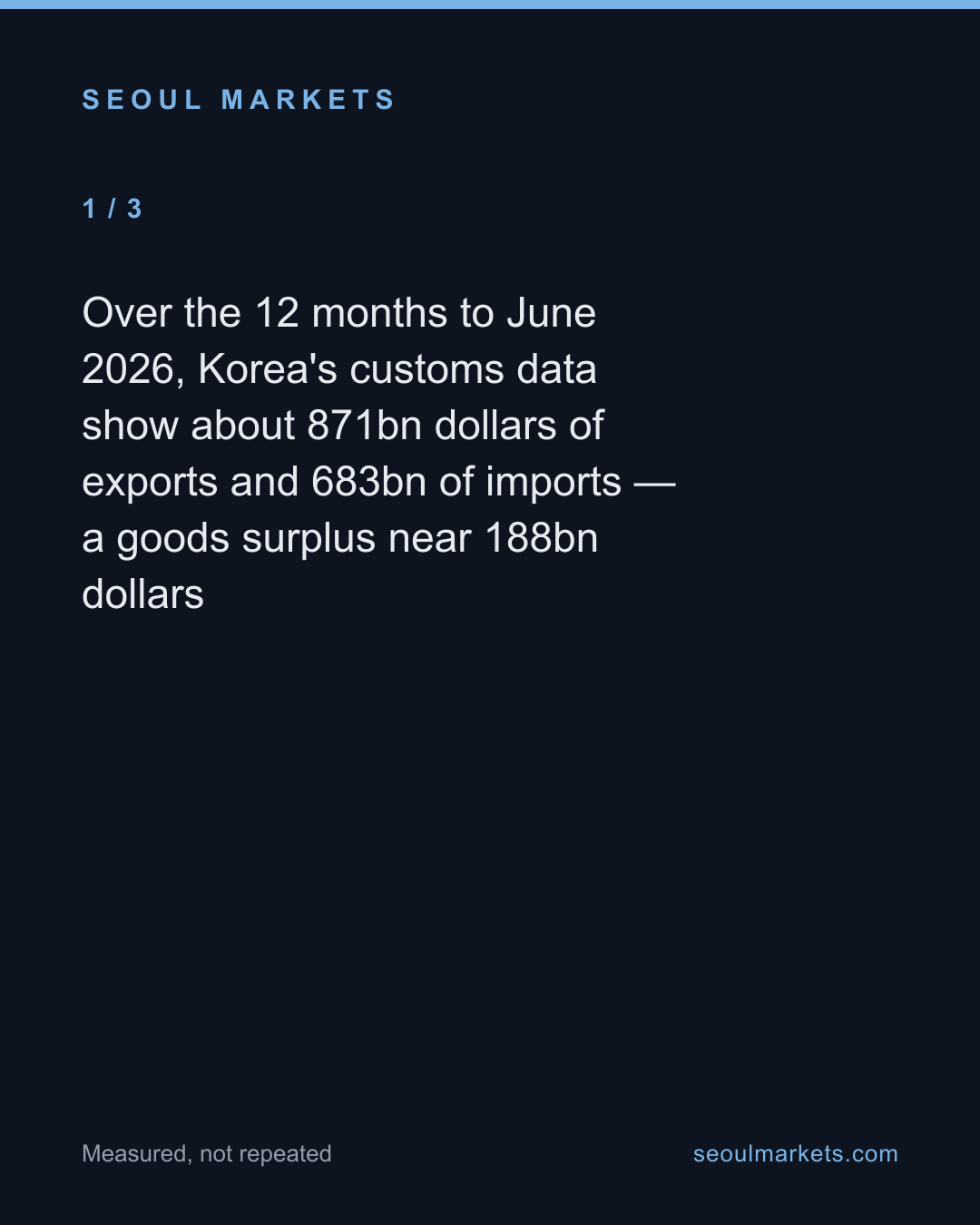
Twelve months of Korea Customs Service data show roughly 871 billion dollars of exports against 683 billion of imports. Sort the partners by bilateral balance and the surplus concentrates hard:
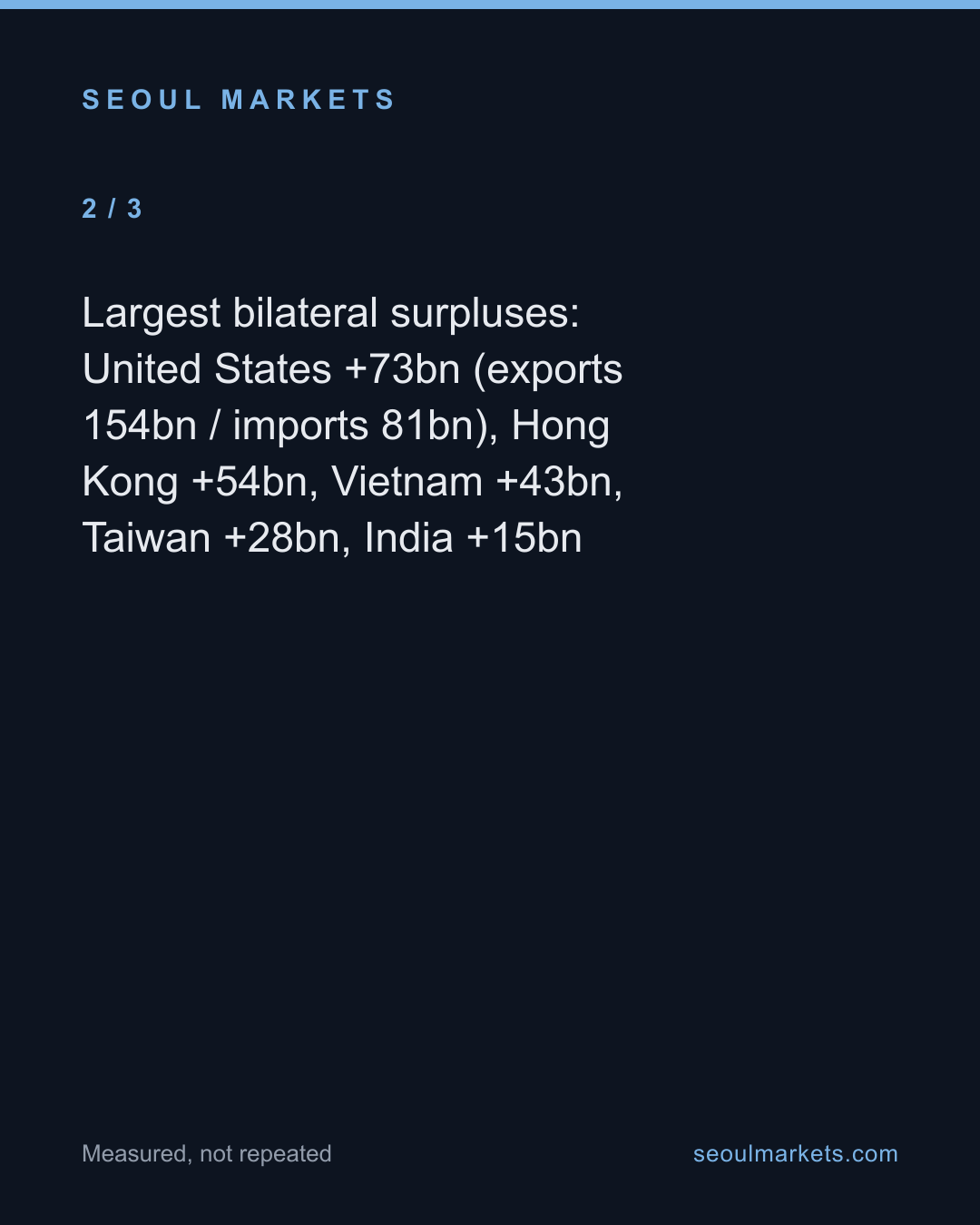
- United States: +73 billion — the single largest, on 154bn of exports against 81bn of imports.
- Hong Kong: +54 billion, Vietnam: +43 billion, Taiwan: +28 billion, India: +15 billion.
These are the destinations for Korea’s finished goods — chips, cars, machinery, displays. Four partners account for the bulk of the entire national surplus.
Where it drains away
Turn the list over and the deficits sit with a completely different group:
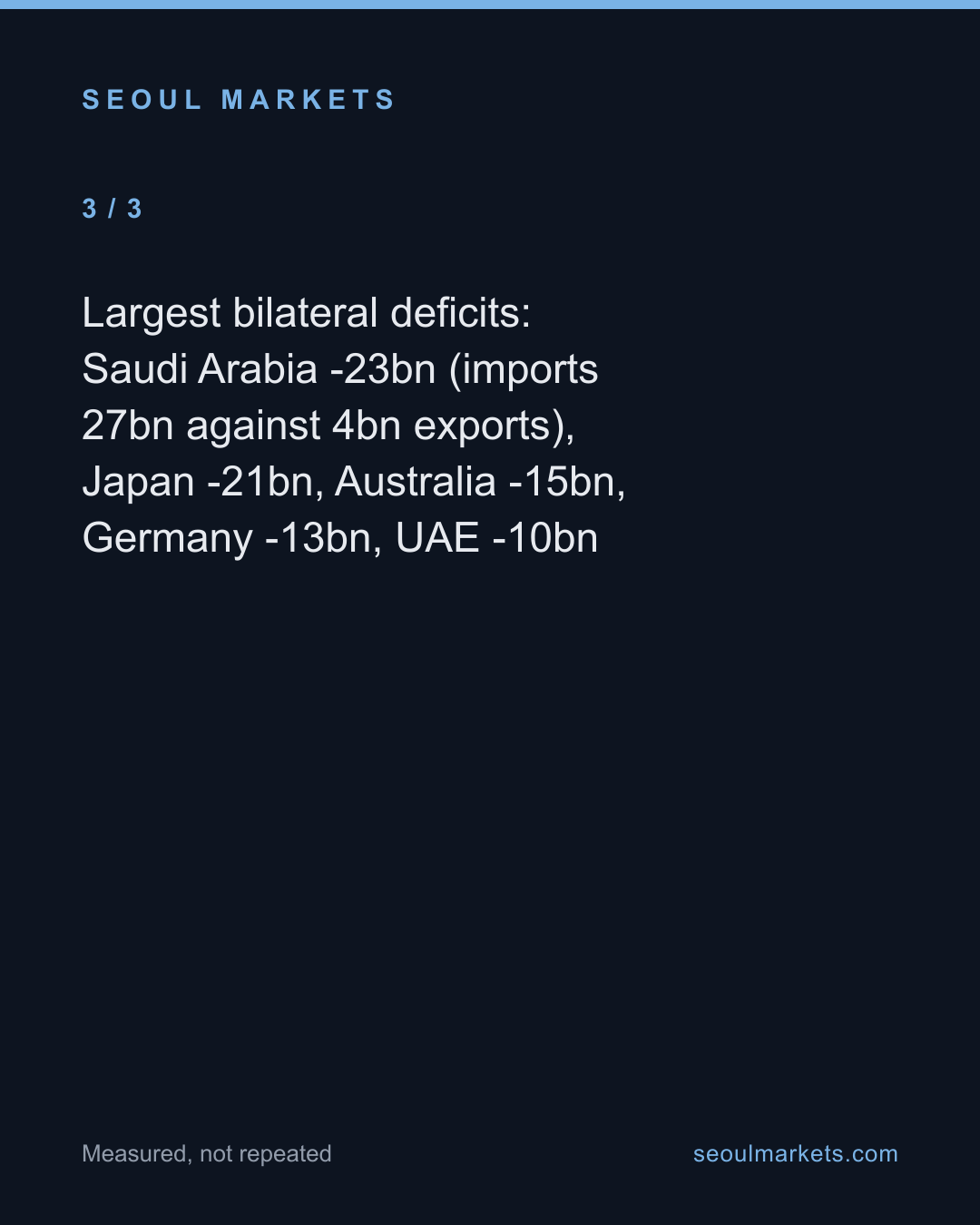
- Saudi Arabia: −23 billion — 27bn of imports against barely 4bn of exports. This is oil.
- Japan: −21 billion, Australia: −15 billion, Germany: −13 billion, United Arab Emirates: −10 billion.
The pattern is clean: Korea runs deficits with the places that sell it energy and raw materials (the Gulf, Australia) and high-end parts and capital goods (Japan, Germany). It earns dollars selling products and spends them buying the inputs those products need.
And China, the giant that nearly balances
The one partner missing from both lists is the biggest of all. By total trade, China is Korea’s largest partner at 330 billion dollars — bigger than the U.S. at 235bn — yet it runs almost even, a surplus of just 9 billion. The relationship that dominates the headlines is, in dollar terms, close to a wash; the surplus that actually funds Korea’s external accounts is made across the Pacific, in the United States.
What this is, and what it is not
This is merchandise trade only — services and investment income sit outside it — and it is not investment advice. A bilateral deficit is not a loss: buying oil from Saudi Arabia or machine tools from Germany is how an export economy runs. Two cautions matter. Hong Kong’s surplus is overstated by re-exports that pass through it to their real destination. And the absolute dollar levels are not to be trusted: the underlying monthly customs totals carry a scale break from March 2026 that lifts the later months, so the figures above read high. That is why we report the shape rather than the levels — Korea’s trade surplus is narrow at the top, concentrated in a few buyers of its finished goods, and it flows straight back out to the sellers of the energy and parts it runs on. The ranking and the concentration survive the break; the exact dollars do not.
Data & Verification Notes
- Data as of
- Sources
- Korea Customs Service trade statistics (via Statistics Korea, KOSIS) — Monthly exports and imports by partner country, table DT_1R11006_FRM101 (org 360, Korea Customs Service), 12 months to June 2026, values in US dollars
- Cross-checks
- Over the 12 months to June 2026, Korea's customs data show about 871bn dollars of exports and 683bn of imports — a goods surplus near 188bn dollars
- Largest bilateral surpluses: United States +73bn (exports 154bn / imports 81bn), Hong Kong +54bn, Vietnam +43bn, Taiwan +28bn, India +15bn
- Largest bilateral deficits: Saudi Arabia -23bn (imports 27bn against 4bn exports), Japan -21bn, Australia -15bn, Germany -13bn, UAE -10bn
- By total trade China is the biggest partner at 330bn dollars, but nearly balanced (+9bn); the U.S. is second at 235bn and is where most of the surplus is made
- Excluded figures
- Hong Kong's figure, which is inflated by entrepôt re-exports — goods routed onward through Hong Kong rather than consumed there, so its +54bn overstates final demand
- Any reading of a bilateral deficit as a loss — Korea's deficits are mostly with energy and raw-material sellers (the Gulf, Australia) and high-end parts makers (Japan, Germany); that is what it buys, not a disadvantage
- Services and income, which the goods balance excludes; this is merchandise trade only
- Exact totals — source values are in thousand dollars and rounded here to billions
The full dataset behind these figures — every listed company, every row — is available to license. SeoulMarkets data for licence →
Not investment advice. SMarkets publishes data journalism for general information only. Nothing here is investment advice, a recommendation, or an offer to buy or sell any security — any investment you make is at your own risk and responsibility. Figures are derived from official public data sources and may be revised by the issuing agency. Verify independently before acting.
Take this away — 5 cards
The figures in this article, as images. Free to repost with the address on them.