Korea's trade balance, in one page: who it sells to, who it pays
Korea's trade in one page: it sells to two giants — the US and China, each about a fifth of exports — and buys energy and machines from everyone else.
AI-assisted, human-reviewed sourcing. Figures are pulled programmatically from the official sources listed at the end of this article and checked by an editor before publication.
tradetrade balanceexportsimportskorea
Korean trade has a simple shape once you see both sides at once. Korea sells finished manufactured goods — chips, cars, ships — to a small number of large markets, and buys raw energy and some high-end machinery from a long tail of everyone else. This page puts the whole picture in one place; each part links to the detail.
What Korea sells — two giants
Two countries are almost the entire export story, and they are nearly the same size.
- China: about 19.5% of exports over the twelve months to June 2026.
- United States: about 17.7%.
No third partner comes close — the next, Hong Kong, is under 9%, and much of that is Korean goods passing through on their way to the mainland. The partner map has the full curve; the short version is that four partners are half of everything Korea sells.
What Korea buys — one supplier, then the oil states
On the buying side the picture tilts toward a single country. China alone supplies about 23.5% of Korea’s imports — a bigger slice than any export destination takes — with the US second at about 11.9%. After that the import bill is dominated by energy.
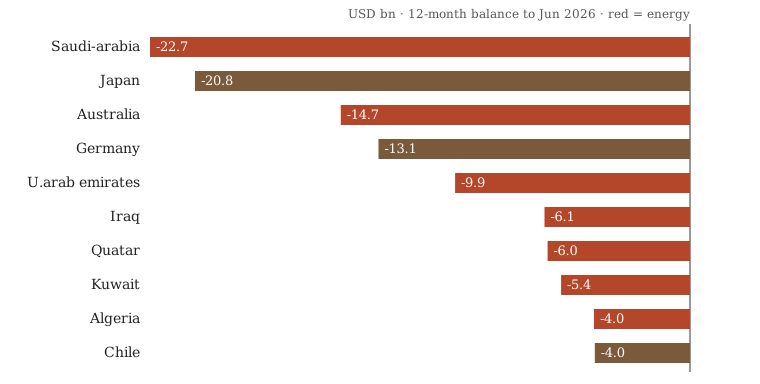
The list of partners Korea runs its biggest deficits with is almost entirely energy and machines: Saudi Arabia, Australia, the UAE, Iraq and the other oil states, plus Japan and Germany for machinery. Korea has almost no domestic oil or gas, so the energy bill is paid abroad, to whoever has it.
The one-line summary
Korea sells manufacturing to two giants of nearly equal size (the US and China) and buys mostly from one supplier plus the oil states. Sells chips and cars; buys fuel and tools.
Every partner, one page each
Want a single country? We keep a page for each of Korea’s biggest trading partners — whether Korea runs a surplus or deficit with it, its rank, and its share of exports and imports. Start at Korea’s trading partners, or jump to China, the United States, Vietnam or Japan.
A note on the numbers
This page uses shares, not dollar levels, on purpose. The underlying dataset — Korea Customs partner-country trade — has a scale break from March 2026 that makes the absolute monthly dollar figures untrustworthy after that month. The shares of the basket each partner holds are stable across that break, so those are what we report. It is drawn from one dataset, which we publish as a free monthly CSV you can reproduce with credit.
Not investment advice — official Korean customs data, reported as shares because of a known scale break.
Data & Verification Notes
- Data as of
- Sources
- Korea Customs Service (via KOSIS, Statistics Korea) — Exports and imports by partner country, monthly, July 2025–June 2026 (table DT_1R11006_FRM101 / 360)
- Cross-checks
- Sell side, share of exports over 12 months: China about 19.5% and the United States about 17.7% — two partners of almost identical size, and no third comes close
- Buy side, share of imports: China is the single biggest supplier at about 23.5%, ahead of the US at about 11.9%
- Deficit side: Korea ran a goods deficit with 84 partner countries; the largest are Saudi Arabia, Japan, Australia, Germany and the UAE — energy and machinery
- Shares are used throughout rather than dollar levels: the underlying monthly totals contain a scale break from March 2026, so absolute figures are not reported, but within-month shares are stable across the break and can be
- Excluded figures
- Absolute dollar balances. The monthly customs totals contain a scale break from March 2026, so we report shares and rankings — which survive the break — not levels
- Partner-country table only; product detail (HS codes) is not in it — energy/machinery is inferred from each partner's known export mix
- This is not investment advice
The full dataset behind these figures — every listed company, every row — is available to license. SeoulMarkets data for licence →
Not investment advice. SMarkets publishes data journalism for general information only. Nothing here is investment advice, a recommendation, or an offer to buy or sell any security — any investment you make is at your own risk and responsibility. Figures are derived from official public data sources and may be revised by the issuing agency. Verify independently before acting.
← More FX