Women hold about 7% of Korean listed-company board seats, and more than half of firms have none
Across 35,004 officers at Korea's listed companies, 7.2% are women. It splits by sector — 10.5% in health care, 4.2% in tech — and 56% of companies disclose no woman officer at all.
AI-assisted, human-reviewed sourcing. Figures are pulled programmatically from the official sources listed at the end of this article and checked by an editor before publication.
genderboardsgovernanceofficerskorea
Korea files who runs its listed companies — every officer, with a gender beside the name. Add it up and the boardroom is one of the least mixed rooms in the economy: 7.2% of officers are women, and most companies have none at all.
Seven percent, and it isn’t evenly thin
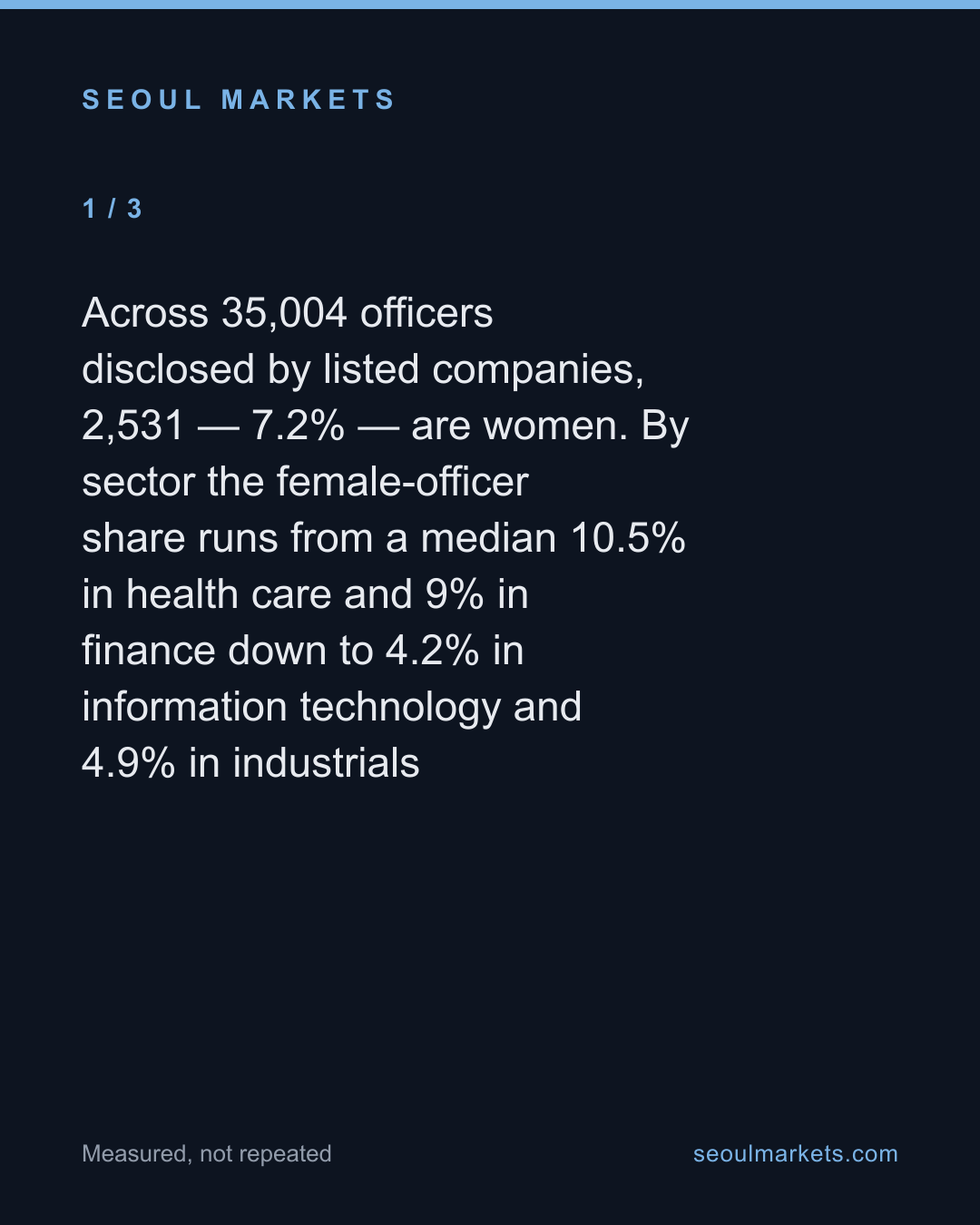
Across 35,004 disclosed officers, 2,531 are women. But the 7.2% is a market average hiding a sector split. Health care seats women in about one board seat in ten (10.5%), finance close behind at 9%. At the other end, information technology — half the market’s value — sits at 4.2%, and heavy industry at 4.9%. The sectors that carry the market’s weight carry the fewest women at the top.
More than half have none
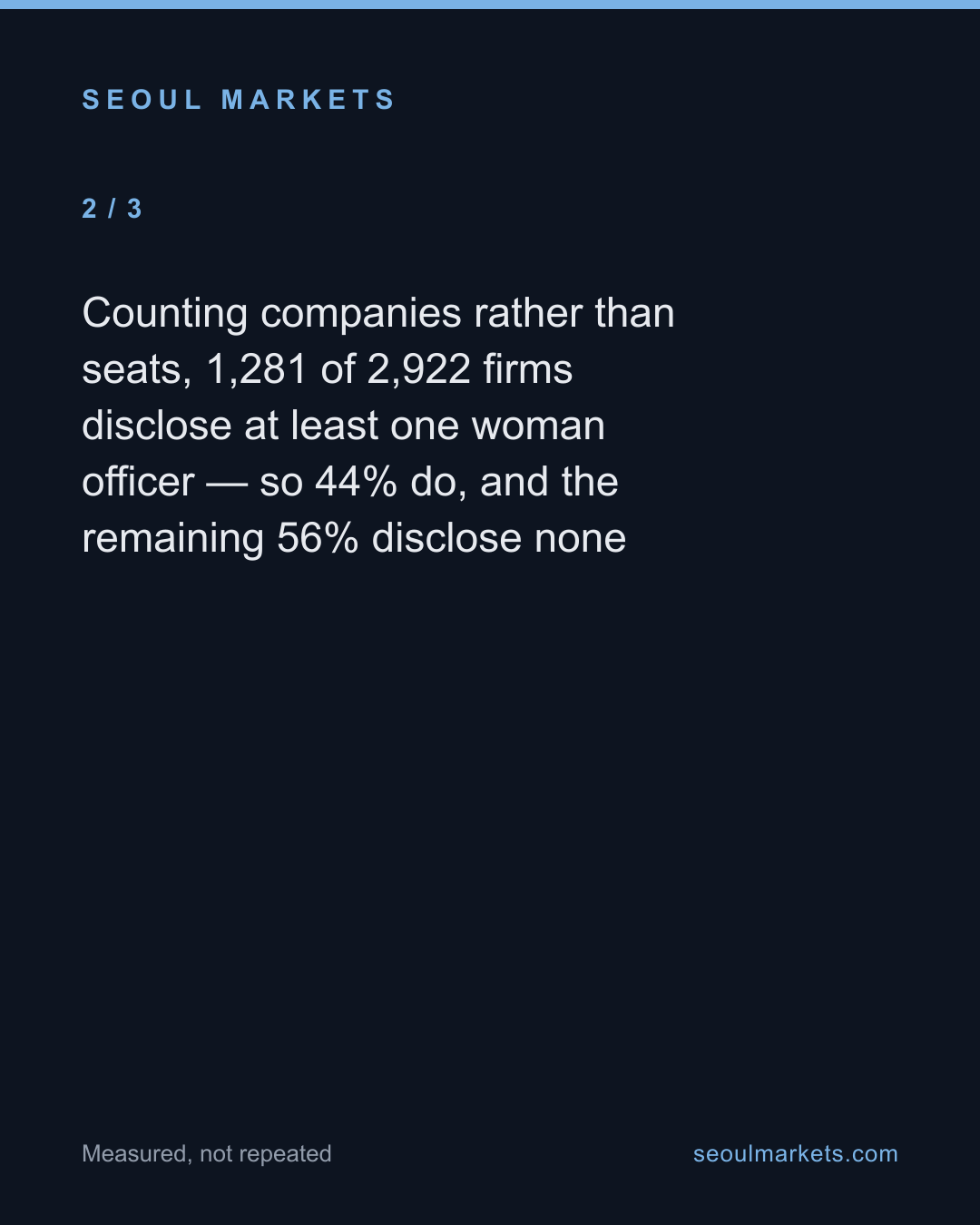
The starker number is per company, not per seat. Of 2,922 listed firms, 1,281 — 44% — disclose at least one woman officer. The other 56% disclose none. A majority of Korea’s listed companies file a board and management with not a single woman on it.
What the number is, and isn’t
This counts officers as filed — it does not sort executive from outside directors, or owner from hired hand. Those splits exist in the data and are their own stories. What this one says is plain and hard to round away: at the level of who is named as running a Korean listed company, women are one in fourteen, and at more than half of firms, none. It is filed, every year, by the companies themselves.
Data & Verification Notes
- Data as of
- Sources
- FSS DART (annual reports) — Executive disclosures — officers by gender and title, filed by each listed company
- Cross-checks
- Across 35,004 officers disclosed by listed companies, 2,531 — 7.2% — are women. By sector the female-officer share runs from a median 10.5% in health care and 9% in finance down to 4.2% in information technology and 4.9% in industrials
- Counting companies rather than seats, 1,281 of 2,922 firms disclose at least one woman officer — so 44% do, and the remaining 56% disclose none
- Officers are as filed in annual reports, joined to our own sector scheme from the statistical industry code. Sectors with at least 20 companies are shown
- Excluded figures
- Any distinction between executive and outside directors, or between board and management roles, beyond what the filing labels — the figure is officers as disclosed
- Whether a woman officer is the owner or a hired executive; that split exists in the data but is not the subject here
- Companies filing no officer table, which are dropped rather than counted as zero women
The full dataset behind these figures — every listed company, every row — is available to license. SeoulMarkets data for licence →
Not investment advice. SMarkets publishes data journalism for general information only. Nothing here is investment advice, a recommendation, or an offer to buy or sell any security — any investment you make is at your own risk and responsibility. Figures are derived from official public data sources and may be revised by the issuing agency. Verify independently before acting.
Take this away — 5 cards
The figures in this article, as images. Free to repost with the address on them.