In every Korean sector, the biggest companies pay more and keep people longer
Split each sector into its market-cap leaders and the rest: the leaders pay 1.2 to 1.43 times more and mostly retain staff longer. But in heavy industry and finance they employ fewer women at the top. A size split, not a stock pick.
AI-assisted, human-reviewed sourcing. Figures are pulled programmatically from the official sources listed at the end of this article and checked by an editor before publication.
Sort each Korean sector by size, take the top fifth by market capitalisation as its leaders, and set them against everyone else. The labour data — pay, tenure, who sits at the top — does not stay flat. It separates, and it separates the same way almost everywhere.
Leaders pay more, in all of them
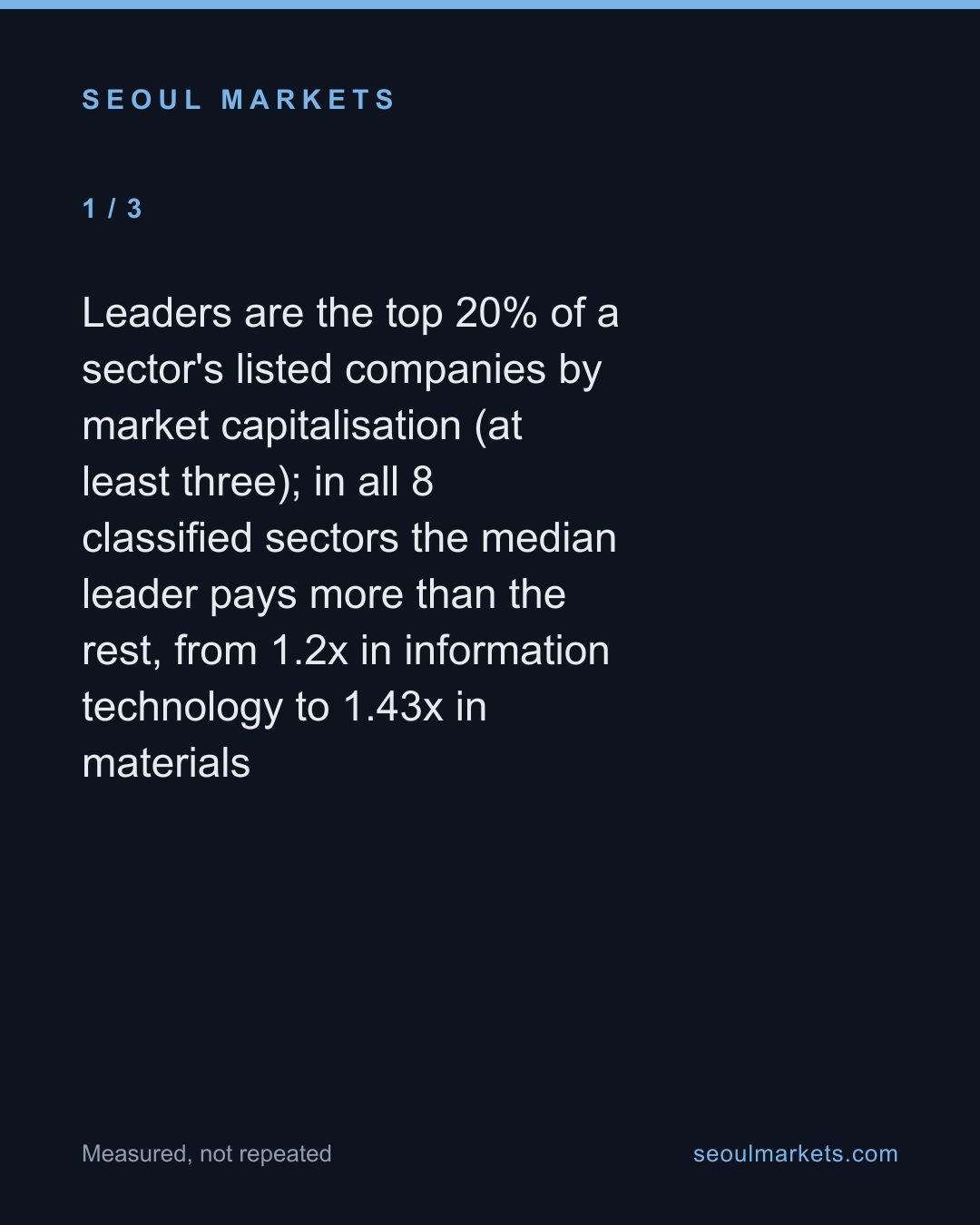
In all eight classified sectors the leaders pay more. The gap runs from 1.2x in information technology to 1.43x in materials, with industrials (1.41x), finance and communication services (1.35x) in between. It is not one or two heavy sectors dragging an average — it is every sector, in the same direction.
And mostly keep people longer
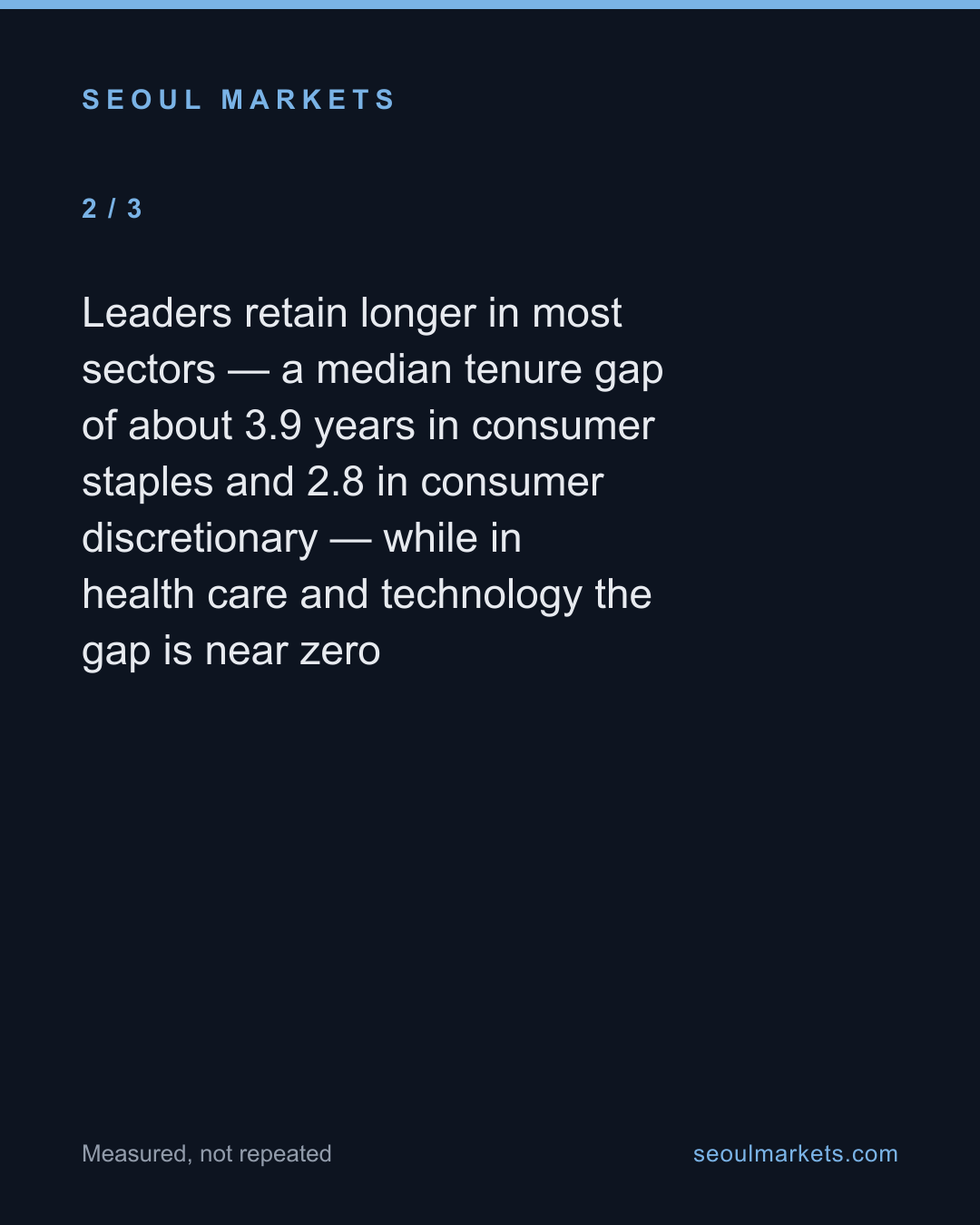
The leaders also tend to hold onto staff. The tenure gap is widest in consumer staples, where leaders keep their people a median 3.9 years longer, and in consumer discretionary (2.8 years). In a few sectors — health care, technology — the tenure gap closes to near zero, so the pay premium there does not come with a retention premium.
But the top is less mixed at the top
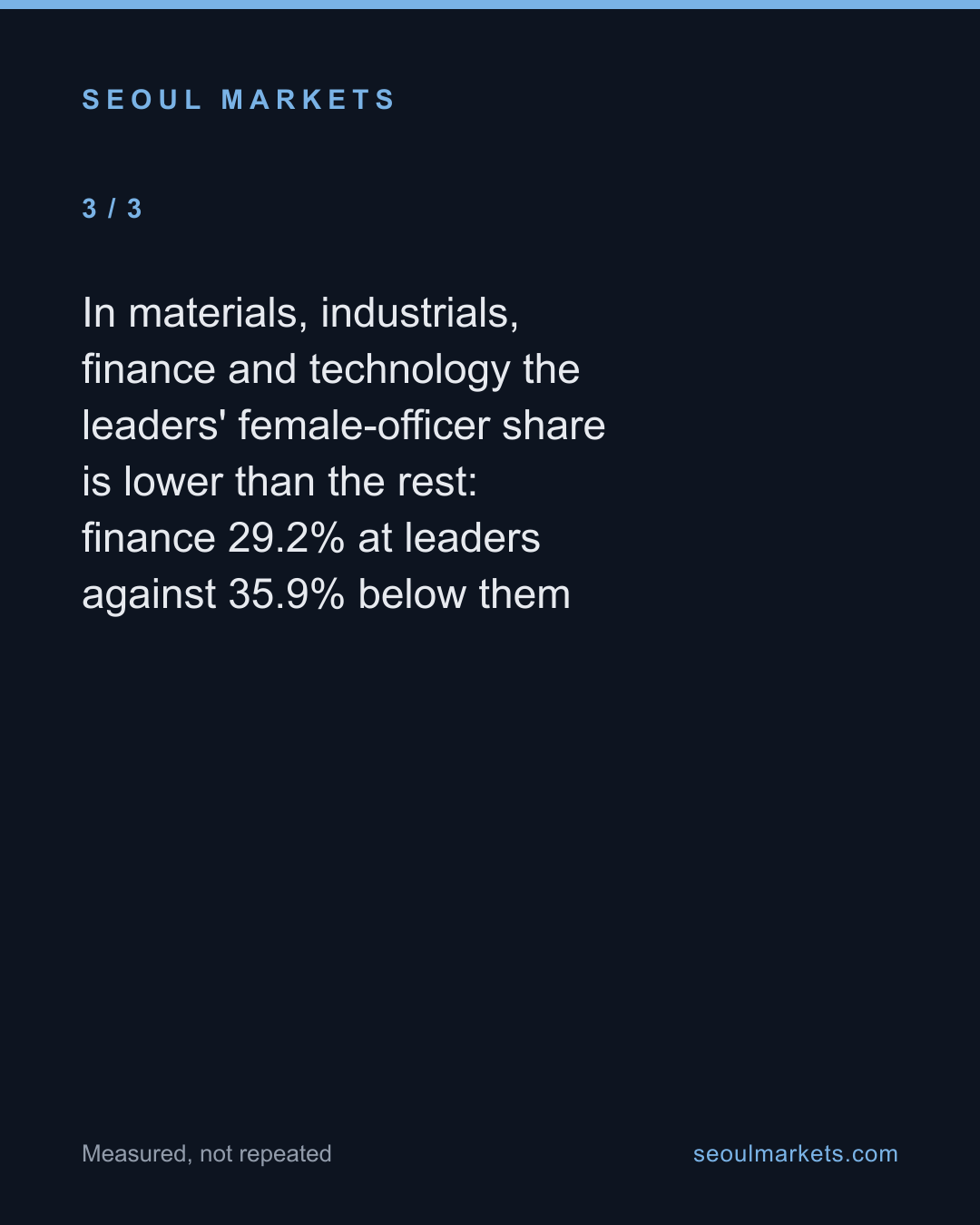
The one place the pattern reverses is gender. In materials, industrials, finance and technology, the leaders employ fewer women at officer level than the smaller firms beneath them. Finance is the sharpest: leaders sit at 29.2% women against 35.9% among the rest. Size buys pay and tenure; it does not buy a more mixed room at the top.
What this is, and what it is not
“Leaders” here means only one thing: the top 20% of a sector by market cap. It is a mechanical split by size, not a judgement of quality and not investment advice — nothing here says the leaders are better stocks, only that they are bigger and that bigger pays and retains differently. Whether that size premium shows up in returns is a separate question this data does not answer. What it does show, cleanly and in the same direction across the market, is that in Korea the biggest companies in a sector pay their people more, keep them longer, and put fewer women at the top.
Data & Verification Notes
- Data as of
- Sources
- SeoulMarkets sector-leaders panel — Company filings (pay, tenure, officers) joined to exchange market cap and our public-KSIC sector scheme
- Cross-checks
- Leaders are the top 20% of a sector's listed companies by market capitalisation (at least three); in all 8 classified sectors the median leader pays more than the rest, from 1.2x in information technology to 1.43x in materials
- Leaders retain longer in most sectors — a median tenure gap of about 3.9 years in consumer staples and 2.8 in consumer discretionary — while in health care and technology the gap is near zero
- In materials, industrials, finance and technology the leaders' female-officer share is lower than the rest: finance 29.2% at leaders against 35.9% below them
- Excluded figures
- Whether leaders outperform as investments — this is a labour description, not a return or a recommendation
- A residual unclassified bucket (holding companies and the like) whose industry code does not map to a sector
- Any company-level naming; the split is by sector, and leaders are defined only by market-cap rank
The full dataset behind these figures — every listed company, every row — is available to license. SeoulMarkets data for licence →
Not investment advice. SMarkets publishes data journalism for general information only. Nothing here is investment advice, a recommendation, or an offer to buy or sell any security — any investment you make is at your own risk and responsibility. Figures are derived from official public data sources and may be revised by the issuing agency. Verify independently before acting.
Take this away — 5 cards
The figures in this article, as images. Free to repost with the address on them.