Women are 57% of the workforce at Korea's apparel firms and 8% at its steelmakers
Across listed firms the median female share of staff is 24%. But it splits hard by sector — about 57% in apparel, film and retail, under 10% in steel, autos and construction. Where women work divides more than how many. Not advice.
AI-assisted, human-reviewed sourcing. Figures are pulled programmatically from the official sources listed at the end of this article and checked by an editor before publication.
genderworkforcesectorsemploymentkorea
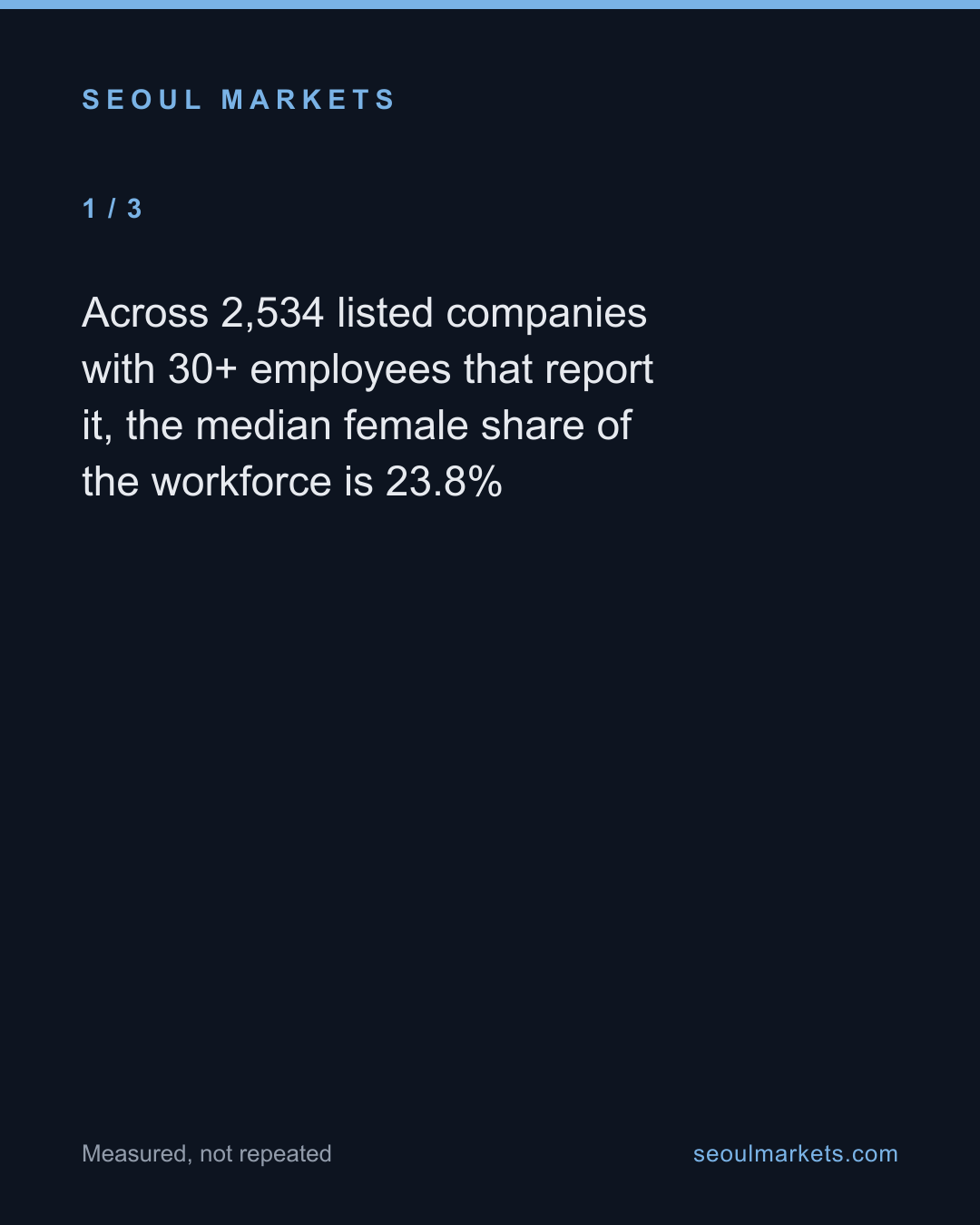
Ask how many women work in Korea’s listed companies and the market-wide answer is unremarkable: the median firm reports that women are 23.8% of its staff. Ask where they work and the picture splits in two. The female share of the workforce is not spread evenly across the economy — it is concentrated, industry by industry, into a pattern so sharp it barely looks like one labour market.
Majority-women sectors, single-digit ones
Sort the 2,534 listed companies with 30 or more employees by industry and read the median female share in each:
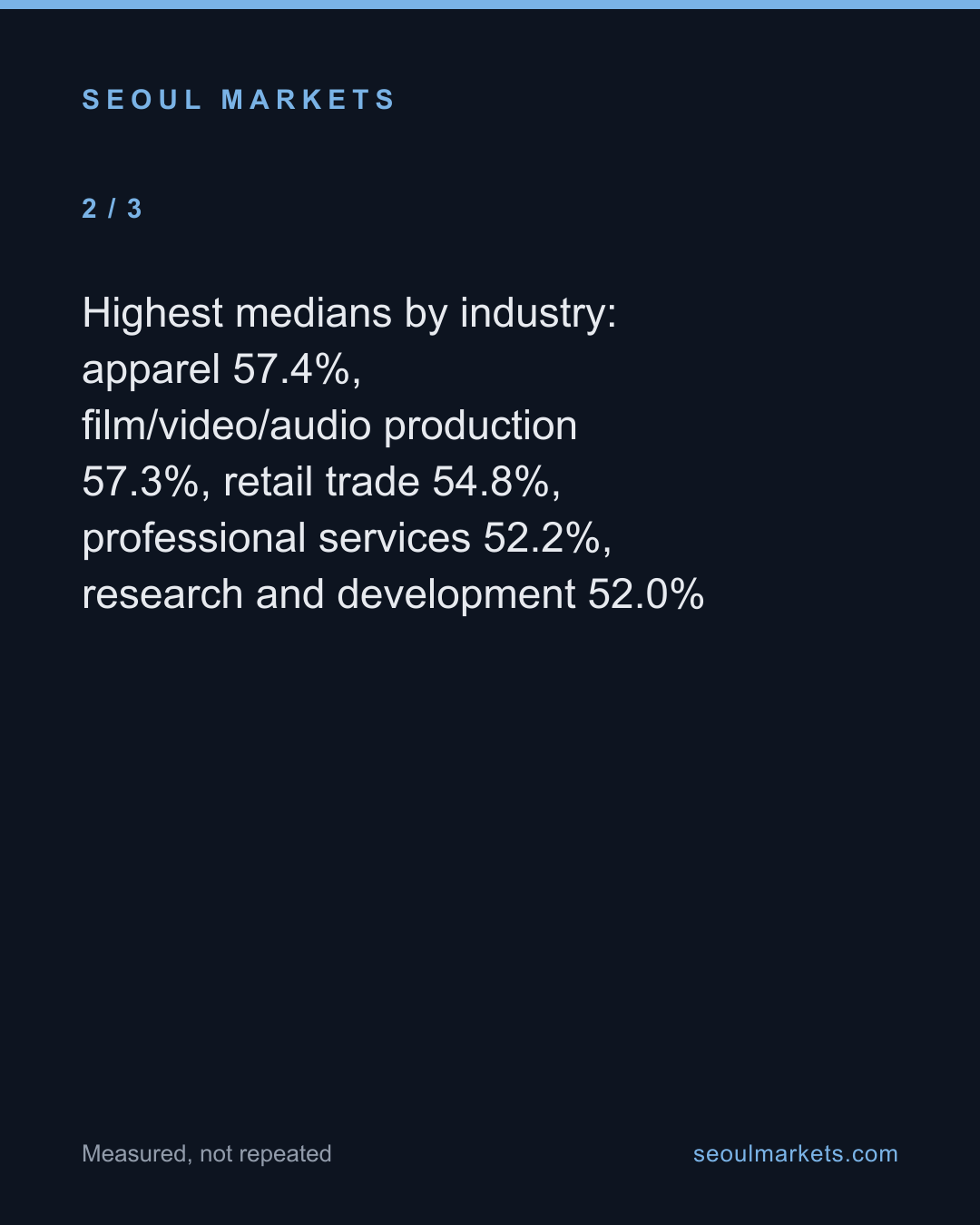
- Apparel — 57.4%. Film, video and audio production — 57.3%. Retail trade — 54.8%. Professional services — 52.2%. Research and development — 52.0%.
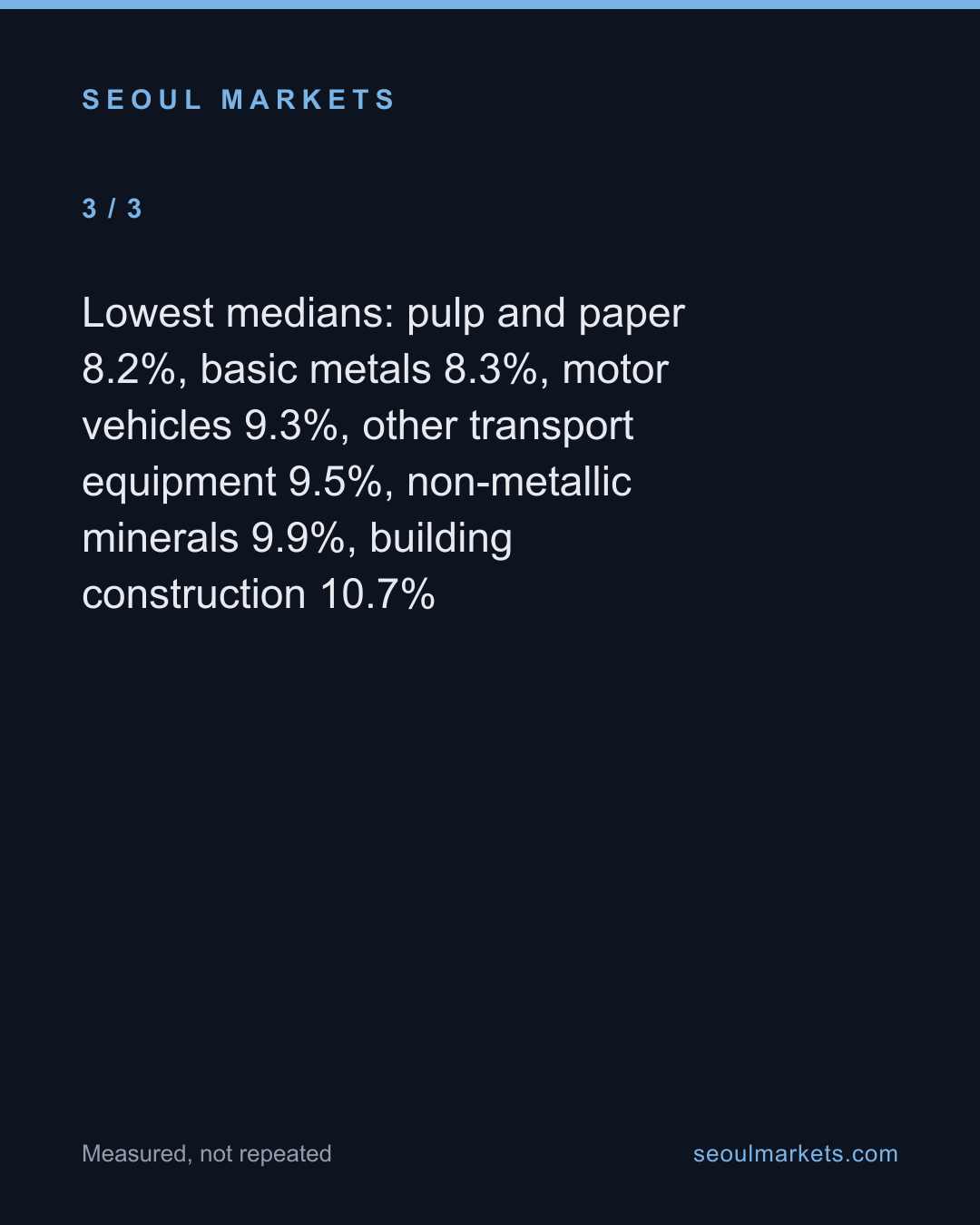
- At the other end: pulp and paper 8.2%, basic metals 8.3%, motor vehicles 9.3%, other transport equipment 9.5%, non-metallic minerals 9.9%, building construction 10.7%.
The gap between the top and bottom is about seven to one. In the industries that make clothes, media, retail and research, women are a majority of the workforce. In the ones that make steel, cars, ships, cement and buildings, they are fewer than one in ten. The market-wide “24%” is not a typical workplace — it is the midpoint of two very different worlds.
What the split is, and is not
This is the share of headcount, not of seniority or pay, and the distinction matters. As earlier pieces showed, a high female share does not narrow a company’s gender pay gap, because the gap lives in which rungs people stand on, not how many women are in the building. A sector can be 57% female and still concentrate its women in its lower-paid roles. So this map answers a narrower question than it seems to: not “where are women paid best,” but simply “where do women work.”
The figure is a median — the typical firm in each industry — chosen because female share is skewed across companies and the median is the robust representative value for a skewed distribution, where an average would be pulled by outliers. This is a description of Korea’s listed workforce, not a judgement of any company and not investment advice. What it shows is plain and stark: in Korea, an industry’s product predicts its gender mix almost better than anything else, and the distance between the sewing floor and the steel mill is sevenfold.
Related — where this shows up
- Women’s workforce share: firm choice or sector mix? — does the rank measure the employer or the industry?
Data & Verification Notes
- Data as of
- Sources
- SeoulMarkets company-filings dataset — Female share of the workforce as filed to DART (FY2025 basis) and KSIC industry, listed companies with 30+ employees
- Cross-checks
- Across 2,534 listed companies with 30+ employees that report it, the median female share of the workforce is 23.8%
- Highest medians by industry: apparel 57.4%, film/video/audio production 57.3%, retail trade 54.8%, professional services 52.2%, research and development 52.0%
- Lowest medians: pulp and paper 8.2%, basic metals 8.3%, motor vehicles 9.3%, other transport equipment 9.5%, non-metallic minerals 9.9%, building construction 10.7%
- Excluded figures
- This is the share of headcount, not of senior roles or pay — as covered before, a high female share does not close the pay gap, which is about which rungs people stand on
- The industry median is the typical firm in that sector, not the sector's total workforce
- Why the method is median, not mean: female share is skewed across firms, and the median is the robust representative value for a skewed distribution
- Companies under 30 employees; and this is not investment advice
The full dataset behind these figures — every listed company, every row — is available to license. SeoulMarkets data for licence →
Not investment advice. SMarkets publishes data journalism for general information only. Nothing here is investment advice, a recommendation, or an offer to buy or sell any security — any investment you make is at your own risk and responsibility. Figures are derived from official public data sources and may be revised by the issuing agency. Verify independently before acting.
Take this away — 5 cards
The figures in this article, as images. Free to repost with the address on them.