Six bonds were 90% of a day's Korean bond trading
Korea's listed bond market has a price on hundreds of issues but trades almost none of them. On 2026-08-21, six bonds were 90% of all trading value, and government benchmarks were 95%. It held that way every day we measured. Not advice.
AI-assisted, human-reviewed sourcing. Figures are pulled programmatically from the official sources listed at the end of this article and checked by an editor before publication.
bondsratesliquidityconcentrationgovernment-bondskorea
We have written about how concentrated Korea’s stock market is — four companies are half its value, and on a normal day two stocks are half its trading. The bond market is the same shape, only more extreme.
Six bonds, ninety percent
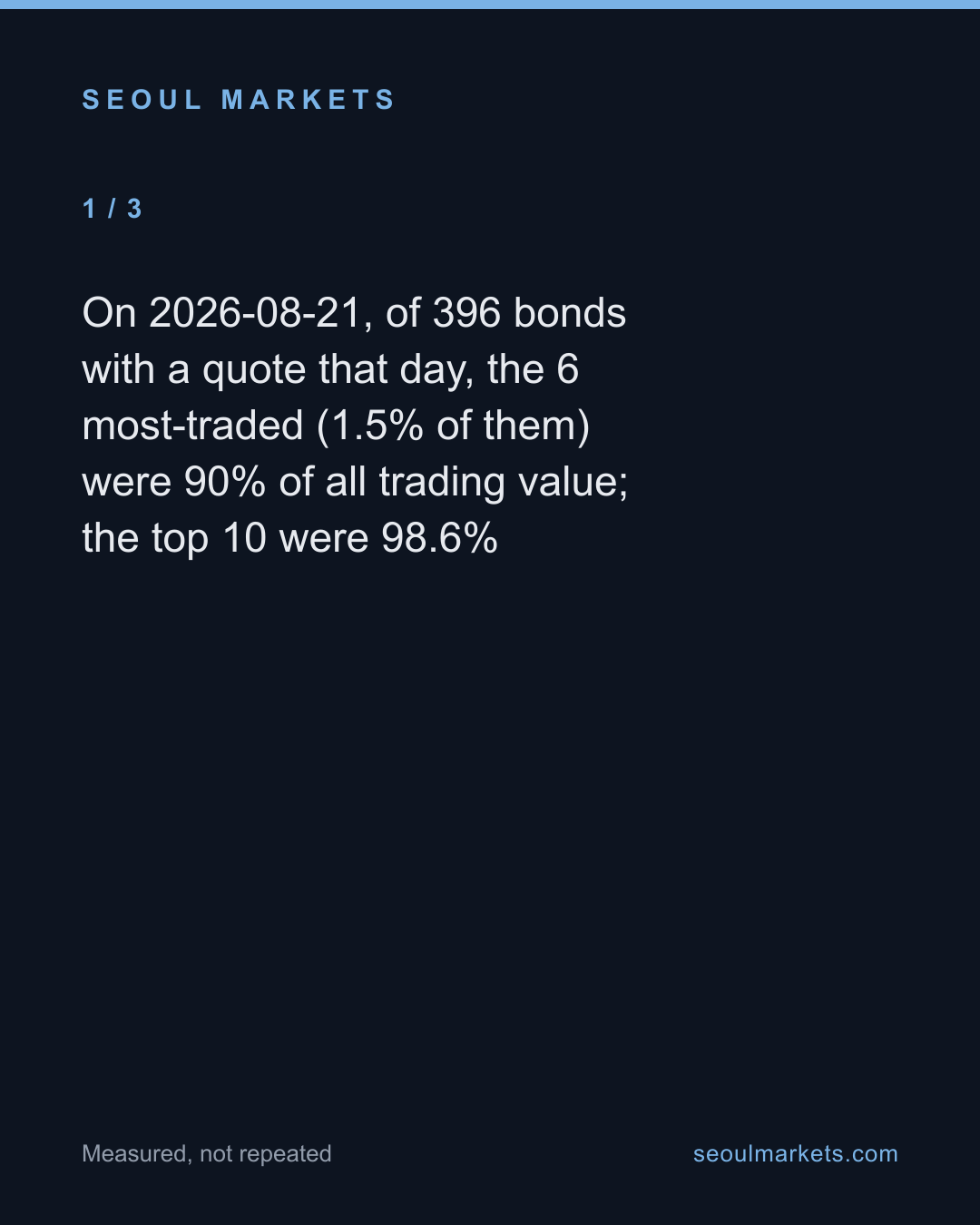
On 2026-08-21, the Korea Exchange carried a quote on 396 bonds. They traded ₩4.2 trillion between them. But almost all of that was a handful of issues: the six most-traded bonds — 1.5% of the list — were 90% of the day’s trading value. The top ten were 98.6%. The other 386 bonds split about 1.4%.
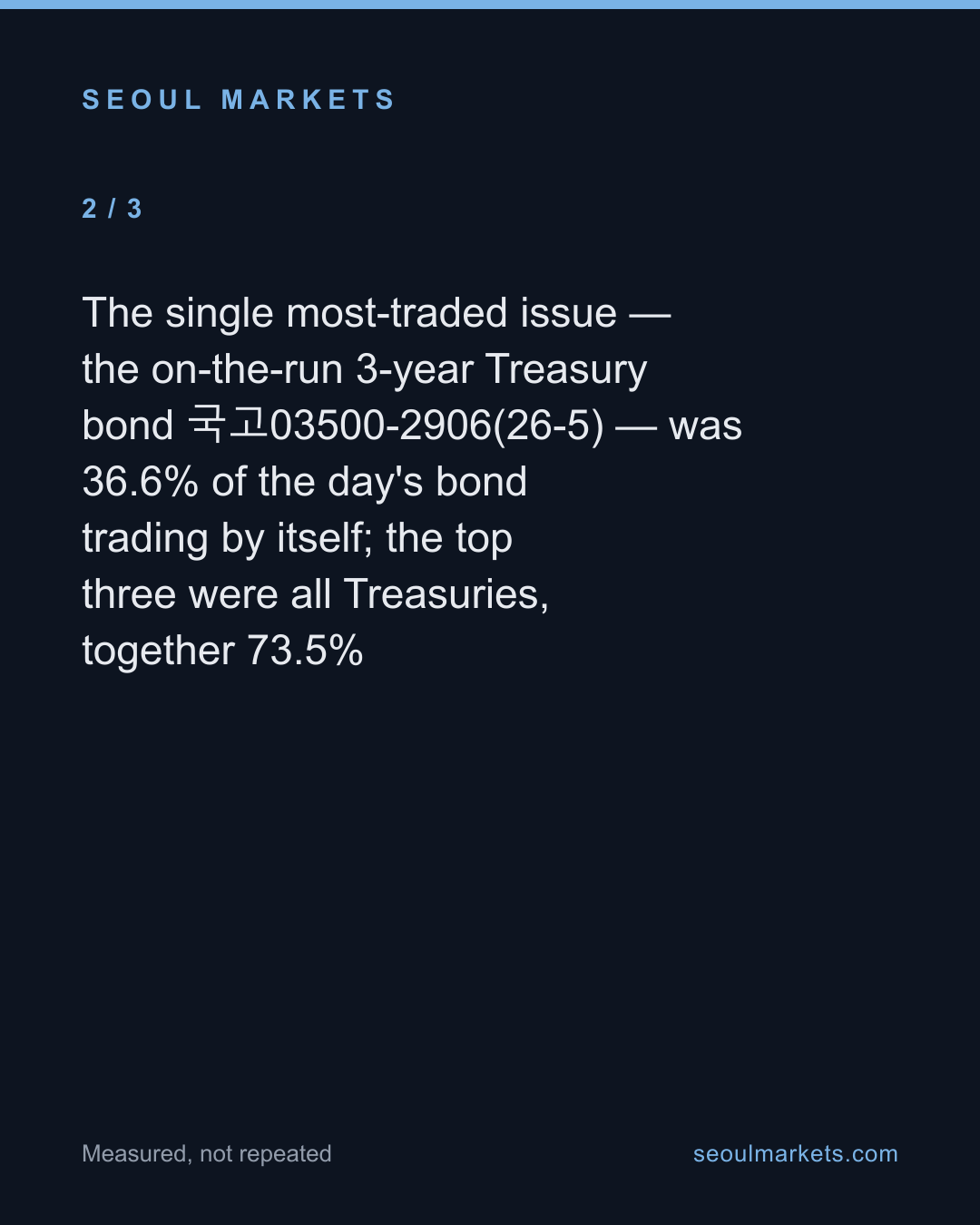
The single busiest bond — the current three-year Treasury benchmark, 국고03500-2906(26-5) — was 36.6% of all bond trading on its own. The top three, all Treasuries, were 73.5% together.
It’s a government-benchmark market
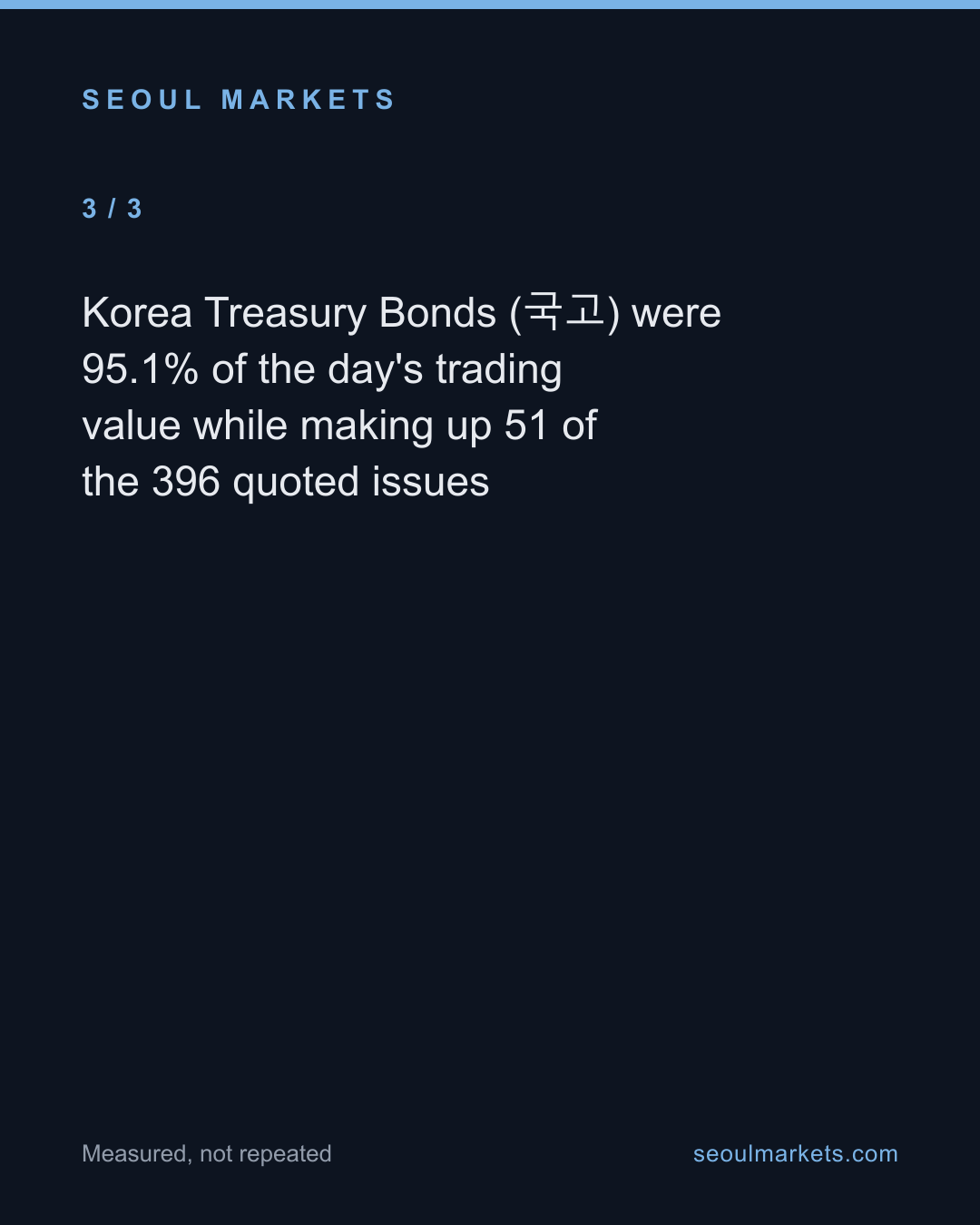
Sort by type and the picture is blunt: Korea Treasury Bonds were 95.1% of the day’s trading value, out of 51 of the 396 quoted issues. Everything else on the board — housing bonds, local-government bonds, bank and corporate paper, hundreds of them — shared the remaining 5%.
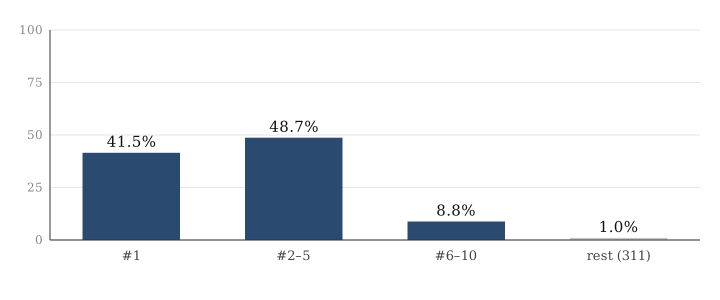
This is not a one-day accident. Across all 22 trading days we measured (2026-08-10 to 09-09), the top ten issues never left the 98.2–99.3% band, and Treasuries stayed between 95.1% and 98.2%. As of the most recent day measured, 2026-09-09, the same bond — 국고03500-2906(26-5) — was still the single busiest issue, now 41.5% of that day’s trading on its own. The concentration is a fixture.
What it means, and what it doesn’t
A caution first, because it matters: this counts bonds that had a quote that day. Hundreds more are listed and simply do not appear — they had no trade. So read the figures as of the bonds that actually traded. That is exactly the point, though: the tradeable Korean bond market, day to day, is a small set of government benchmarks. Price discovery happens in a few Treasury issues; the rest of the market sits still.
For anyone building a curve or a fund from Korean bonds, this is the terrain. The daily concentration series here is a free CSV you can reproduce with credit, alongside our stock concentration data and the Treasury yield curve — every figure dated, ratios not levels.
Not investment advice.
Data & Verification Notes
- Data as of
- Sources
- Korea Exchange (KRX OPEN API) — Daily listed-bond trading (close, trading value ACC_TRDVAL, residual maturity) for 2026-08-10 through 2026-09-09 (22 trading days)
- Cross-checks
- On 2026-08-21, of 396 bonds with a quote that day, the 6 most-traded (1.5% of them) were 90% of all trading value; the top 10 were 98.6%
- The single most-traded issue — the on-the-run 3-year Treasury bond 국고03500-2906(26-5) — was 36.6% of the day's bond trading by itself; the top three were all Treasuries, together 73.5%
- Korea Treasury Bonds (국고) were 95.1% of the day's trading value while making up 51 of the 396 quoted issues
- Across all 22 trading days measured (2026-08-10 to 09-09), the top 10 issues held 98.2–99.3% of trading and Treasuries held 95.1–98.2% — a structure, not a one-day snapshot
- As of 2026-09-09, the pattern still holds: 321 quoted bonds, top 10 were 99%, Treasuries 97.1%, and the single busiest issue was again 국고03500-2906(26-5) — the same bond that led on 2026-08-21
- Excluded figures
- The universe is bonds that carried a close and trading value in the KRX daily file that day (i.e. had a quote); it is not the full registry of listed bonds, and non-trading issues are simply absent — so read every share as 'of quoted-bond turnover'
- Concentration is measured on trading value (a KRX-reported aggregate), reported only as ratios, which do not depend on the won price level
- Treasury benchmarks are the most liquid by design, so high concentration is expected; the point is the degree (≈99% in ten issues) and that 300-plus other issues split about 1%
- Twenty-two trading days is about a month; we say 'held every day measured', not that it is fixed forever
- This is not investment advice
The full dataset behind these figures — every listed company, every row — is available to license. SeoulMarkets data for licence →
Not investment advice. SMarkets publishes data journalism for general information only. Nothing here is investment advice, a recommendation, or an offer to buy or sell any security — any investment you make is at your own risk and responsibility. Figures are derived from official public data sources and may be revised by the issuing agency. Verify independently before acting.
Take this away — 5 cards
The figures in this article, as images. Free to repost with the address on them.