Four stocks are half of Korea's entire stock market
Of 2,764 listed companies, the four biggest are 52% of all market value and the top ten are 60%. Samsung alone is a quarter. Meanwhile 1,822 KOSDAQ names together are just 7%. Korea's market is a few giants and a very long tail. Not advice.
AI-assisted, human-reviewed sourcing. Figures are pulled programmatically from the official sources listed at the end of this article and checked by an editor before publication.
market-capconcentrationkospikosdaqsamsungkorea
Korea has 2,764 companies listed on its two stock markets. Four of them are worth more than all the others combined.
A few giants, a very long tail
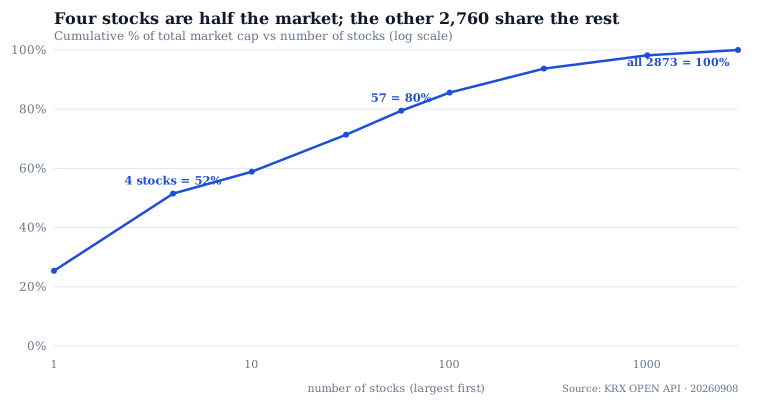
Rank every listed issue by market value and add them up from the top. You pass half of the entire market at the fourth name. By the tenth you are at 60%; by the fifty-seventh, at 80%. The remaining 2,700-plus companies — the vast majority of the market by count — share the last fifth between them. The median listed company is a rounding error next to the top: the largest issue is worth thousands of times the middle one.
At the very top sits one name.
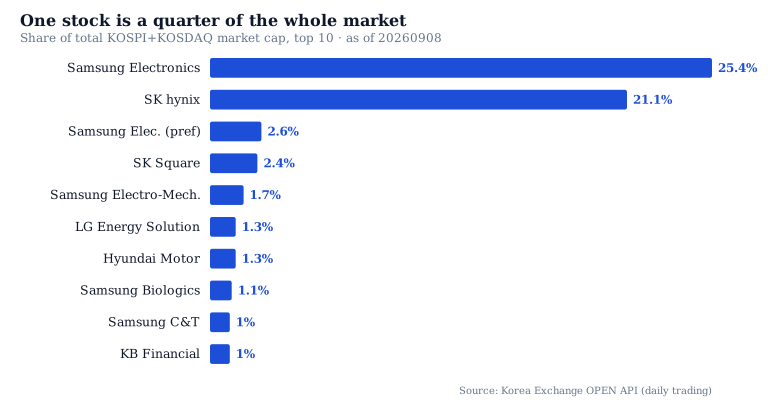
Samsung Electronics is 26.7% of the whole market on its own — and once its preferred shares are added, the company is about 29%. SK hynix is another 20.5%. So two companies — both riding the memory and AI cycle that tripled chip producer prices — are together nearly half of everything listed in Korea. After them the bars fall off a cliff: third place is under 3%. That same pair is also who Korea’s state utility went to first when it needed grid money up front.
The two markets are not the same size at all
The lopsidedness has a second layer. Korea’s main board, KOSPI, has 942 issues and holds 92.8% of all market value. Its junior board, KOSDAQ, has almost twice as many companies — 1,822 — yet they add up to just 7.2% of the total. KOSDAQ is where most Korean companies are; almost none of the market value is.
What the numbers are, and are not
This is a portrait of concentration, and it is reported as ratios — the four-stocks-are-half figure does not depend on whether the won prices are high or low that day, only on how value is distributed across issues. Two honest caveats travel with it: preferred shares are counted as separate lines, so Samsung shows up twice, meaning its true company weight is even larger than the single 26.7% bar; and the issue count mixes common shares, preferred shares and holding companies rather than ultimate parents. As an earlier piece put it, the KOSPI is effectively a semiconductor index — and this is the fuller picture behind that: a market where a handful of chip and industrial champions carry almost all the weight, and thousands of small companies carry almost none. This is a description of Korea’s listed market on one day, not investment advice.
Data & Verification Notes
- Data as of
- Sources
- Korea Exchange (KRX OPEN API) — Daily trading information for KOSPI (stk_bydd_trd) and KOSDAQ (ksq_bydd_trd), market capitalisation by issue, 2026-08-21
- Cross-checks
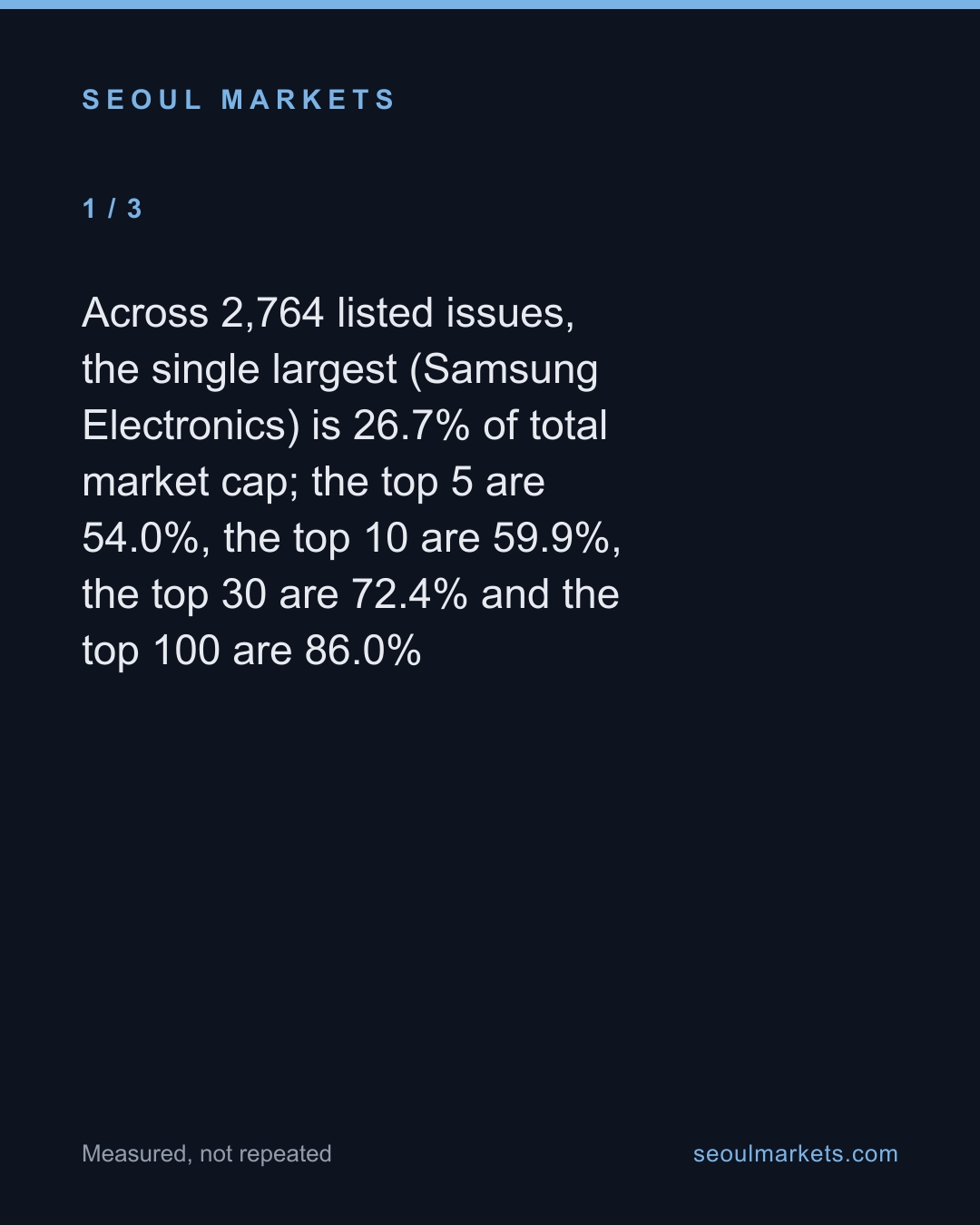
- Across 2,764 listed issues, the single largest (Samsung Electronics) is 26.7% of total market cap; the top 5 are 54.0%, the top 10 are 59.9%, the top 30 are 72.4% and the top 100 are 86.0%
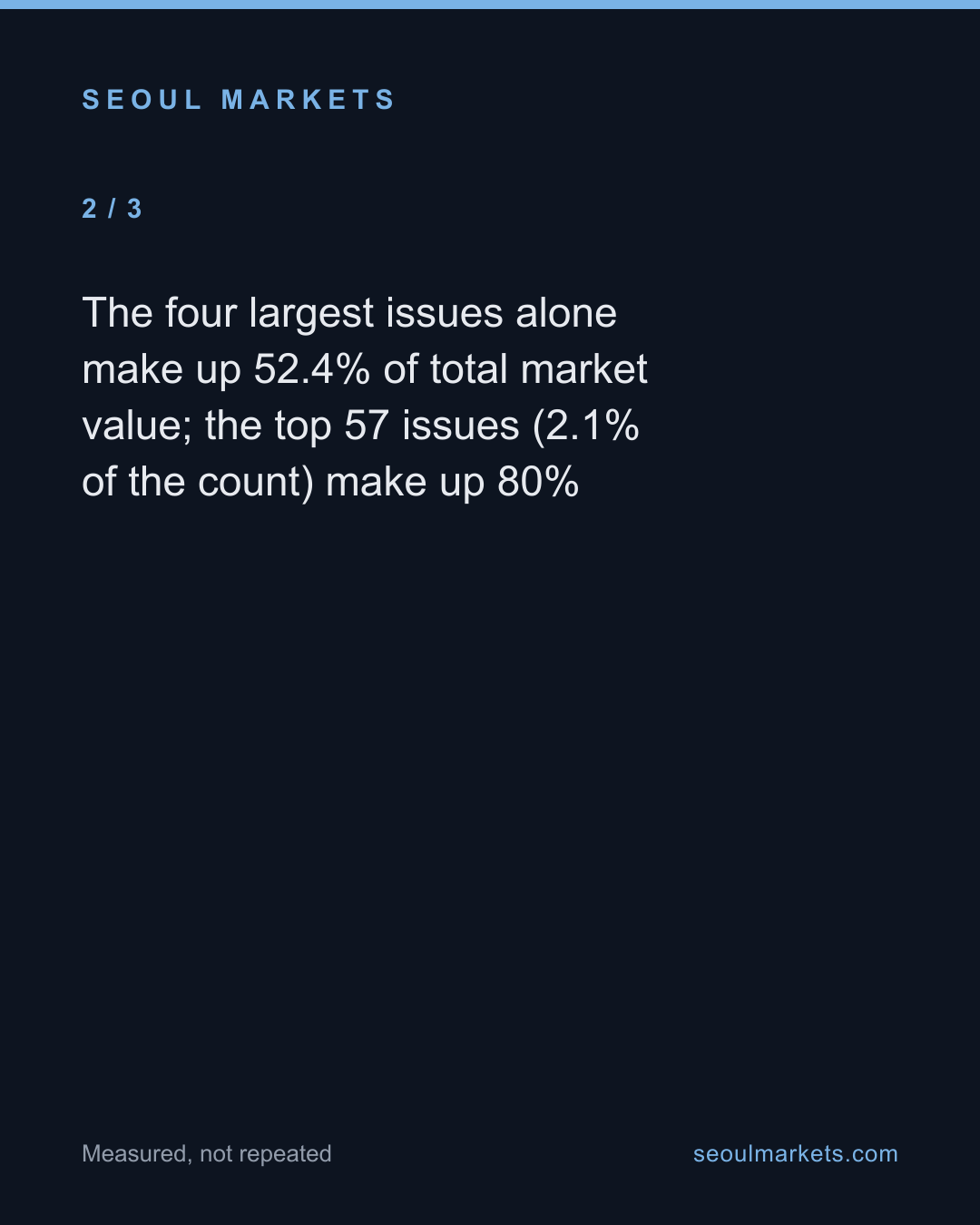
- The four largest issues alone make up 52.4% of total market value; the top 57 issues (2.1% of the count) make up 80%
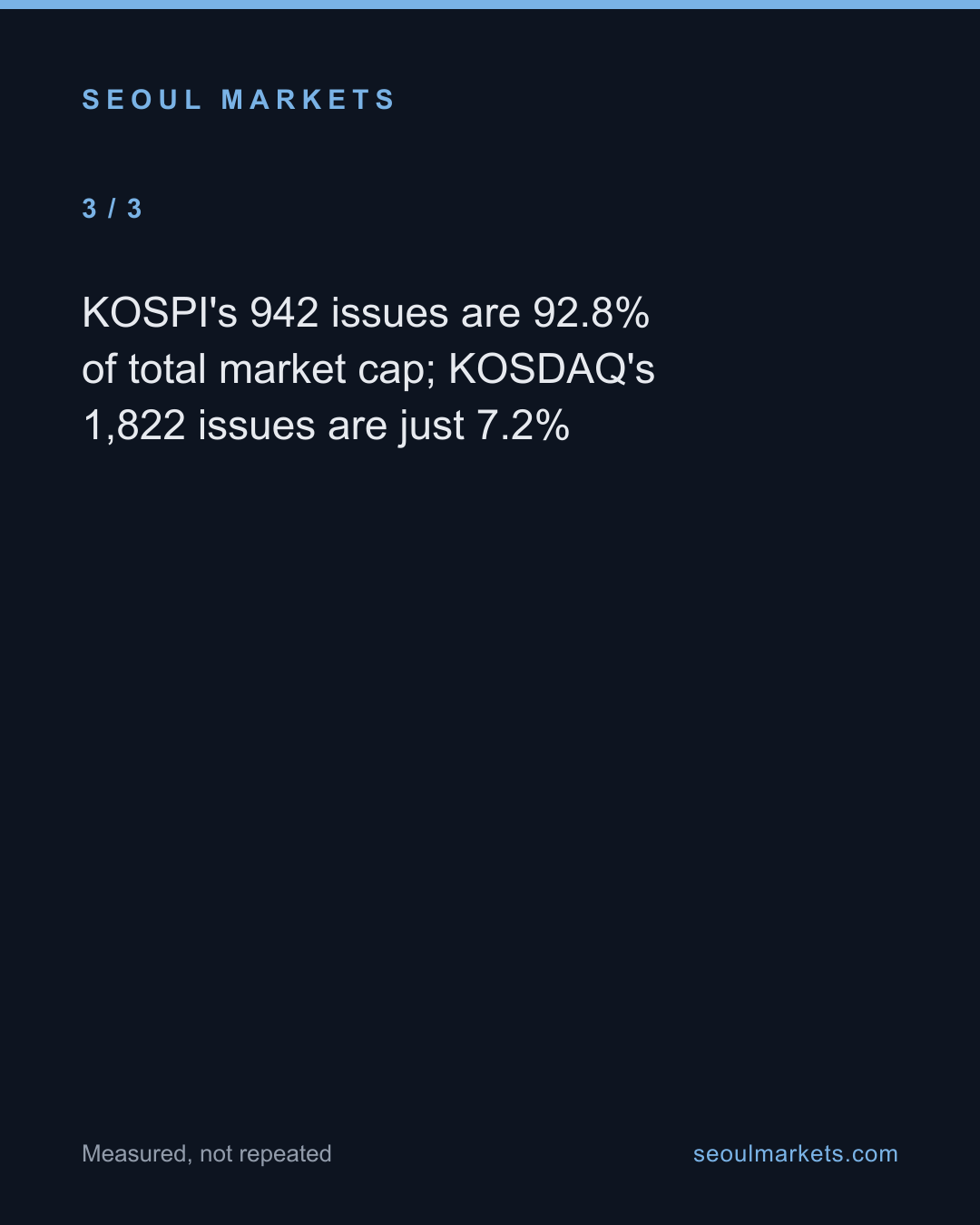
- KOSPI's 942 issues are 92.8% of total market cap; KOSDAQ's 1,822 issues are just 7.2%
- Samsung Electronics common and preferred shares together are about 29.4% of the whole market; with SK hynix the two companies are roughly 47%
- Excluded figures
- Market cap is shares outstanding times one day's close (2026-08-21); this piece reports concentration ratios, which do not depend on the price level
- Preferred shares are listed as separate issues, so Samsung appears twice in the top 10; its company-level weight is larger than any single line
- Issue count includes common and preferred lines and some holding structures; the ratios are by listed issue, not by ultimate parent
- This is not investment advice
The full dataset behind these figures — every listed company, every row — is available to license. SeoulMarkets data for licence →
Not investment advice. SMarkets publishes data journalism for general information only. Nothing here is investment advice, a recommendation, or an offer to buy or sell any security — any investment you make is at your own risk and responsibility. Figures are derived from official public data sources and may be revised by the issuing agency. Verify independently before acting.
Take this away — 5 cards
The figures in this article, as images. Free to repost with the address on them.