The Korean sectors that employ women, and the ones that barely do
Sort every listed company by our sector scheme and take the median female share. Health care is 40% women and finance 35%; heavy industry, materials and utilities sit near 11 to 14%. The gap is roughly four to one.
AI-assisted, human-reviewed sourcing. Figures are pulled programmatically from the official sources listed at the end of this article and checked by an editor before publication.
genderworkforcesectorsemploymentkorea
Every listed company files how many of its people are women. Roll it up by sector and Korea’s workforce splits along a line almost as old as its industries: the businesses that care, serve and finance are close to evenly split, and the ones that build, dig and power are not.
Four to one
Taking the median company in each sector, the female share runs from 40% in health care and 35% in finance down to 13% in materials, 14% in heavy industry and 11% in utilities. Top to bottom, roughly four women employed for every one — not in a single firm, but as the middle of an entire sector.
| Sector | Median female share |
|---|---|
| Health care | 40% |
| Finance | 35% |
| Communication services | 35% |
| Consumer staples | 33% |
| Consumer discretionary | 30% |
| Information technology | 21% |
| Energy | 18% |
| Industrials | 14% |
| Materials | 13% |
| Utilities | 11% |
What it tracks, and what it doesn’t
The pattern is not surprising, but the size is worth a number. Pharmaceuticals, hospitals, banks and consumer businesses hire women at nearly twice the rate of shipbuilders, chemicals and power. Even information technology — half the market’s value — sits at 21%, below the consumer sectors and far below health care.
One caution travels with the figure. This is who is employed, not who is paid — a sector can be 40% women and still pay them less, and that gap is a different column. Female share says where women work in Korea’s listed economy. On that, the answer splits cleanly down the middle of the sector table.
Data & Verification Notes
- Data as of
- Sources
- FSS DART (annual reports) — Employees by gender, filed by each listed company
- Cross-checks
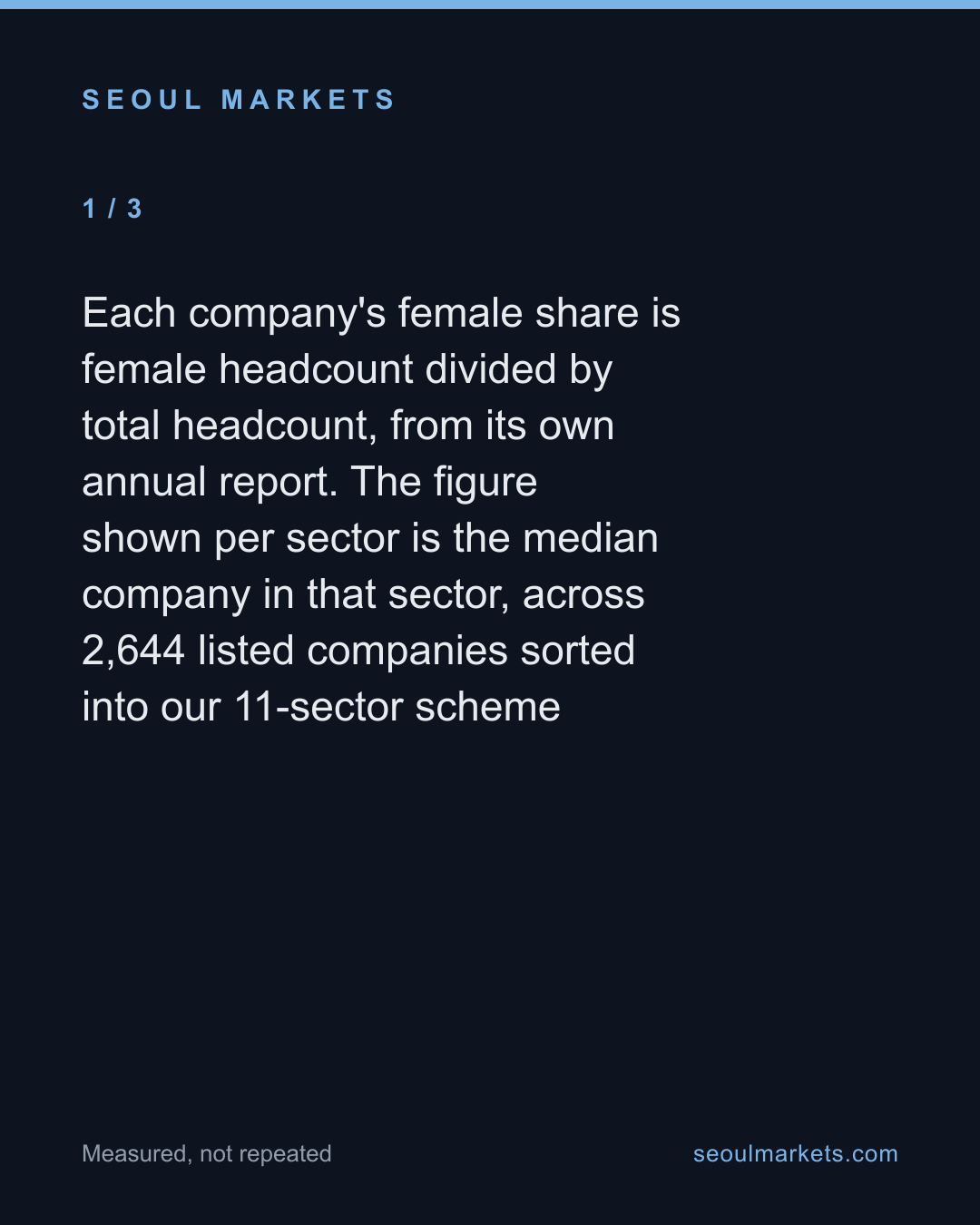
- Each company's female share is female headcount divided by total headcount, from its own annual report. The figure shown per sector is the median company in that sector, across 2,644 listed companies sorted into our 11-sector scheme
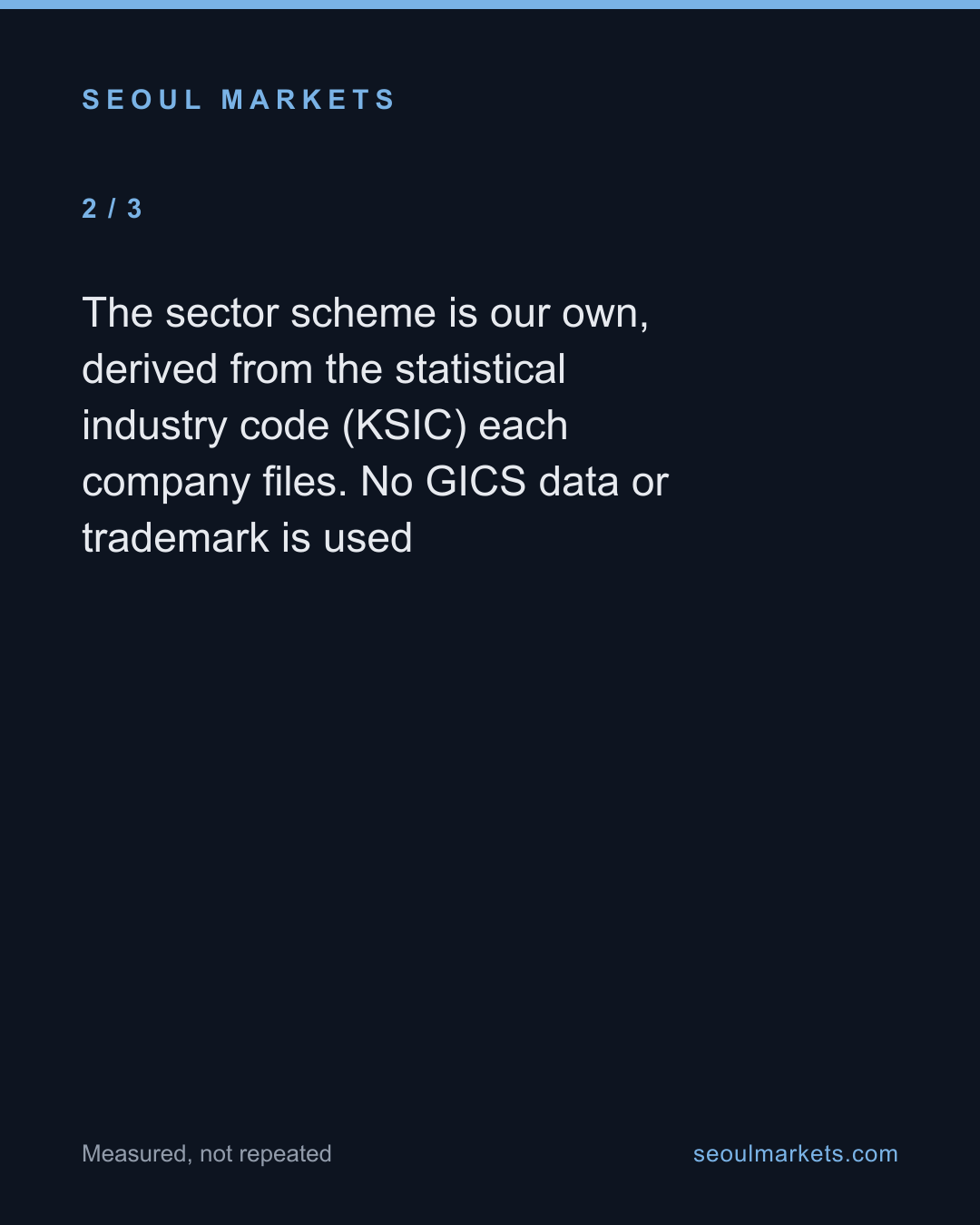
- The sector scheme is our own, derived from the statistical industry code (KSIC) each company files. No GICS data or trademark is used
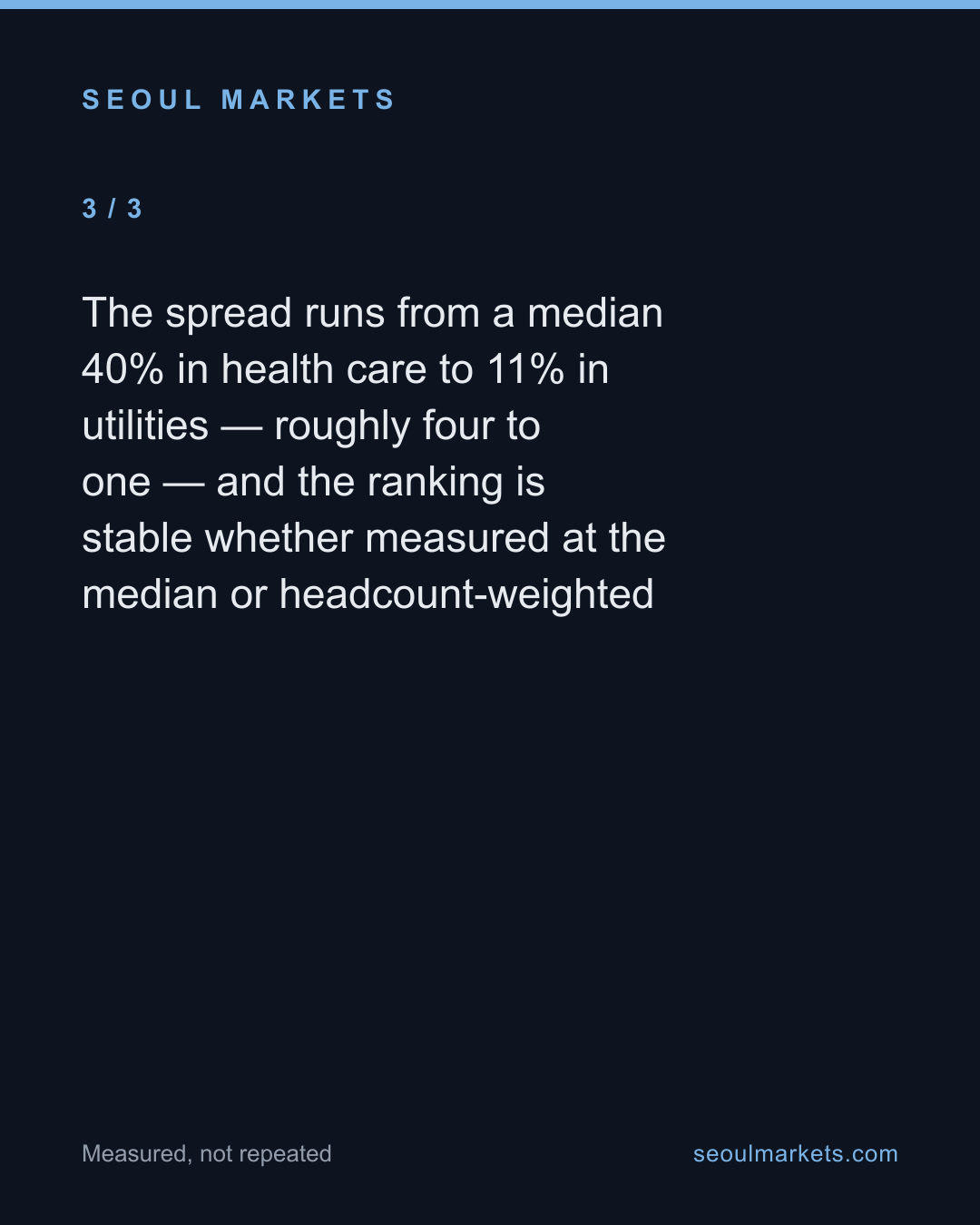
- The spread runs from a median 40% in health care to 11% in utilities — roughly four to one — and the ranking is stable whether measured at the median or headcount-weighted
- Excluded figures
- Companies that do not disclose headcount by gender; a median is used precisely so a few blanks do not move the figure
- The unclassified bucket of companies whose filing carries no industry code, which is not a sector
- Any claim about pay from this cut. Female share is who is employed, not what they are paid — the gender pay gap is a separate column in the panel
The full dataset behind these figures — every listed company, every row — is available to license. SeoulMarkets data for licence →
Not investment advice. SMarkets publishes data journalism for general information only. Nothing here is investment advice, a recommendation, or an offer to buy or sell any security — any investment you make is at your own risk and responsibility. Figures are derived from official public data sources and may be revised by the issuing agency. Verify independently before acting.
Take this away — 5 cards
The figures in this article, as images. Free to repost with the address on them.