Five Korean firms filed share buybacks today. Only one is cancelling the shares.
Buyback plans worth up to about 18 billion won reached the regulator on a single day. But the step that actually shrinks the share count — cancellation — appears in just one of them, Fims. The rest keep the stock in the drawer. Not advice.
AI-assisted, human-reviewed sourcing. Figures are pulled programmatically from the official sources listed at the end of this article and checked by an editor before publication.
buybackvalue-upkosdaqgovernancekorea
Five Korean listed companies told the regulator on the same day, 13 August, that they intend to buy their own shares. Read together, the filings are a small snapshot of a habit the market has picked up — and of the one detail that decides whether a buyback means anything.
What was filed
Four of the five filed a direct on-market acquisition decision with DART, the country’s electronic disclosure system:
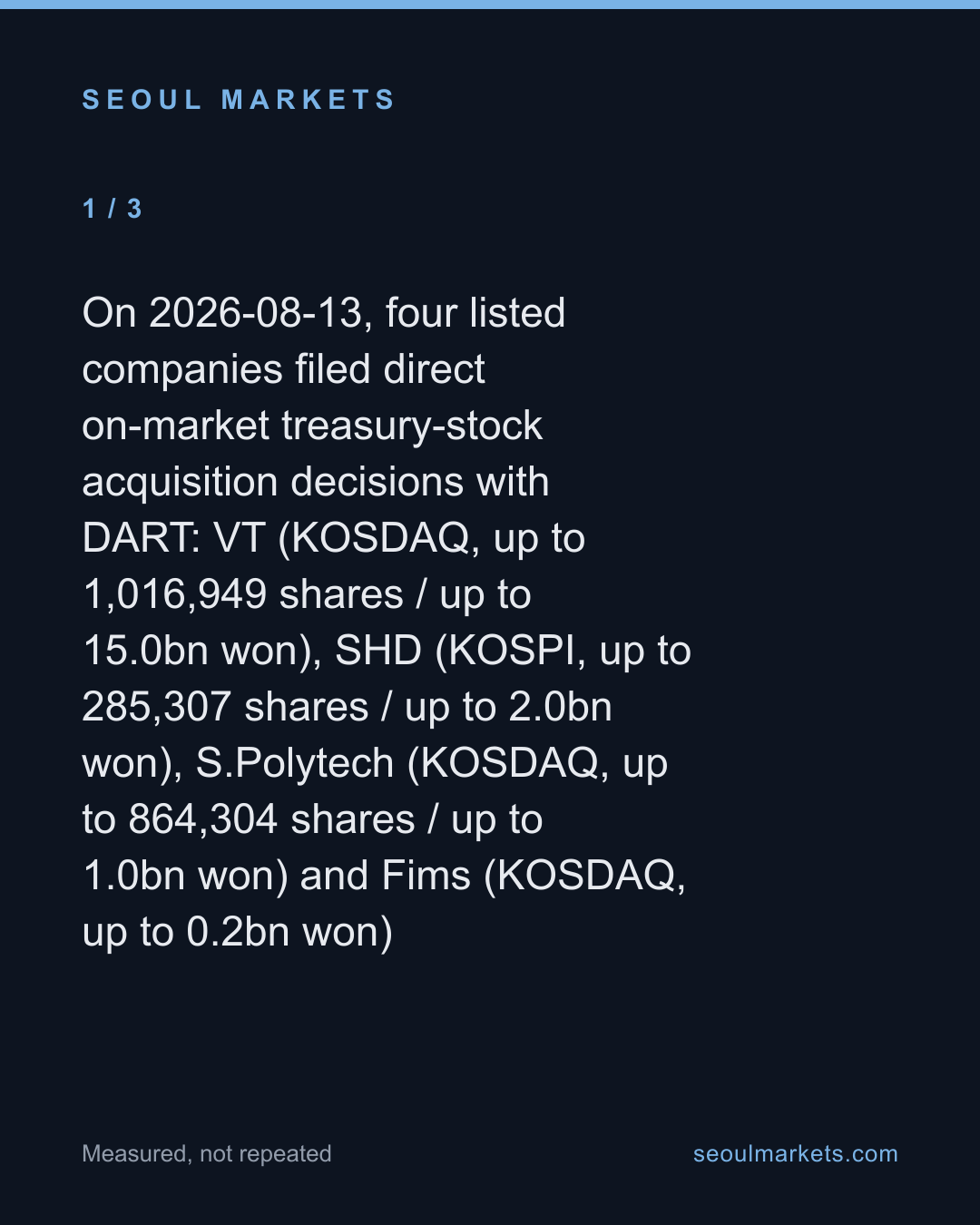
- VT (KOSDAQ) — up to 1,016,949 shares, budgeted at up to 15.0 billion won, through NH Investment & Securities, running to 12 November.
- SHD (KOSPI) — up to 285,307 shares, up to 2.0 billion won, through Shinhan, to 23 October.
- S.Polytech (KOSDAQ) — up to 864,304 shares, up to 1.0 billion won, through NH, to 13 November.
- Fims (KOSDAQ) — up to 0.2 billion won, through Samsung Securities, to 13 November.
The four announced budgets add up to about 18.2 billion won — roughly 13 million US dollars at current rates. A fifth company, HL Holdings, signed a buyback trust contract, a different route in which a broker does the buying on the company’s behalf over the contract term.
The line that matters: buy, or buy and cancel
A buyback and a cancellation are not the same thing, and the gap between them is where the value sits. When a company buys its own shares it takes them off the market, which can support the price. But unless it then cancels them, the shares sit in treasury and can come back — sold again, or handed out later — so the total count is unchanged in the long run. Cancellation is the irreversible step: it permanently shrinks the share count, and every remaining shareholder owns a slightly larger slice of the same company.
Of today’s five, only Fims wrote the second half into its filing — its stated purpose is acquisition followed by cancellation. The other three gave the softer language the market hears most often, “shareholder value” or “price stabilisation,” with no cancellation attached. That is not a criticism of any of them; it is simply the distinction an overseas reader should make before treating “buyback” as a single word.
Why this lands on an English desk
Korea’s Corporate Value-up push has made buyback filings routine — five in one ordinary day is unremarkable now, which is the point. For an investor watching from outside the country, the volume is easy to see and the nuance is easy to miss. The number that gets a headline is the won figure; the number that changes the arithmetic of ownership is whether the shares are cancelled. Today, four companies bought, and one said it would cancel.
This is a record of what was filed with DART on 13 August, drawn straight from the primary disclosures, and it is not investment advice — nothing here says any of these five is worth owning. What it shows is narrow and exact: the buyback has become a reflex in Korea, and cancellation, the part that actually counts, is still the exception rather than the rule.
A later week’s filings show the same split at a bigger scale — see Celltrion filed Korea’s biggest buyback this week — and won’t cancel a share.
Data & Verification Notes
- Data as of
- Sources
- DART (Financial Supervisory Service electronic disclosure) — Treasury-stock acquisition decisions (tsstkAqDecsn) and the daily filing list for 2026-08-13, read directly from the OpenDART API
- Cross-checks
- On 2026-08-13, four listed companies filed direct on-market treasury-stock acquisition decisions with DART: VT (KOSDAQ, up to 1,016,949 shares / up to 15.0bn won), SHD (KOSPI, up to 285,307 shares / up to 2.0bn won), S.Polytech (KOSDAQ, up to 864,304 shares / up to 1.0bn won) and Fims (KOSDAQ, up to 0.2bn won)
- The four announced budgets sum to about 18.2bn won; a fifth company, HL Holdings, filed a buyback trust contract, a separate mechanism with no share figure in the same field
- Only Fims stated its purpose as acquisition followed by cancellation; the other three gave 'shareholder value' or 'price stabilisation' without a cancellation commitment
- Excluded figures
- HL Holdings' trust-contract amount, which is filed under a different disclosure type and not compared here
- Fims' share count, because its filed share figure and won budget do not reconcile to a sensible per-share price; only its won budget is cited
- Any view on whether these shares are worth buying or holding — this reports what five companies filed today, and is not investment advice
The full dataset behind these figures — every listed company, every row — is available to license. SeoulMarkets data for licence →
Not investment advice. SMarkets publishes data journalism for general information only. Nothing here is investment advice, a recommendation, or an offer to buy or sell any security — any investment you make is at your own risk and responsibility. Figures are derived from official public data sources and may be revised by the issuing agency. Verify independently before acting.
Take this away — 5 cards
The figures in this article, as images. Free to repost with the address on them.