Celltrion's biggest buyback won't cancel a share
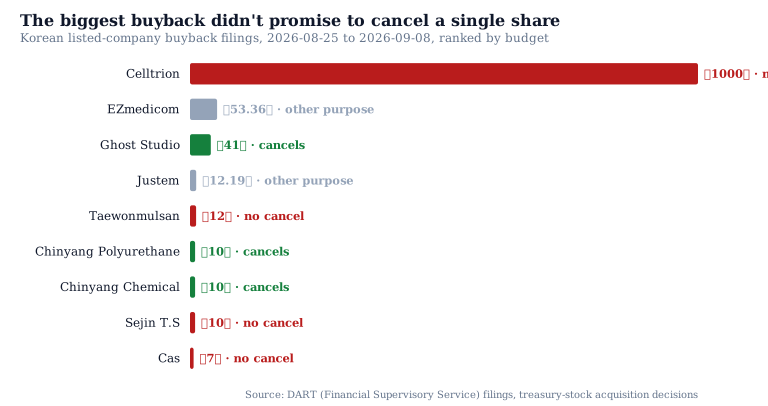
Celltrion's ₩100.0bn buyback dwarfs eight others filed with Korea's regulator this week — and carries no cancellation clause. The three firms that do promise to cancel are the smallest on the list.
AI-assisted, human-reviewed sourcing. Figures are pulled programmatically from the official sources listed at the end of this article and checked by an editor before publication.
buybackgovernancedartkoreadebate
Between 25 August and 1 September, nine Korean listed companies told the regulator they intend to buy back their own shares. Line the filings up by size and one company towers over the rest — and it is not one of the three that promised to shrink its share count.
The filings, ranked
| Rank | Company | Budget | Cancels shares? |
|---|---|---|---|
| 1 | Celltrion | ₩100.0bn | No |
| 2 | EZmedicom | ₩5.34bn | No (merger buy-back, see below) |
| 3 | Ghost Studio | ₩4.10bn | Yes |
| 4 | Justem | ₩1.22bn | No (employee reserve, see below) |
| 5 | Taewonmulsan | ₩1.20bn | No |
| 6 | Chinyang Polyurethane | ₩1.00bn | Yes |
| 6 | Chinyang Chemical | ₩1.00bn | Yes |
| 8 | Sejin T.S | ₩1.00bn | No |
| 9 | Cas | ₩0.70bn | No |
Source: DART treasury-stock acquisition filings, 2026-08-25 to 2026-09-01. English names are DART’s own registered translation.
Buy, or buy and cancel
A buyback and a cancellation are not the same step. Buying takes shares off the market and can support the price, but the shares still exist — sitting in treasury, available to be sold again or handed out later. Cancellation is the part that is irreversible: it permanently reduces the share count, so every remaining share represents a slightly larger claim on the company. Filed purposes like “price stability” or “shareholder value” describe the first step only; a company has to say the second part out loud for it to count.
Of the seven filings in this window that describe an ordinary, discretionary buyback, only three commit to cancellation in the filing itself: Chinyang Polyurethane, Chinyang Chemical and Ghost Studio — a combined ₩6.1bn. The other four, including the single largest filing on the list, do not.
The size doesn’t predict the commitment
Celltrion’s plan is ₩100.0bn — bigger than the other eight filings put together, several times over. Its stated purpose, like most of the others, is price stability and shareholder value. It does not say the shares will be cancelled.
Put the two facts side by side and the ranking asks its own question: if the largest buyback of the week doesn’t retire a single share, and the ones that do are a fortieth its size, does the size of a buyback tell an outside reader anything about whether it will actually shrink the company’s share count? On this week’s filings, the two numbers move independently.
What we left out, and why
Two filings on the list are not ordinary discretionary buybacks, and we do not count them in the comparison above. EZmedicom’s ₩5.34bn purchase is triggered by dissenting shareholders exercising appraisal rights after a merger — the company is legally required to buy those shares, so “will it cancel them” is a different question than for a voluntary buyback. Justem’s ₩1.22bn filing states its purpose as funding employee compensation — the shares are bought to be distributed, not held or retired, so cancellation was never the plan. Both are real filings and both are in the table; neither belongs in a count of “who promised to cancel and who didn’t.”
This is a record of what nine companies filed with DART in one seven-day window, drawn from the primary disclosures, and it is not investment advice — nothing here says any of these nine is worth owning or avoiding. What it shows is narrow and exact: on this week’s evidence, a bigger buyback is not a more committed one.
The debate
Should regulators or exchanges require a buyback filing to state upfront whether the shares will be cancelled — or is “price stability,” left vague, a legitimate purpose on its own? What do you think? This is a talking point, not a verdict — argue it out below.
Buybacks shrink the share count when cancelled; a rights issue does the opposite — and the same week’s filings show size doesn’t predict how much it dilutes existing holders either. See the three-instrument synthesis for the full pattern.
Data & Verification Notes
- Data as of
- Sources
- DART (Financial Supervisory Service electronic disclosure) — Treasury-stock acquisition decisions (tsstkAqDecsn), daily filing lists 2026-08-25 through 2026-09-01, read directly from the OpenDART API. English company names are DART's own corp_name_eng field, not translated by us.
- Cross-checks
- Nine listed companies filed a buyback with a usable won budget in this window: Celltrion ₩100.0bn, EZmedicom ₩5.34bn, Ghost Studio ₩4.10bn, Justem ₩1.22bn, Taewonmulsan ₩1.20bn, Chinyang Polyurethane ₩1.00bn, Chinyang Chemical ₩1.00bn, Sejin T.S ₩1.00bn, Cas ₩0.70bn
- Of the seven filed as ordinary discretionary buybacks ('shareholder value' / 'price stability'), only three state a cancellation purpose: Chinyang Polyurethane, Chinyang Chemical and Ghost Studio — the three smallest of the seven, ₩1.00bn, ₩1.00bn and ₩4.10bn
- Celltrion's filing, 20 to 100 times larger than any of the three cancelling firms, states its purpose as price stability and shareholder value only — no cancellation clause
- Excluded figures
- EZmedicom's ₩5.34bn filing, which is a court-adjacent appraisal-rights repurchase from merger-dissenting shareholders — a legal obligation, not a discretionary buyback, so it is left out of the cancellation comparison (shown in the table, not in the count)
- Justem's ₩1.22bn filing, whose stated purpose is funding employee compensation — shares bought to be handed out, not a candidate for cancellation either way
- Korea Citibank's filing in the same window, which reported no share or won figure in this field and is not rankable
- Any view on whether these shares are worth buying or holding — this reports what nine companies filed, and is not investment advice
- Instruments
- 068270, 010640, 051630, 067770, 417840, 950190, 001420, 016920
The full dataset behind these figures — every listed company, every row — is available to license. SeoulMarkets data for licence →
Not investment advice. SMarkets publishes data journalism for general information only. Nothing here is investment advice, a recommendation, or an offer to buy or sell any security — any investment you make is at your own risk and responsibility. Figures are derived from official public data sources and may be revised by the issuing agency. Verify independently before acting.
What do you think?
This is a talking point, not a verdict — argue it out.
More rankings we take apart in the debate series — where we cite a ranking, then question what it actually measures.