From Celltrion to KG Mobility, one flaw repeats
This week we ranked 35 Korean capital-raising filings three ways — buybacks, rights issues, convertible bonds. In every single one, the size of the deal did not predict what it meant for existing shareholders.
AI-assisted, human-reviewed sourcing. Figures are pulled programmatically from the official sources listed at the end of this article and checked by an editor before publication.
buybackrights issueconvertible bonddilutiondartkoreadebate
This week we published three separate rankings of Korean capital-raising filings — buybacks, rights issues, and convertible bonds — each time asking the same question: does the size of the deal tell you anything about what it means for the shareholders already holding the stock? Lined up together, the three answers repeat the same word: no.
Three instruments, one pattern
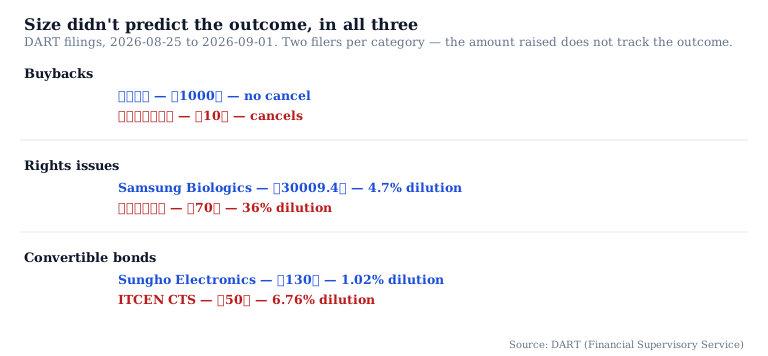
| Instrument | Filers | Biggest filing | Outcome | A smaller filing | Outcome |
|---|---|---|---|---|---|
| Buybacks | 9 | Celltrion, ₩100.0bn | No cancellation | Chinyang Polyurethane, ₩1.00bn | Cancels |
| Rights issues | 21 | Samsung Biologics, ₩3.00tn | 4.7% dilution | PhionX, ₩10.0bn | 53.8% dilution |
| Convertible bonds | 5 | Sungho Electronics, ₩13.0bn | 1.02% dilution | ITCEN CTS, ₩5.0bn | 6.76% dilution |
Each row compares real filings from the same seven-day window, 25 August–1 September 2026. Full rankings and method are in the linked reports.
The direction isn’t even consistent
Notice that the pattern doesn’t point the same way twice. In buybacks, the biggest filer is the one that skipped the shareholder-friendly step (cancellation); the small filer did it. In rights issues, it flips: the biggest filer diluted the least, and a much smaller one diluted the most. In convertible bonds, the larger of the pair diluted less than the smaller one.
That inconsistency is the finding. If size reliably predicted the outcome — in either direction — a reader could use the won figure on the cover of a filing as a shortcut. It doesn’t. A large number and a small number tell you the scale of the transaction. They tell you nothing about whether it costs an existing shareholder more or less.
What does tell you
Across all three reports this week, the thing that did track the outcome was a structural detail buried below the headline number: whether a buyback’s stated purpose included cancellation; whether a rights issue went to existing holders first or to selected investors by third-party allotment; how a convertible’s conversion price was set relative to the company’s existing share count. None of those details fit in a one-line summary, which is exactly why they don’t make it into most write-ups of these filings.
This is not investment advice, and it is not a claim that any of these 35 companies did something wrong — a rights issue, a buyback, and a convertible bond are all ordinary, legal financing tools. It is a narrower point, repeated three times this week with real filings and real names: the number that makes a headline is not the number that answers the shareholder’s question.
The debate
Should Korean disclosure rules require every capital-raising filing to state its shareholder-facing outcome — cancellation, dilution percentage — in the same headline field as the won amount? What do you think? This is a talking point, not a verdict — argue it out below.
Data & Verification Notes
- Data as of
- Sources
- DART (Financial Supervisory Service electronic disclosure) — Treasury-stock acquisition decisions (tsstkAqDecsn), rights-issue decisions (piicDecsn), and convertible-bond decisions (cvbdIsDecsn) — the same three datasets built for this week's three separate reports, not re-pulled or recomputed.
- Cross-checks
- Buybacks (9 filers): Celltrion's ₩100.0bn is the largest and carries no cancellation commitment; Chinyang Polyurethane's ₩1.00bn — a hundredth the size — commits to cancelling
- Rights issues (21 filers): Samsung Biologics' ₩3.00tn raise dilutes 4.7%; PhionX's ₩10.0bn raise — three hundred times smaller — dilutes 53.8%
- Convertible bonds (5 filers): Sungho Electronics raised ₩13.0bn at 1.02% dilution; ITCEN CTS raised less, ₩5.0bn, at 6.76% dilution — nearly seven times more
- Across all three instruments and 35 filers, the largest filing in each category is not the one with the least favourable outcome for shareholders, nor the most favourable — the two measures move independently
- Excluded figures
- Any single ranking or statistical test of correlation between size and outcome — three small samples (9, 21, 5) are shown side by side as evidence of a pattern, not proof of one that would require a much larger sample
- Any view on whether these filings are good or bad for their own shareholders — this reports what 35 companies filed this week across three separate mechanisms, and is not investment advice
- Instruments
- 068270, 010640, 051630, 067770, 417840, 950190, 001420, 016920, 207940, 900100, 003620, 095190, 043260, 413630, 031820
The full dataset behind these figures — every listed company, every row — is available to license. SeoulMarkets data for licence →
Not investment advice. SMarkets publishes data journalism for general information only. Nothing here is investment advice, a recommendation, or an offer to buy or sell any security — any investment you make is at your own risk and responsibility. Figures are derived from official public data sources and may be revised by the issuing agency. Verify independently before acting.
What do you think?
This is a talking point, not a verdict — argue it out.
More rankings we take apart in the debate series — where we cite a ranking, then question what it actually measures.