Korea's producer prices rose 7.7% — its chip prices tripled
The headline producer price index barely moved. Underneath, chip prices rose 315% and memory 291% in a year while forest and vegetable prices fell 20-35%. The 7.7% average hides a violent split. Not advice.
AI-assisted, human-reviewed sourcing. Figures are pulled programmatically from the official sources listed at the end of this article and checked by an editor before publication.
producer-pricessemiconductorsmemoryinflationbank-of-koreakorea
Read the headline and Korea’s factory-gate inflation looks tame: producer prices rose 7.7% over the year to July 2026. Look underneath the average and it is not one number at all — it is a chasm, with silicon at one edge and farmland at the other.
The average is a fiction
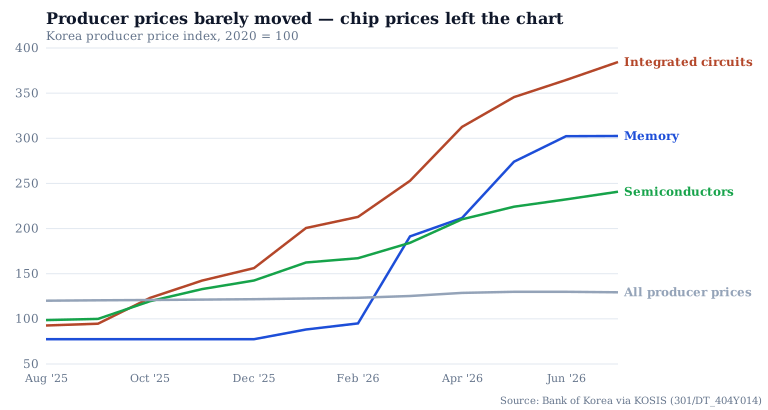
The all-items line barely tilts — 120 to 129. But integrated circuits rose 315%, their index tripling from 93 to 384. Computer memory rose 291%; semiconductors 144%; computers and peripherals 143%. These are not consumer gadgets getting dearer at the shop — they are the prices Korean producers charge for chips, and they have gone vertical. The 7.7% headline is simply where the soaring chip lines and everything else average out. It describes no actual product.
The timing is worth marking. The memory index sat dead flat at 77.4 through January 2026, then more than tripled in five months. That step-change is the memory upcycle arriving — the same demand wave behind the semiconductor makers’ earnings — printed straight into the price statistics.
Silicon at the top, the farm at the bottom
Sort producers by how much their output prices moved and the top of the list is almost entirely made of chips and the oil that feeds industry.
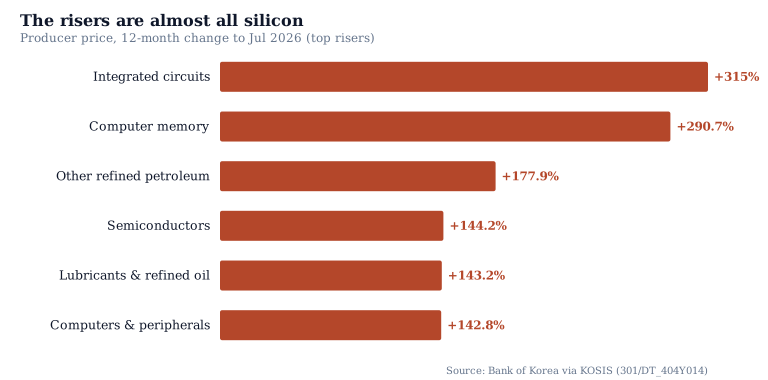
At the other end, prices fell: edible forest products −35%, ordinary forest products −26%, vegetables −26%, vegetables and fruit −19%. So while the chip economy was repricing upward by triple digits, Korea’s farms and forests were in outright price deflation. One producer price index contained a boom and a bust at the same time.
What it means, and does not
This is a reminder of how concentrated Korea’s price story has become. As an earlier piece showed, the KOSPI is really a semiconductor index; the tail of the producer price basket now tells the same tale. And it dovetails with the import side — where, as we found, the won did much of the lifting: memory and circuit boards were among the fastest-rising imports too, so Korea is paying up for chips it buys and charging up for chips it sells.
Two cautions travel with it. This is the producer price index — factory-gate selling prices, not the consumer prices a household faces, which move far more gently. And +315% is an index change, not a price: it says integrated-circuit prices are now roughly four times their 2020 level, driven by a global memory and AI-demand upcycle whose full cause is beyond this table. This is a reading of the Bank of Korea’s index, not a forecast and not investment advice. What it shows is stark: behind a calm 7.7% average, Korea’s producers lived through one of the sharpest price booms — and one quiet farm bust — on record.
Data & Verification Notes
- Data as of
- Sources
- Bank of Korea (via KOSIS) — Producer price index (basic classification), 2020=100, table DT_404Y014 (org 301), monthly Aug 2025–Jul 2026
- Cross-checks
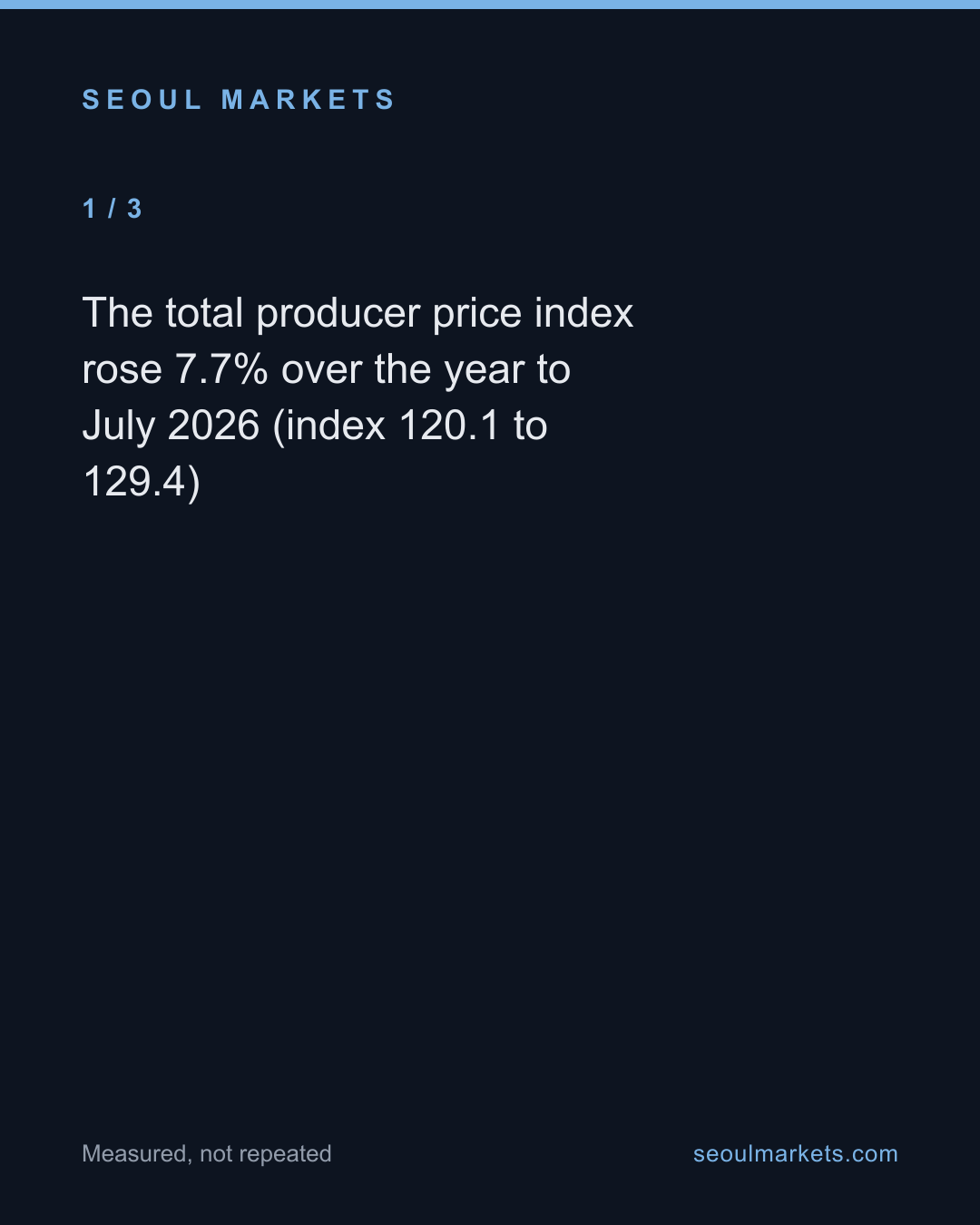
- The total producer price index rose 7.7% over the year to July 2026 (index 120.1 to 129.4)
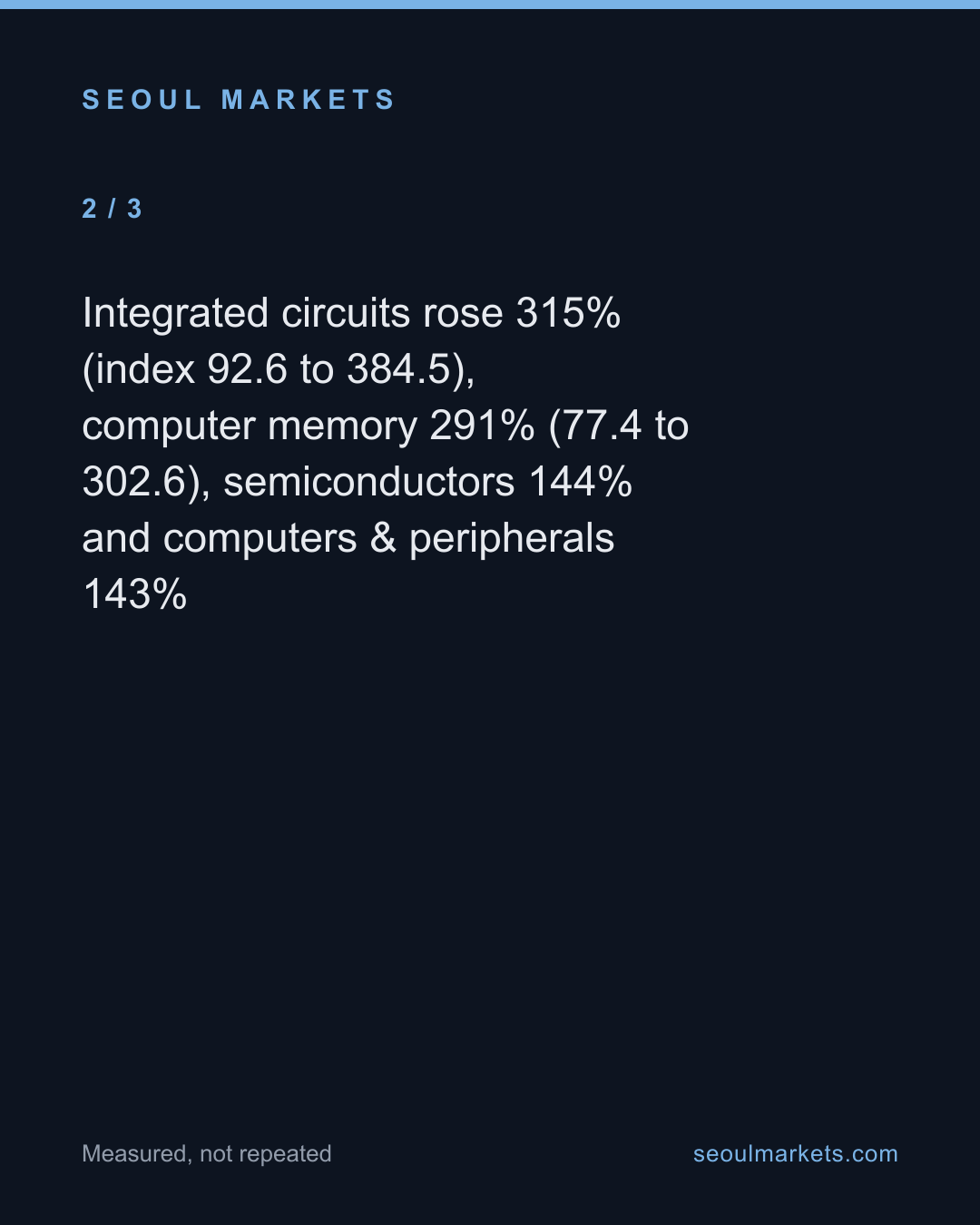
- Integrated circuits rose 315% (index 92.6 to 384.5), computer memory 291% (77.4 to 302.6), semiconductors 144% and computers & peripherals 143%
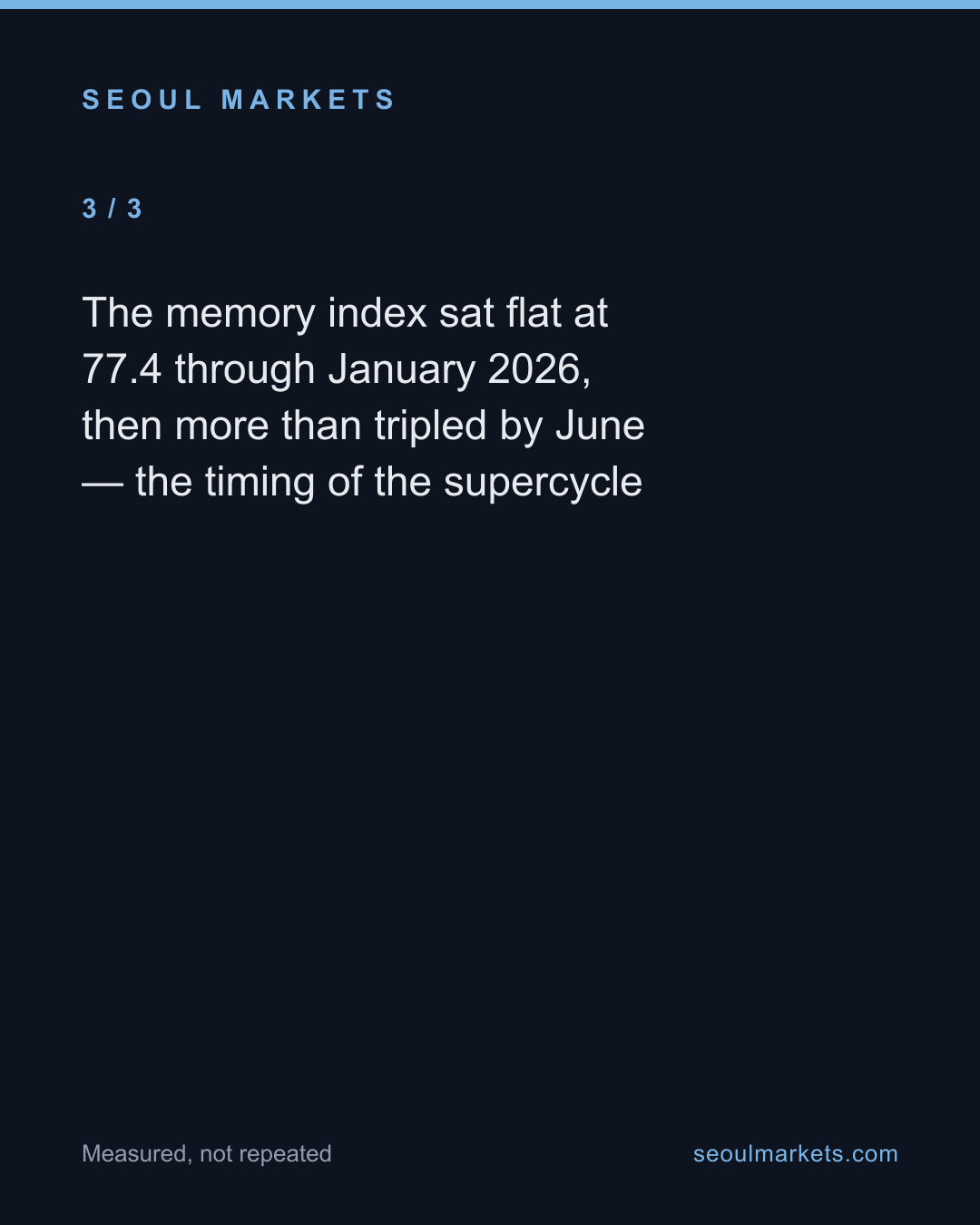
- The memory index sat flat at 77.4 through January 2026, then more than tripled by June — the timing of the supercycle
- At the other end, edible forest products fell 34.9%, forest products 25.7%, vegetables 25.5% and vegetables & fruit 19.4%
- Excluded figures
- This is an index (2020=100). A reading of 384 means prices are 3.8x the 2020 level; +315% is the change over these twelve months, not a price
- The producer price index is what Korean producers charge at the factory gate, not what shoppers pay — consumer inflation is a separate, milder series
- The chip surge reflects a global memory and AI-demand upcycle showing up in Korean output prices; we report the index move, not a full account of its cause
- This is not investment advice
The full dataset behind these figures — every listed company, every row — is available to license. SeoulMarkets data for licence →
Not investment advice. SMarkets publishes data journalism for general information only. Nothing here is investment advice, a recommendation, or an offer to buy or sell any security — any investment you make is at your own risk and responsibility. Figures are derived from official public data sources and may be revised by the issuing agency. Verify independently before acting.
Take this away — 5 cards
The figures in this article, as images. Free to repost with the address on them.