Korea's 10 largest listed companies — and why most rankings double-count Samsung
The largest Korean companies by market value: Samsung Electronics is 29% of the whole market, SK hynix 21% — the two are nearly half. But most rankings count Samsung twice, because its preferred shares list separately. Not advice.
AI-assisted, human-reviewed sourcing. Figures are pulled programmatically from the official sources listed at the end of this article and checked by an editor before publication.
largest korean companiesbiggest company in koreasamsung market capkospimarket-capkorea stock market
The single most-searched question about the Korean stock market has a surprisingly slippery answer: which companies are the biggest? Slippery because the rankings most sites publish quietly count one company twice.
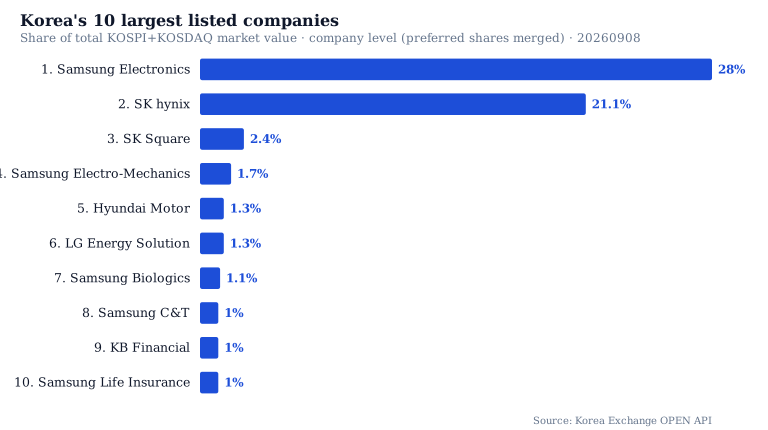
Two companies, nearly half the market
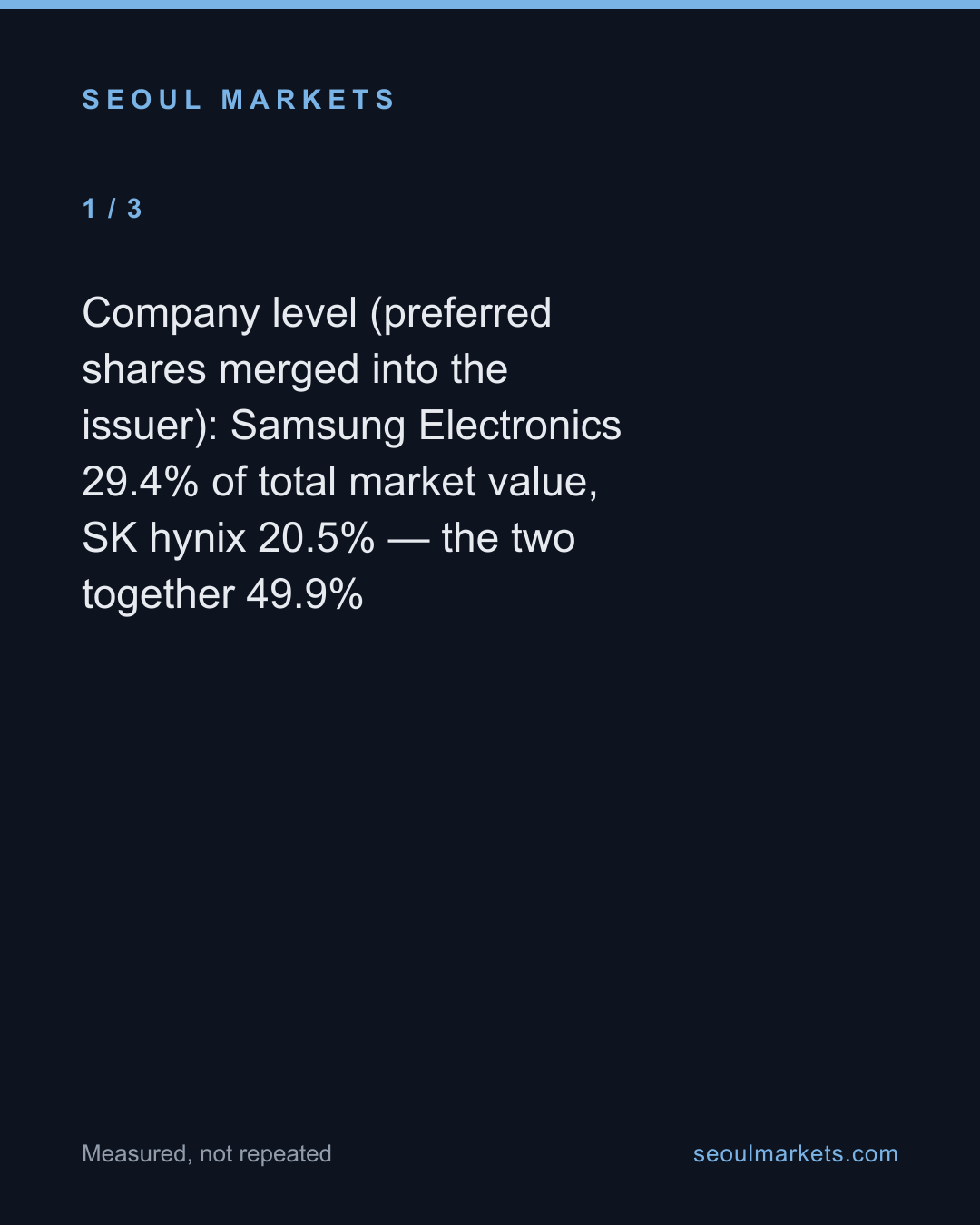
At company level — merging each firm’s common and preferred shares — Samsung Electronics is 29.4% of the entire market (KOSPI and KOSDAQ combined) and SK hynix is 20.5%. Those two alone are 49.9% — essentially half of everything listed in Korea sits in two chipmakers riding the memory and AI cycle. After them the drop is a cliff: third place, SK Square, is 2.4%.
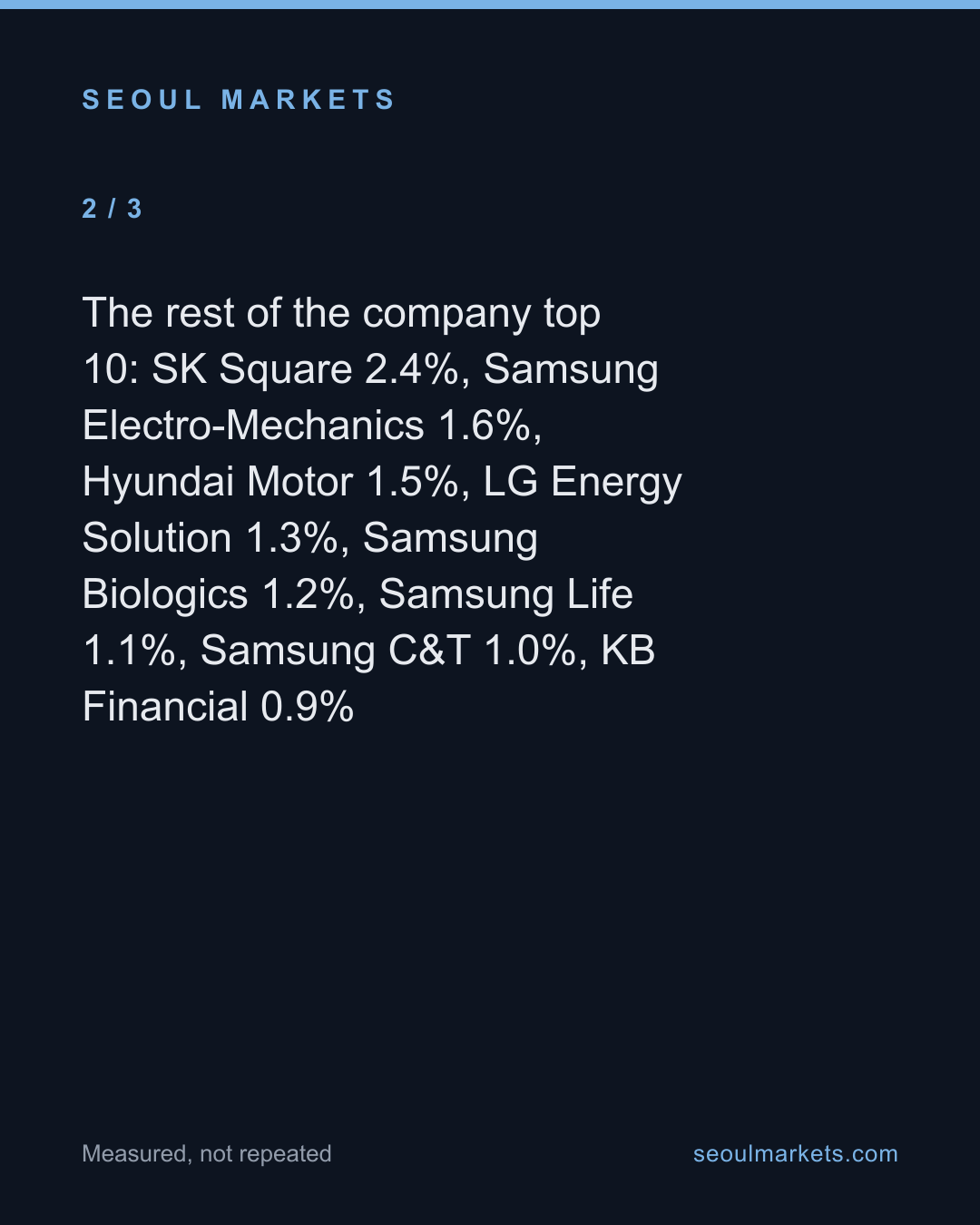
The rest of the top ten are all under 2.5%: SK Square (2.4%), Samsung Electro-Mechanics (1.6%), Hyundai Motor (1.5%), LG Energy Solution (1.3%), Samsung Biologics (1.2%), Samsung Life (1.1%), Samsung C&T (1.0%) and KB Financial (0.9%). Note how many carry the Samsung name — five of the ten largest companies are Samsung affiliates.
Why the usual ranking is wrong
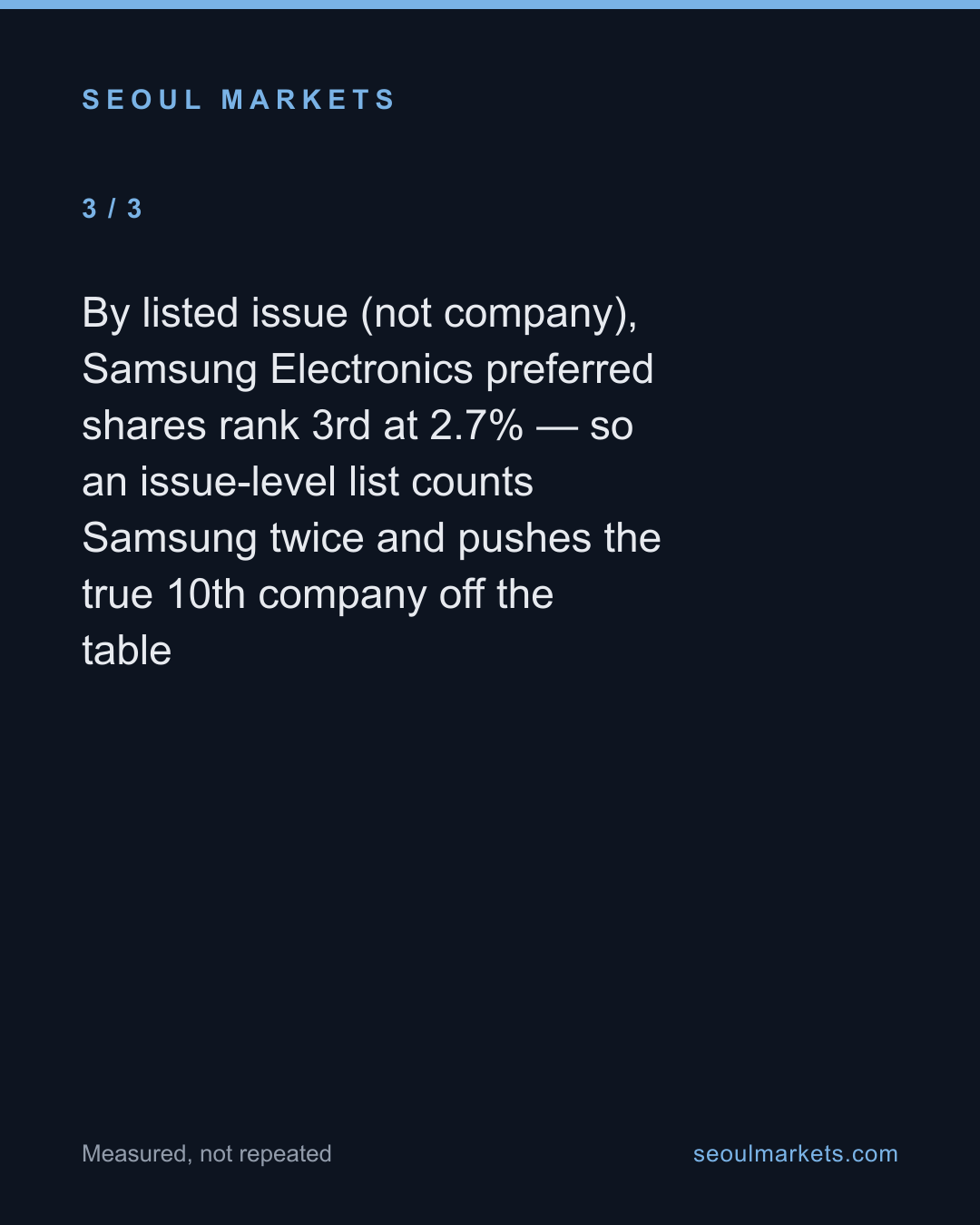
Here is the counting trap. Korea lists preferred shares as separate securities from common shares. So if you rank by listed issue — as most quick lists do — Samsung Electronics’ preferred line shows up as its own entry, ranked third at 2.7%, as if it were a different company. That double-counts Samsung and shoves the genuine tenth-largest company (KB Financial, here) off the bottom of the list.
The honest fix is to rank by company, folding a firm’s preferred shares back into the issuer — which is what the chart above does. It does not, however, merge separate affiliates: Samsung Biologics and Samsung Life are their own listed companies and are counted as such, even though they share a name.
What this is, and is not
Every figure here is a share of total market value, not a won amount — the price level in this data feed is a simulation, so only the ratios, which do not depend on it, are used. “Largest” means most valuable on one trading day (2026-08-21), which moves with the market. For the fuller picture of just how top-heavy this is — four stocks are half the market, and the same lopsidedness runs through Korea’s trade. This is a description of Korea’s biggest listed companies, not investment advice.
Update, 11 September 2026 — the answer changes with the measure
This article ranks by one measure: share of total market value on a single day. Since it was published we have built the annual financial statements for every listed company, so the same question can now be asked three more ways — by revenue, by total assets, and by operating profit.
They do not agree. Take the top ten on each of the four measures and put them in one pile and you get 21 companies, not ten; only Samsung Electronics and Hyundai Motor appear in all four. SK Square, third here by market value, is 270th by revenue. Korea Electric Power is fifth by revenue and 34th by market value. Nineteen of the hundred most valuable companies have no revenue line at all, most of them banks and insurers.
The four rankings, with the ranks side by side and every count of what is missing, are on the largest companies in Korea. That page carries won amounts rather than shares, because it is built on the public data portal’s price dataset instead of the simulated feed used here.
Looking for the weights themselves?
This article stops at ten companies. If what you want is the index weight of every KOSPI constituent — each company’s share of total market value, all 828 of them, ranked and free to read — that is a separate page: what share of KOSPI is each company. The two largest are 52.2 percent of the market between them on 2026-09-09.
⚠ One caveat stated there and worth repeating: those are shares of full market value, not of free float. Index providers weight by float, so a company whose founding family holds a large block will sit lower in the official index than it does on that page. We say so rather than publishing a float-adjusted number we cannot source.
Related — where this shows up
- What Korea’s pension’s 107% return really measures — the national pension is a major holder of these same large-caps; read the label on that number.
- Korea’s “biggest company” ranking measures hope, not output — ranking these firms by market value is ranking a bet, not output.
Data & Verification Notes
- Data as of
- Sources
- Korea Exchange (KRX OPEN API) — Daily trading — market capitalisation by issue, KOSPI + KOSDAQ, 2026-08-21; preferred shares consolidated to the issuer for company-level ranking
- Cross-checks
- Company level (preferred shares merged into the issuer): Samsung Electronics 29.4% of total market value, SK hynix 20.5% — the two together 49.9%
- The rest of the company top 10: SK Square 2.4%, Samsung Electro-Mechanics 1.6%, Hyundai Motor 1.5%, LG Energy Solution 1.3%, Samsung Biologics 1.2%, Samsung Life 1.1%, Samsung C&T 1.0%, KB Financial 0.9%
- By listed issue (not company), Samsung Electronics preferred shares rank 3rd at 2.7% — so an issue-level list counts Samsung twice and pushes the true 10th company off the table
- Five of the ten largest companies are Samsung affiliates (Electronics, Electro-Mechanics, Biologics, Life, C&T)
- Excluded figures
- Ranked by share of total market value, not won amounts: the KRX price level in this feed is a simulation, so only ratios are used
- Company level merges a firm's common and preferred shares (e.g. Samsung Electronics + its preferred line); it does NOT merge separate affiliates — Samsung Biologics, Samsung Life etc. are counted as the distinct listed companies they are
- Market value is shares outstanding times one day's close (2026-08-21)
- This is not investment advice
The full dataset behind these figures — every listed company, every row — is available to license. SeoulMarkets data for licence →
Not investment advice. SMarkets publishes data journalism for general information only. Nothing here is investment advice, a recommendation, or an offer to buy or sell any security — any investment you make is at your own risk and responsibility. Figures are derived from official public data sources and may be revised by the issuing agency. Verify independently before acting.
Take this away — 5 cards
The figures in this article, as images. Free to repost with the address on them.