Every kind of Korean bank loan turned more variable this year. Companies moved fastest.
The fixed-rate share of outstanding bank loans fell across corporates, households and mortgages over the year to June. Companies led it, dropping nearly eight points to 31%. Mortgages stayed the most fixed, at 63%.
AI-assisted, human-reviewed sourcing. Figures are pulled programmatically from the official sources listed at the end of this article and checked by an editor before publication.
interest ratesbank loansfixed vs floatinghouseholdskorea
Korea’s borrowers spent the past year drifting onto floating rates. Not in a rush, and not evenly — but in the same direction, whether they were companies, households or people paying off a home.
The fixed share fell across the board
The Bank of Korea reports what portion of outstanding bank loans carries a fixed rate rather than a floating one, and it splits it three ways. Over the year to June 2026, the fixed portion dropped in all three.
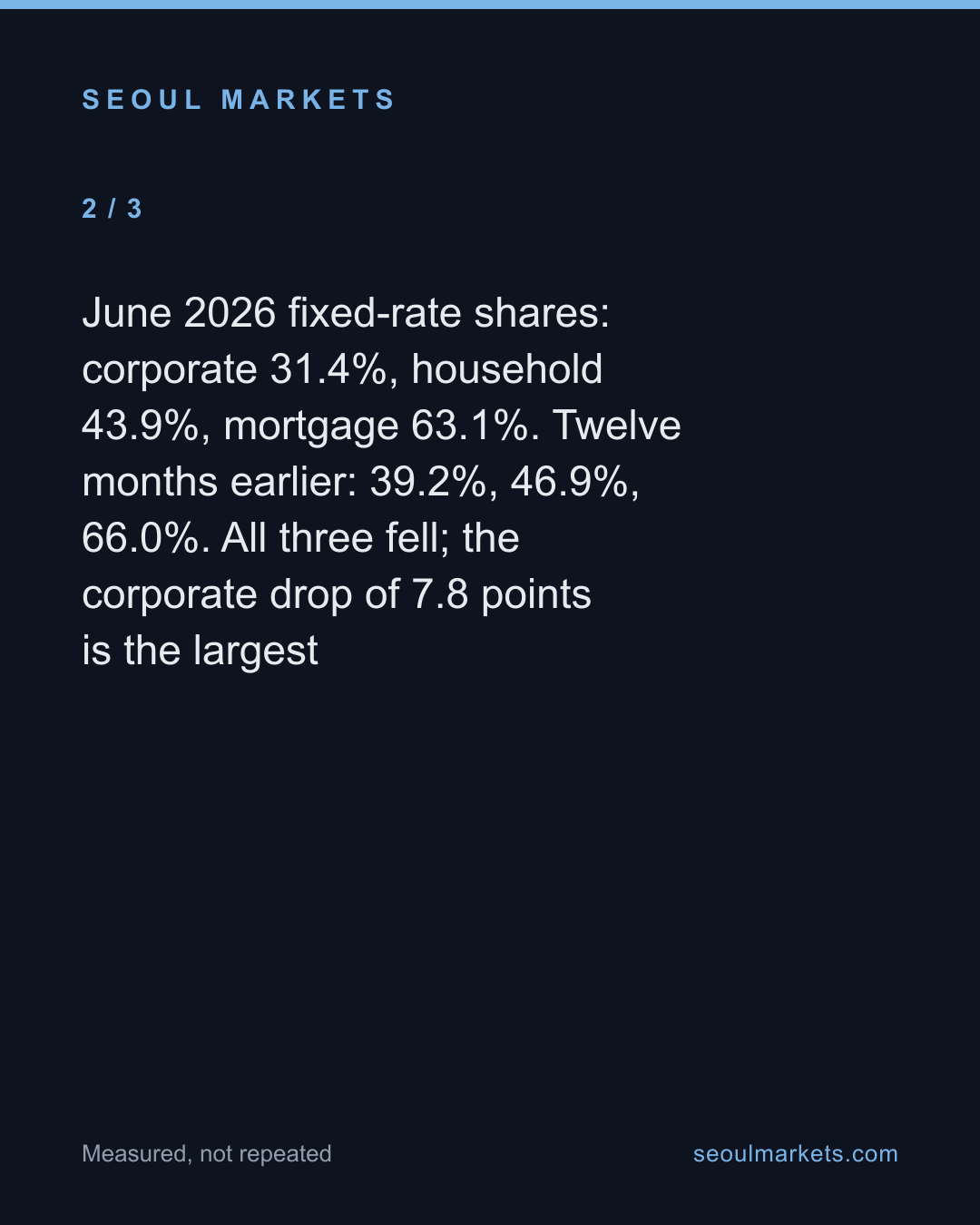
| Borrower | Fixed-rate share, Jun 2026 | A year earlier | Floating now |
|---|---|---|---|
| Corporate | 31.4% | 39.2% | 68.6% |
| Household | 43.9% | 46.9% | 56.1% |
| Mortgage | 63.1% | 66.0% | 36.9% |
Companies moved the most, shedding nearly eight points of fixed-rate balance in twelve months. Households and mortgage holders moved less — about three points each — but the same way.
The two ends of the market
Strip out the direction and the levels tell their own story: Korean borrowers are not all alike in how they hold rate risk.
At one end sit companies, two-thirds of whose loan balance floats. Corporate treasurers borrow short and reprice often; a floating book is normal, and in a year when they expected the cost of money to come down, letting it float is a bet that pays as rates fall.
At the other end sit mortgages, still 63% fixed even after a year of drift. A home loan is the one debt an ordinary borrower most wants to pin down, and Korean mortgage holders keep pinning it — the fixed share fell, but it is the only category where fixed still wins. Households overall land in between, a near-even 44/56 split that reflects the mix of the two.
What a drifting balance says
Because this is the whole outstanding balance and not this month’s new loans, it moves slowly, and a broad move means something broad — either borrowers are writing new floating loans, or old fixed ones are maturing faster than they are replaced. The data cannot say which. What it can say is that every kind of borrower ended the year with a smaller cushion of fixed rate than they started it — and that when rates next move, more of Korea’s loan book moves with them than a year ago.
Data & Verification Notes
- Data as of
- Sources
- Statistics Korea — KOSIS (Bank of Korea data) — Deposit bank fixed/variable-rate loan share (예금은행 고정·변동금리대출 비중), outstanding-balance basis, table DT_121Y011
- Cross-checks
- Monthly shares of bank loan balances at fixed versus floating rates, July 2025 to June 2026, split into corporate, household and mortgage borrowers. For each group the fixed and floating shares sum to 100, and match the 'total' row the source reports separately
- June 2026 fixed-rate shares: corporate 31.4%, household 43.9%, mortgage 63.1%. Twelve months earlier: 39.2%, 46.9%, 66.0%. All three fell; the corporate drop of 7.8 points is the largest
- This is the outstanding balance, not new lending. The figures and the 'based on outstanding' definition were pulled from KOSIS together, so the wording matches the source
- Excluded figures
- New-loan flow. This measures the stock of loans on the books, which moves slowly; a borrower choosing fixed or floating on a fresh loan this month barely shifts it. The move here is the whole balance drifting, not this month's decision
- The interest rates themselves. This is the fixed-versus-floating mix, not the level of rates. A falling fixed share says how loans are priced, not how dear they are
- Why the mix shifted. Balances turn floating either because new floating loans are written or because fixed ones mature and roll off; this data cannot separate the two
- The market-linked, prime-linked and deposit-linked sub-types. The source breaks floating into several kinds; here they are combined into one floating share so it sums cleanly against fixed
The full dataset behind these figures — every listed company, every row — is available to license. SeoulMarkets data for licence →
Not investment advice. SMarkets publishes data journalism for general information only. Nothing here is investment advice, a recommendation, or an offer to buy or sell any security — any investment you make is at your own risk and responsibility. Figures are derived from official public data sources and may be revised by the issuing agency. Verify independently before acting.
Take this away — 5 cards
The figures in this article, as images. Free to repost with the address on them.