Samsung Biologics raised 300x more, diluted 11x less
Samsung Biologics' ₩3.00tn rights issue diluted shareholders 4.7%. PhionX raised 300 times less — and diluted 53.8%, eleven times more. Twenty-one filings this week show size doesn't predict dilution.
AI-assisted, human-reviewed sourcing. Figures are pulled programmatically from the official sources listed at the end of this article and checked by an editor before publication.
rights issuedilutiondartgovernancekoreadebate
Twenty-one Korean companies filed rights-issue decisions with the regulator between 25 August and 1 September, raising anywhere from ₩4.7 billion to ₩3.00 trillion. Rank them by size and the two ends of the list make an odd pair.
The filings, ranked by amount raised
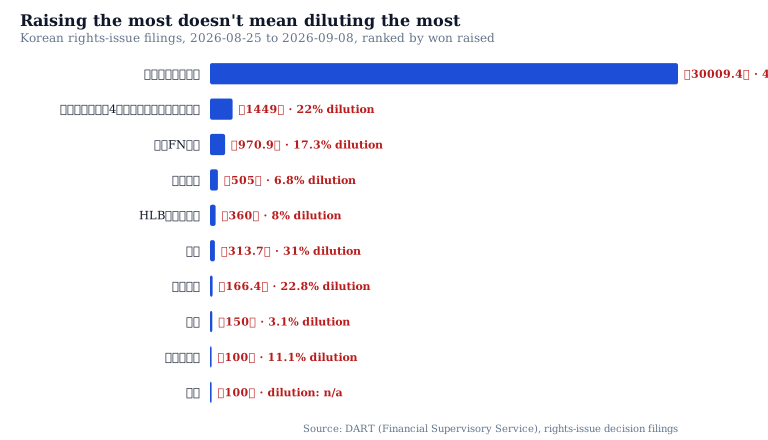
| Rank | Company | Raised | Dilution | Method |
|---|---|---|---|---|
| 1 | Samsung Biologics | ₩3.00tn | 4.7% | Rights offering + public offer of unclaimed shares |
| 2 | Private rental-housing REIT (HUB4) | ₩144.9bn | 22.0% | Rights offering |
| 3 | SamsungFN REIT | ₩97.1bn | 17.3% | Rights offering + public offer |
| 4 | Taeyoung E&C | ₩50.5bn | 6.8% | Third-party allotment |
| 5 | HLB innoVation | ₩36.0bn | 8.0% | Third-party allotment |
| 6 | VUNO | ₩31.4bn | 31.0% | Rights offering + public offer |
| … | (15 more, ₩1.9bn–₩16.6bn) | |||
| 20 | PhionX | ₩10.0bn | 53.8% | Third-party allotment |
| 21 | Logis Mon | ₩4.7bn | 33.3% | General public offering |
Full 21-company ranking and sourcing at the data page. Source: DART rights-issue filings, 2026-08-25 to 2026-09-01.
The pair at the extremes
Samsung Biologics’ filing is the largest on the list by a wide margin: ₩3.00 trillion, of which ₩2.71 trillion is earmarked for a business acquisition and ₩295 billion for facilities. Existing shareholders are diluted by 4.7% — because the company offered the new shares to them first, proportionally, before any leftover shares went to the public.
PhionX’s filing raised ₩10.0 billion — three hundred times less — entirely for working capital, and existing shareholders are diluted by 53.8%, eleven times more than Samsung Biologics’ shareholders. The shares were not offered to existing holders at all: they went straight to selected investors through third-party allotment.
What actually moves the dilution number
Line up all 21 filings and the relationship between size and dilution is not a straight line. The next three largest raises — a private REIT, SamsungFN REIT, and Taeyoung E&C — carry dilution of 22.0%, 17.3% and 6.8%, in no particular order relative to their size. What tracks more closely with dilution here is how the shares are sold: a rights offering gives existing holders first claim, which is one reason (among several) that some rights-offering filings still land at high dilution when the raise is large relative to the existing share count, while others land low. A third-party allotment skips that step by design, and on this week’s evidence, several of the highest-dilution filings used it.
This is not a claim that either method is better for a shareholder — an existing holder in a rights offering can subscribe and avoid dilution entirely, while a third-party allotment gives them no such choice. It is a narrower point: a bigger won figure at the top of a filing does not, by itself, tell an outside reader how much their stake will shrink.
This is a record of what 21 companies filed with DART in one seven-day window, and it is not investment advice — nothing here says any of these companies’ shares are worth owning or avoiding.
The debate
If a rights issue dilutes existing shareholders more than half, should disclosure rules require that number — not just the won figure — in the filing’s headline? What do you think? This is a talking point, not a verdict — argue it out below.
A convertible-bond ranking the same week finds the same pattern: dilution and the size of the raise don’t move together, and DART already reports the dilution figure itself. See the three-instrument synthesis for all three side by side.
Data & Verification Notes
- Data as of
- Sources
- DART (Financial Supervisory Service electronic disclosure) — Rights-issue decisions (piicDecsn), matched to daily filing lists 2026-08-25 through 2026-09-01, read directly from the OpenDART API. English company names are DART's own corp_name_eng field, not translated by us.
- Cross-checks
- 21 companies' rights-issue filings this window carried a usable won figure and share count, from ₩3.00tn (Samsung Biologics) down to ₩4.7bn (Logis Mon)
- Dilution is computed as new shares ÷ (new shares + shares outstanding before issuance), from the same filing's own share counts — not modelled or estimated
- Samsung Biologics: ₩3.00tn raised (₩2.71tn earmarked for a business acquisition, ₩295bn for facilities), 4.7% dilution, via a rights offering to existing shareholders plus a public offering of any unclaimed shares. PhionX: ₩10.0bn raised, entirely for working capital, 53.8% dilution, via third-party allotment (shares sold directly to selected investors, not offered to existing holders)
- The three next-largest raises by amount — a private REIT (₩144.9bn), SamsungFN REIT (₩97.1bn), Taeyoung E&C (₩50.5bn) — carried dilution of 22%, 17.3% and 6.8% respectively, so the pattern is not a straight line: it is the issuance method, not only the size, that moves with dilution
- Excluded figures
- 11 of the 32 rights-issue filings in this window: their decision was reported as a subsidiary's rights issue under a parent company's disclosure (e.g. Samsung C&T, NAVER Webtoon), a different DART report path that this API call does not return for the parent's own corp code. Shown as unmeasured, not zero
- Any view on whether a given rights issue, or the dilution it brings, is good or bad for that company's shareholders — this ranks what was filed and computes the arithmetic of dilution, and is not investment advice
- Instruments
- 207940, 900100
The full dataset behind these figures — every listed company, every row — is available to license. SeoulMarkets data for licence →
Not investment advice. SMarkets publishes data journalism for general information only. Nothing here is investment advice, a recommendation, or an offer to buy or sell any security — any investment you make is at your own risk and responsibility. Figures are derived from official public data sources and may be revised by the issuing agency. Verify independently before acting.
What do you think?
This is a talking point, not a verdict — argue it out.
More rankings we take apart in the debate series — where we cite a ranking, then question what it actually measures.