KG Mobility's convertible bond dilutes shares 22%
Five Korean convertible bonds filed this week all pay 0% surface interest — the option to convert is the entire return. Potential dilution on conversion ranges from 1.0% to 22.0%, and it isn't the biggest raise that dilutes least.
AI-assisted, human-reviewed sourcing. Figures are pulled programmatically from the official sources listed at the end of this article and checked by an editor before publication.
convertible bonddilutiondartgovernancekoreadebate
Five Korean listed companies filed convertible-bond decisions with the regulator between 25 August and 1 September. Every one of them pays 0% surface interest. And the dilution a conversion would eventually cause ranges more than twenty-fold across the five.
The filings, ranked by amount raised
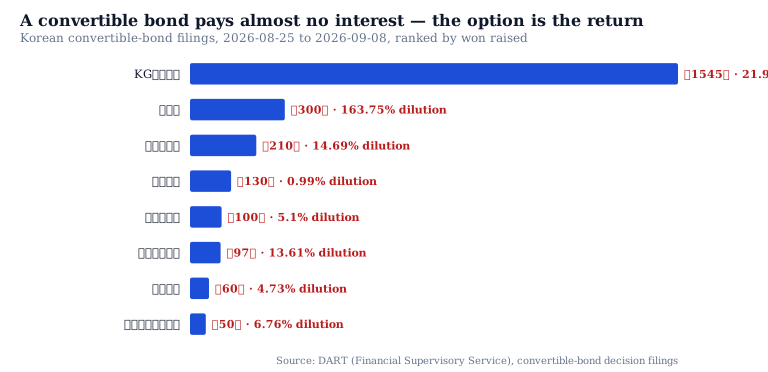
| Rank | Company | Raised | Surface rate | Dilution on conversion |
|---|---|---|---|---|
| 1 | KG Mobility | ₩154.5bn | 0.0% | 21.96% |
| 2 | Shinhwapritech | ₩21.0bn | 0.0% | 14.69% |
| 3 | Sungho Electronics | ₩13.0bn | 0.0% | 1.02% |
| 4 | CP System | ₩10.0bn | 0.0% | 5.10% |
| 5 | ITCEN CTS | ₩5.0bn | 0.0% | 6.76% |
Dilution is DART’s own reported figure (new shares on conversion ÷ total shares after conversion) — we did not compute it. Source: DART convertible-bond filings, 2026-08-25 to 2026-09-01.
Zero interest is not the same as zero cost
A convertible bond pays a bondholder in two possible ways: interest along the way, and the option to convert into shares later if the stock rises past the conversion price. All five filings this week set the surface interest rate at exactly 0.0% — the lender is paid nothing while holding the bond. The entire compensation is the conversion option. That is a normal, common structure in Korea’s private-placement convertible-bond market, and it is not, by itself, a warning sign. But it does mean the real cost of the deal to existing shareholders is not in the interest column at all — it is entirely in the dilution column, which most headlines about a bond raise never mention.
The size of the raise doesn’t rank with the dilution
KG Mobility’s bond is the largest here — ₩154.5 billion — and carries the highest dilution on the list, 21.96%. That might suggest a simple rule: raise more, dilute more. The rest of the list breaks it. Sungho Electronics raised more than ITCEN CTS (₩13.0bn versus ₩5.0bn) but dilutes existing shareholders at roughly a sixth of the rate (1.02% versus 6.76%). The gap comes down to the conversion price set relative to the company’s existing share count, not to the won amount on the cover page.
This is not a claim that any of these five terms are fair or unfair, generous or aggressive — DART’s own dilution field is doing the arithmetic, and it is arithmetic, not judgment. It is a narrower point: the won figure that leads a headline about a bond raise is not the number that tells an existing shareholder how much their stake will shrink if it converts.
This is a record of what five companies filed with DART in one seven-day window, and it is not investment advice — nothing here says any of these five is worth owning or avoiding.
The debate
If every convertible bond already reports its own dilution percentage to the regulator, should that number — not the won amount — lead the headline when a bond raise is reported? What do you think? This is a talking point, not a verdict — argue it out below.
This week’s buyback and rights-issue rankings found the same thing. See the three-instrument synthesis for all three together.
Data & Verification Notes
- Data as of
- Sources
- DART (Financial Supervisory Service electronic disclosure) — Convertible-bond decisions (cvbdIsDecsn), matched to daily filing lists 2026-08-25 through 2026-09-01, read directly from the OpenDART API. English company names are DART's own corp_name_eng field. Dilution is DART's own reported field (cvisstk_tisstk_vs) — not recomputed by us.
- Cross-checks
- Five listed companies filed a private-placement convertible bond this window with a usable amount and dilution figure: KG Mobility ₩154.5bn (21.96% dilution), Shinhwapritech ₩21.0bn (14.69%), Sungho Electronics ₩13.0bn (1.02%), CP System ₩10.0bn (5.10%), ITCEN CTS ₩5.0bn (6.76%)
- All five carry a 0.0% surface (coupon) interest rate; yield-to-maturity ranges 0.0%–3.0%. The return to the bondholder comes almost entirely from the option to convert to shares, not from interest paid along the way
- Ranked by amount raised, dilution does not fall in step: Sungho Electronics raised more than ITCEN CTS (₩13.0bn vs ₩5.0bn) but dilutes existing shareholders roughly a sixth as much (1.02% vs 6.76%)
- Excluded figures
- One convertible-bond filing this window (Hanwool & Jeju) that this API could not match to a usable record in the date window queried — shown as unmeasured, not zero
- Any view on whether a given bond's terms are fair to existing shareholders or to the bond buyer — this reports what was filed, and is not investment advice
- Instruments
- 003620, 095190, 043260, 413630, 031820
The full dataset behind these figures — every listed company, every row — is available to license. SeoulMarkets data for licence →
Not investment advice. SMarkets publishes data journalism for general information only. Nothing here is investment advice, a recommendation, or an offer to buy or sell any security — any investment you make is at your own risk and responsibility. Figures are derived from official public data sources and may be revised by the issuing agency. Verify independently before acting.
What do you think?
This is a talking point, not a verdict — argue it out.
More rankings we take apart in the debate series — where we cite a ranking, then question what it actually measures.