In Korea, the industries that hold their workers longest are mostly the ones that pay them most
Rank 44 listed industries by how long they keep people and by what they pay, and the two line up at 0.67. Long-tenure sectors pay 1.7 times the high-churn ones — but retail keeps people cheaply, and research pays for talent it cannot keep.
AI-assisted, human-reviewed sourcing. Figures are pulled programmatically from the official sources listed at the end of this article and checked by an editor before publication.
human capitalpaycorporate disclosuretenureindustry
Two numbers sit side by side in every Korean annual report: how long the average worker has stayed, and how much the average worker is paid. Put them on the same axis, industry by industry, and they move together — the sectors that hold people longest are, with a few loud exceptions, the sectors that pay them most.
They track at 0.67
Across the 44 listed industries big enough to rank — each with at least 3,000 covered workers — average tenure and average pay correlate at 0.67, both weighted by headcount. That is a strong line for social data, and you can see it in the ends. The ten longest-tenure industries pay an average of 112 million won a year; the ten shortest-tenure pay 66 million — a 1.7-times gap that rides on top of the tenure gap, not instead of it.
| Industry | Avg tenure (yrs) | Avg pay (₩m/yr) |
|---|---|---|
| Motor vehicles | 16.0 | 117 |
| Telecommunications | 15.1 | 123 |
| Coke and refined petroleum | 15.1 | 139 |
| Insurance and pensions | 14.5 | 123 |
| Financial services | 14.2 | 116 |
| Retail trade | 10.9 | 57 |
| Publishing | 5.4 | 77 |
| Research and development | 3.8 | 71 |
The top of both ladders is the same place: carmakers, telecoms, refiners, insurers and banks — old, capital-heavy, and paying six figures in dollar terms to people who joined young and stayed. The highest single pay figure, 147 million won at financial-support services, sits at a middling 11.6 years, a reminder that the very top of the pay scale is bought by the work, not only the years.
Where the line breaks — and why that is the interesting part
A correlation of 0.67 leaves a lot unexplained, and the residuals tell their own stories.
Retail keeps people cheaply. Retail trade holds its 77,000 listed workers for 10.9 years — longer than most of manufacturing — yet pays the least of any long-tenure industry, 57 million won. Loyalty here is not bought with wages; it is the shape of a workforce dominated by a few very large chains, where people stay because the ladder is stable, not because it is tall. Tenure without pay is its own kind of signal.
Research pays for people it cannot keep. Research and development sits at the very bottom for tenure, 3.8 years, but pays 71 million — above the average for the whole low-tenure group. This is talent priced at the door rather than by seniority: young, high-skill, and mobile, working at firms too new to have long-tenured staff in the first place. The pay is real; the short tenure is youth as much as churn.
What the pair is good for
Neither number is worth much alone. Tenure without pay can be a stable low-wage floor; pay without tenure can be a signing war for scarce skills. Together they sort Korea’s industries into something more honest than either: the places that hold people and pay them, the places that hold people instead of paying them, and the places that pay for people they are always about to lose.
Data & Verification Notes
- Data as of
- Sources
- Financial Supervisory Service (Korea) — DART Open API — empSttus (Employee Status: average tenure and average annual pay)
- Financial Supervisory Service (Korea) — DART Open API — company (industry code)
- Cross-checks
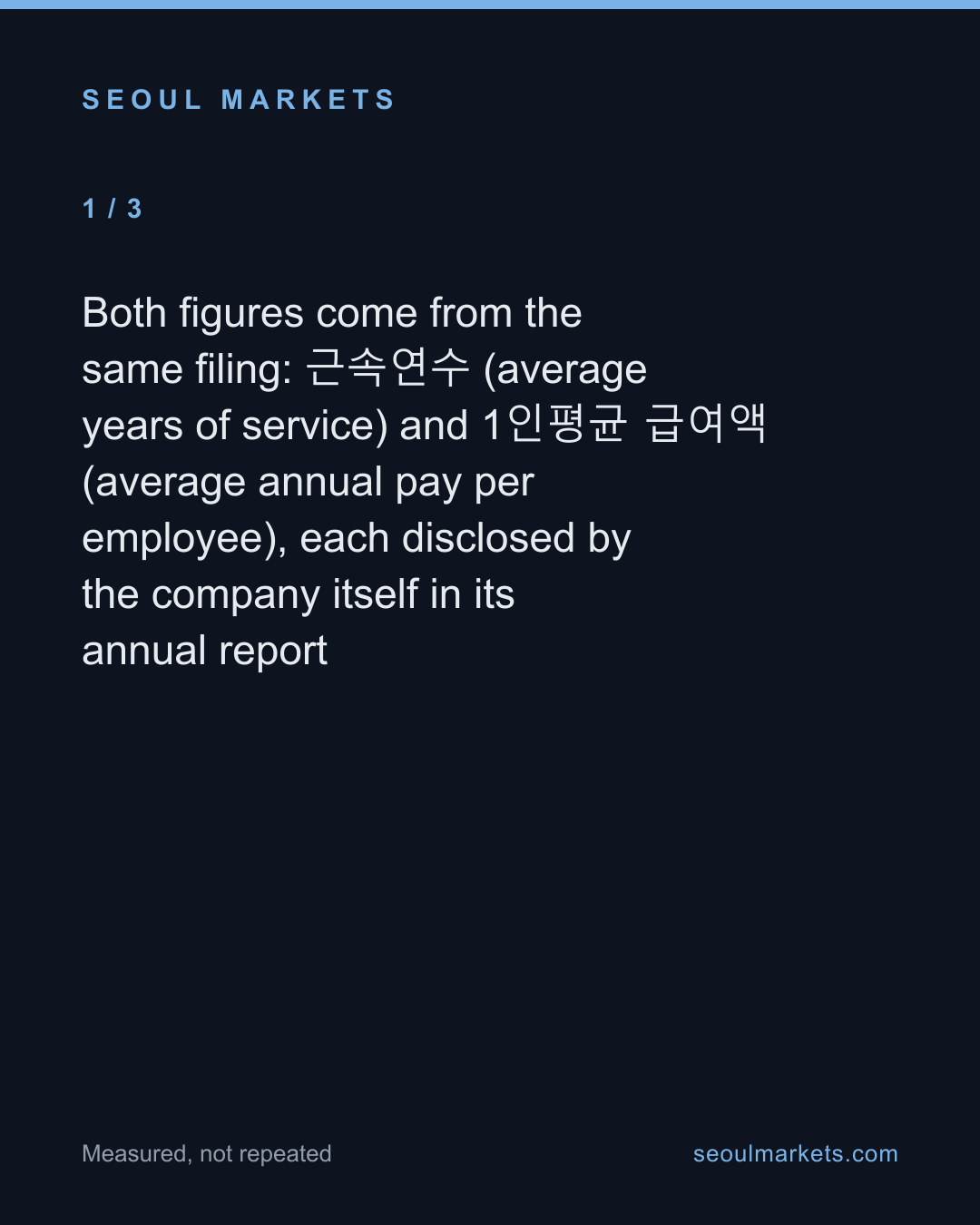
- Both figures come from the same filing: 근속연수 (average years of service) and 1인평균 급여액 (average annual pay per employee), each disclosed by the company itself in its annual report
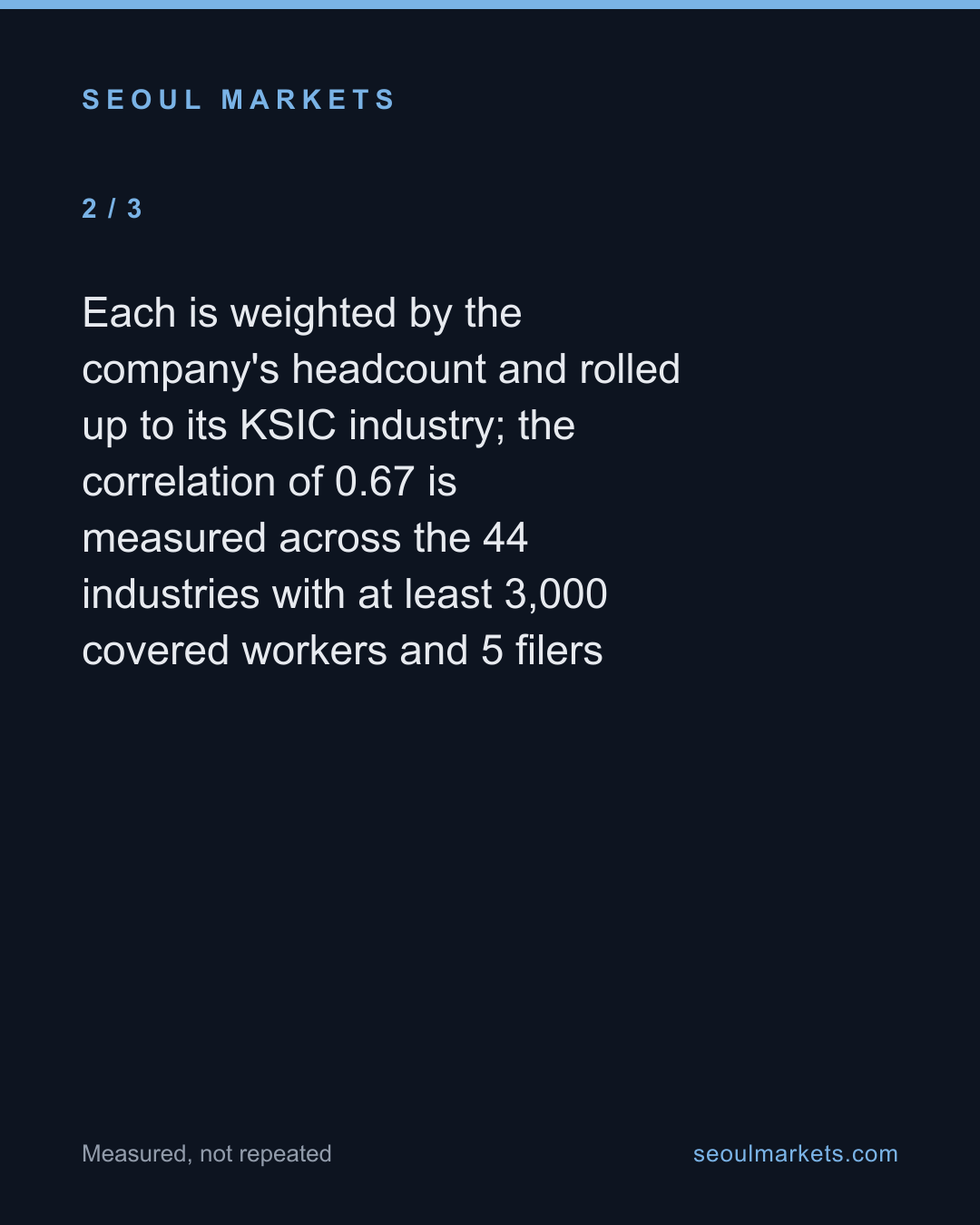
- Each is weighted by the company's headcount and rolled up to its KSIC industry; the correlation of 0.67 is measured across the 44 industries with at least 3,000 covered workers and 5 filers
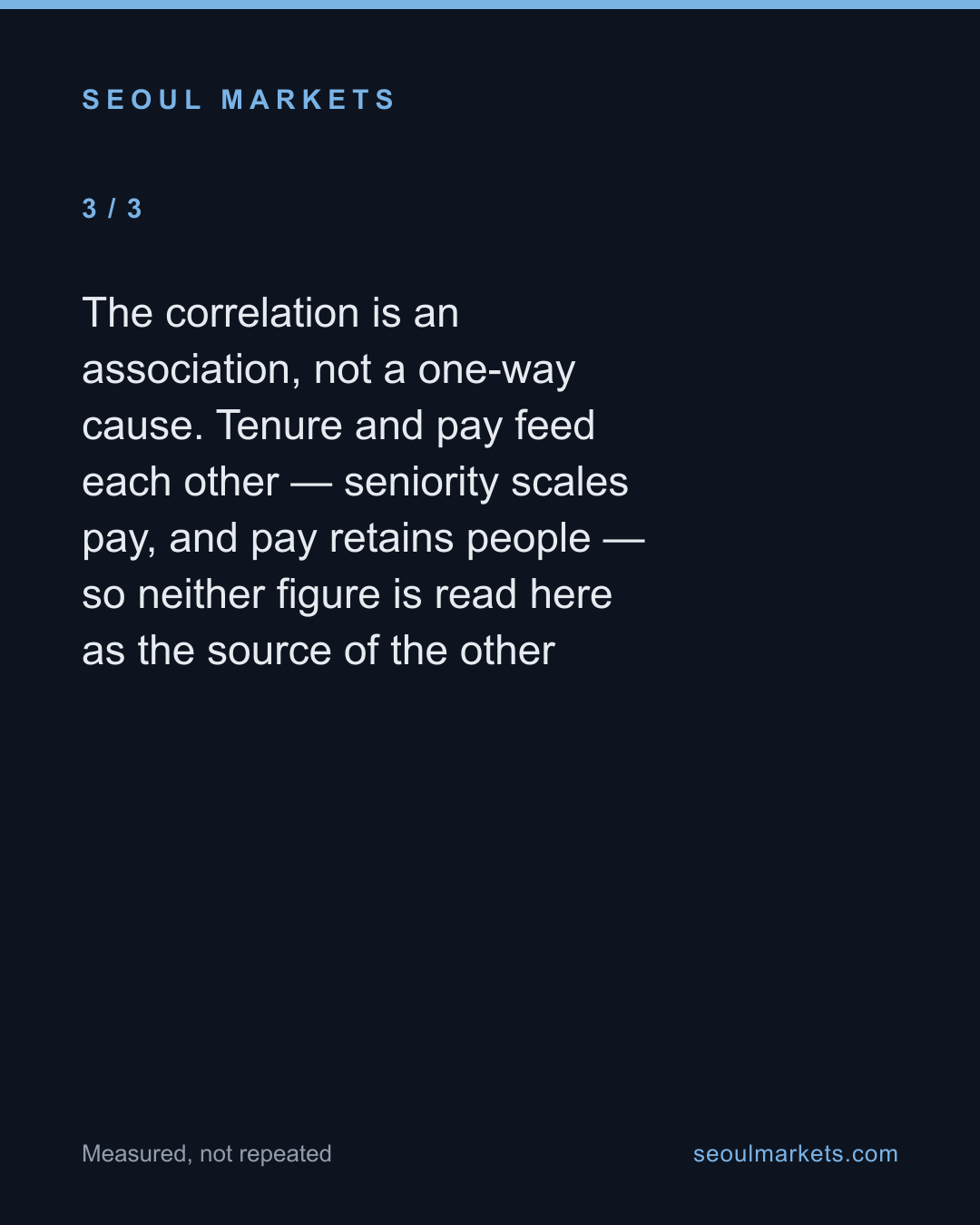
- The correlation is an association, not a one-way cause. Tenure and pay feed each other — seniority scales pay, and pay retains people — so neither figure is read here as the source of the other
- Pay is as filed; holding companies count head office only and bonus and option treatment differ by company, so a single company's pay is noisier than an industry's headcount-weighted average
- Excluded figures
- Industries below the 3,000-worker, 5-filer bar, whose pay or tenure would turn on one company
- Any claim that longer tenure earns higher pay for a given worker. This compares industries, not careers; within one company the seniority link is real but it is not what these industry averages measure
- Unlisted employers, which pay less and turn over faster than the listed set shown here
The full dataset behind these figures — every listed company, every row — is available to license. SeoulMarkets data for licence →
Not investment advice. SMarkets publishes data journalism for general information only. Nothing here is investment advice, a recommendation, or an offer to buy or sell any security — any investment you make is at your own risk and responsibility. Figures are derived from official public data sources and may be revised by the issuing agency. Verify independently before acting.
Take this away — 5 cards
The figures in this article, as images. Free to repost with the address on them.