China is Korea's biggest trade partner, but almost none of its surplus
China is Korea's biggest partner both ways — and the two nearly cancel. Its balance is about 5% of the national surplus on a fifth of all trade. The surplus is earned from the US, Vietnam and Taiwan; the deficits are oil, gas and machinery.
AI-assisted, human-reviewed sourcing. Figures are pulled programmatically from the official sources listed at the end of this article and checked by an editor before publication.
tradetrade balanceexportschinakorea
Ask who Korea trades with and the answer is China. It is the largest destination for Korean exports and the largest source of Korean imports, and it is not close. Ask where Korea’s trade surplus comes from, though, and China all but disappears.
The biggest partner is the most balanced one
Over the year to June 2026, Korea sent $169.8bn of goods to China and bought $160.6bn back. That is $330bn of trade — more than a fifth of everything Korea ships or receives — and it nets to a surplus of $9.2bn. On a national goods surplus of $187.7bn, China accounts for under 5%.
The country that dominates the volume barely moves the balance. To find the surplus, you have to look past it.
A note on the figures: these are nominal customs dollars over twelve months, and the underlying monthly totals carry a scale break from March 2026 that lifts the later months, so the absolute levels below read high. What we rely on — and what survives the break — is the structure: which partners are surpluses and which are deficits, the ranking, and China’s share of the total. Those are the findings; the exact dollar levels are not.
Where the surplus is actually earned
| Surplus with | Twelve-month balance |
|---|---|
| United States | +$73.2bn |
| Hong Kong | +$53.9bn* |
| Vietnam | +$43.2bn |
| Taiwan | +$27.9bn |
| India | +$14.8bn |
The United States alone earns Korea more than eight times the surplus China does — $154.2bn of exports against $81.0bn of imports. Vietnam, where Korean firms have moved much of their assembly, buys $78.1bn and sells back $34.9bn. Taiwan and Korea, the two poles of the chip industry, trade heavily and Korea comes out ahead.
*Hong Kong is the asterisk. Its $53.9bn surplus is not really demand from Hong Kong — the territory is a waypoint, and most of what lands there is forwarded to the mainland. The customs line records the shipping label, not the buyer. Count it as goods heading to greater China by another door, and China’s real pull looks larger than the $9bn balance suggests. We leave the figure in and mark it rather than delete a number the source reports.
Where the money goes back out
The deficits are cleaner to read, because they are all things Korea has to buy.
| Deficit with | Twelve-month balance |
|---|---|
| Saudi Arabia | −$22.7bn |
| Japan | −$20.8bn |
| Australia | −$14.7bn |
| Germany | −$13.1bn |
| United Arab Emirates | −$9.9bn |
Saudi Arabia, Australia and the UAE are oil, gas and coal — a $47bn hole that is really the price of energy for a country with almost none of its own. Japan and Germany are the other kind of deficit: machinery, precision components and capital goods, the equipment that goes into Korean factories before Korean products come out.
The shape of it
Put the two lists together and Korea’s trade has a clear structure. It runs its surpluses selling finished goods to rich consumer markets and to the assembly hubs downstream of it. It runs its deficits buying the raw energy it lacks and the high-end machinery it has not displaced. China sits in the middle of the volume and at the edge of the balance — the partner everyone names, and the one that, on the bottom line, cancels itself out.
Data & Verification Notes
- Data as of
- Sources
- Statistics Korea — KOSIS (Korea Customs Service data) — 국가별 품목별 수출입액 (exports and imports by country), table DT_1R11006_FRM101
- Cross-checks
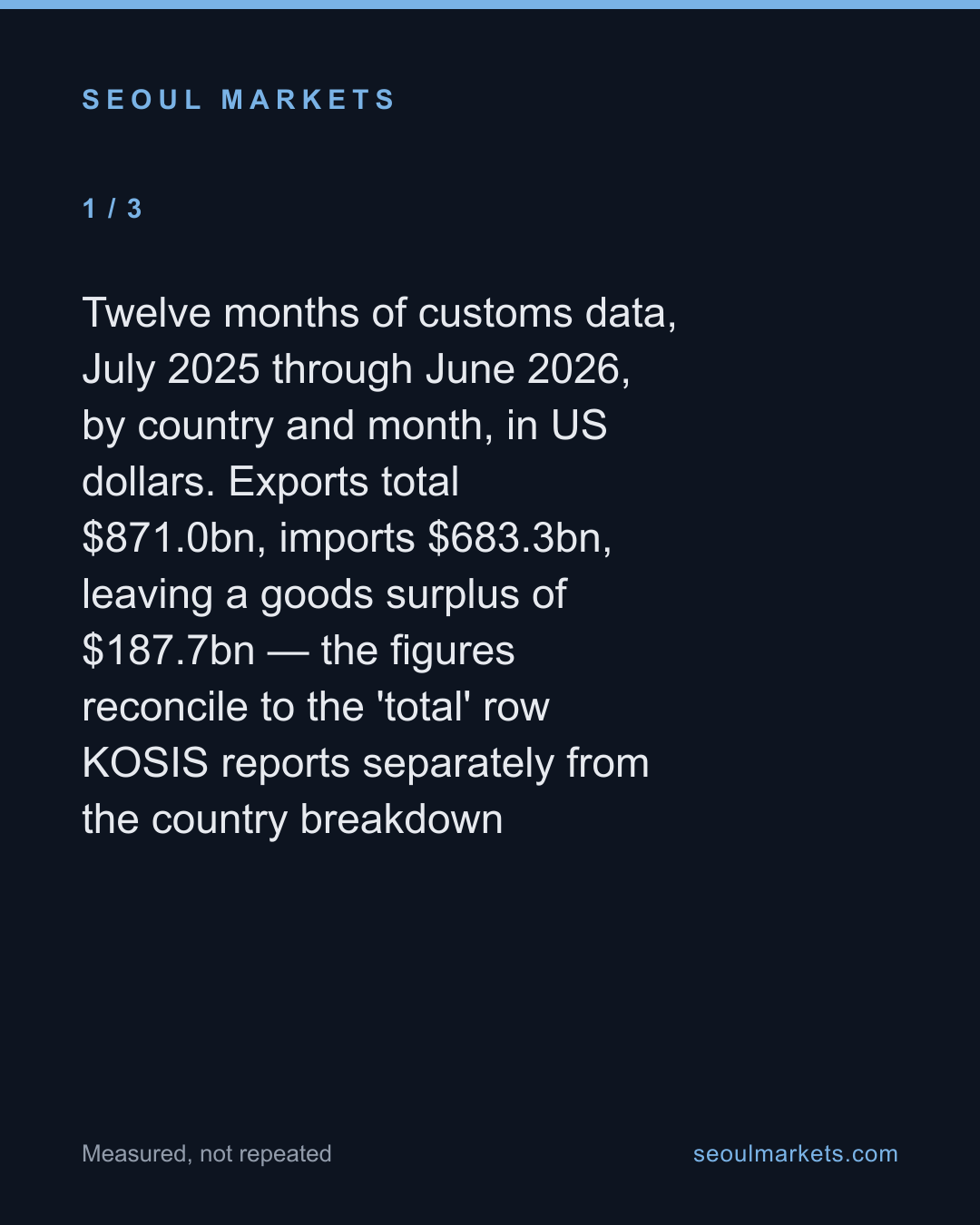
- Twelve months of customs data, July 2025 through June 2026, by country and month, in US dollars. Exports total $871.0bn, imports $683.3bn, leaving a goods surplus of $187.7bn — the figures reconcile to the 'total' row KOSIS reports separately from the country breakdown
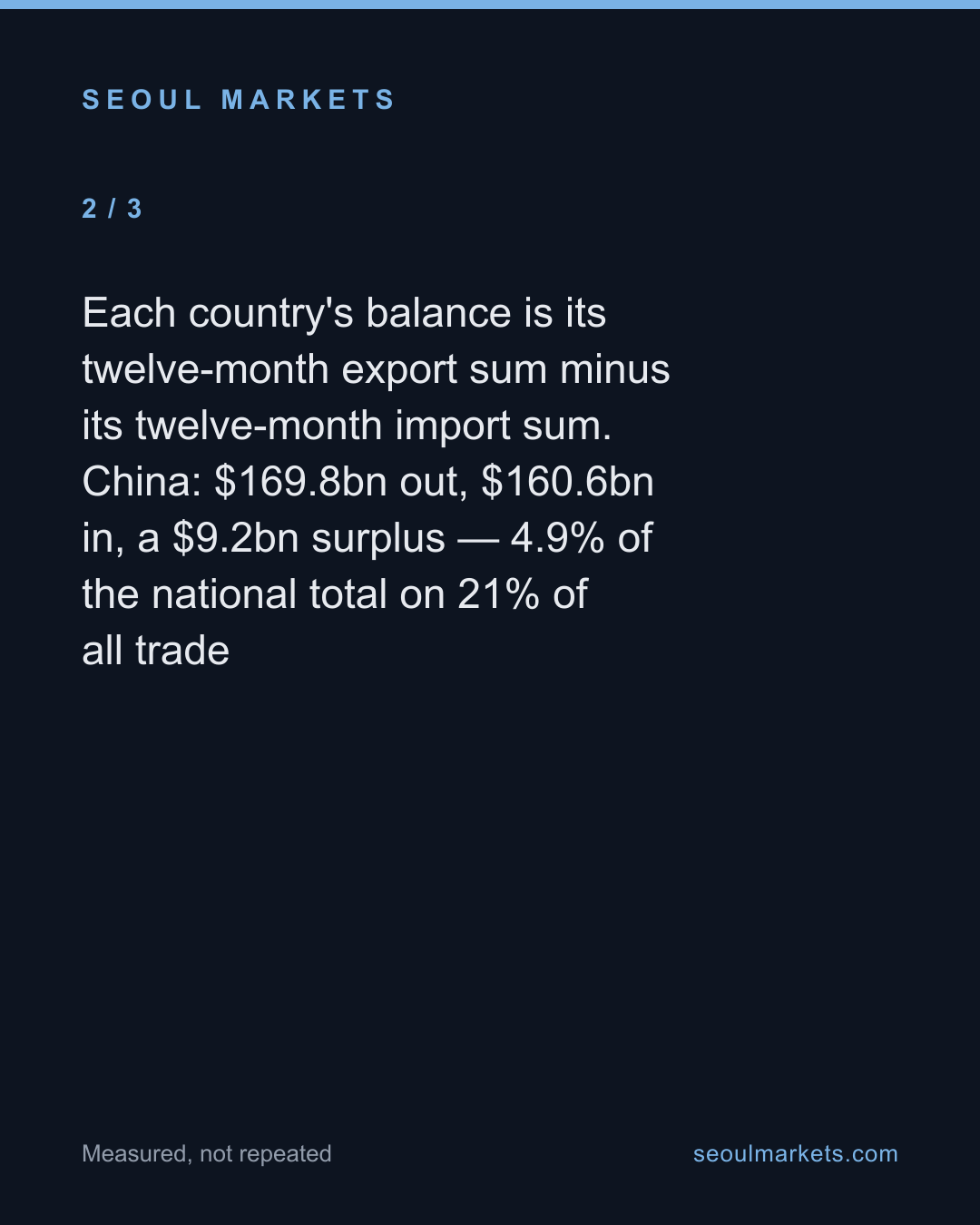
- Each country's balance is its twelve-month export sum minus its twelve-month import sum. China: $169.8bn out, $160.6bn in, a $9.2bn surplus — 4.9% of the national total on 21% of all trade
- The statistical definition (customs-cleared goods, thousand-dollar units) was pulled from KOSIS alongside the figures, not carried from memory, so the wording here matches the source
- Excluded figures
- Hong Kong's $53.9bn 'surplus' is flagged in the text, not removed: Hong Kong is an entrepôt and much of what Korea ships there is forwarded to mainland China. The customs figure records where the goods were sent, not where they were finally consumed. Read it as a routing figure, not a demand figure
- Services — shipping, tourism, royalties, finance. This is goods trade only. A country's dollar flows with Korea are larger than what appears here
- The current account. A trade surplus is not the same as the current-account balance, which also carries income and transfers. This measures goods crossing the customs line
- Why the balances fall where they do. The data shows the size and direction of each surplus and deficit; it does not explain exchange rates, contracts or commodity prices
The full dataset behind these figures — every listed company, every row — is available to license. SeoulMarkets data for licence →
Not investment advice. SMarkets publishes data journalism for general information only. Nothing here is investment advice, a recommendation, or an offer to buy or sell any security — any investment you make is at your own risk and responsibility. Figures are derived from official public data sources and may be revised by the issuing agency. Verify independently before acting.
Take this away — 5 cards
The figures in this article, as images. Free to repost with the address on them.