An eighth of Korean pay is bonus — lumped into a few months
Special payments are about 12–15% of a regular worker's yearly pay in Korea — and nearly a third of the year's total lands in December and January alone.
AI-assisted, human-reviewed sourcing. Figures are pulled programmatically from the official sources listed at the end of this article and checked by an editor before publication.
korea wagesbonusspecial paymentslabourmacro
A Korean worker’s monthly pay slip is not the same size every month, and it is mostly one line that does it. Beyond the fixed salary sits special pay — bonuses and one-off payments — and it is both a large share of the year and a very uneven one.
About an eighth of pay, and slowly shrinking
Across all industries, special payments have made up between roughly 12% and 15% of a regular employee’s total earnings every year since 2011. The share has drifted down — 15.3% in 2011 to 12.6% in 2025 — but the headline is how big it is at all: something like one part in eight of Korean pay is not the monthly salary.
| Year | Bonus share of pay |
|---|---|
| 2011 | 15.3% |
| 2015 | 13.8% |
| 2020 | 11.9% |
| 2025 | 12.6% |
It arrives in a few months, not twelve
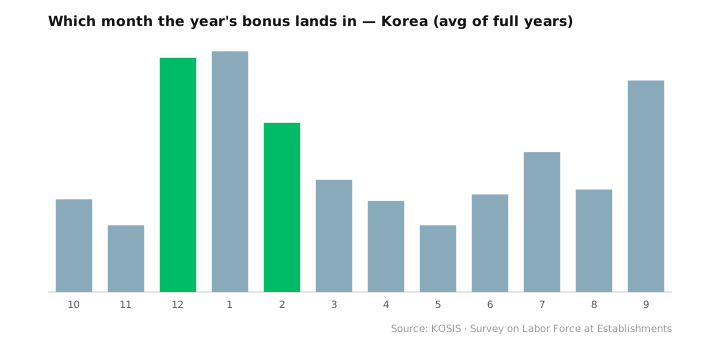
The bigger story is timing. Averaged over full years, the year’s special pay is not spread evenly — it clusters:
| Month | Share of the year’s bonus |
|---|---|
| January | 14.8% |
| December | 14.4% |
| September | 13.0% |
| February | 10.4% |
| … | … |
| May / November | ~4.1% each |
December and January together hold 29% of the whole year’s bonus. Add September and February and four months hold about half of it. The leanest months, May and November, hold about 4% each. So a worker’s December or January pay can tower over their May pay without their salary changing at all.
Why this matters for reading any monthly wage number
This is the mechanism behind a warning we have made before: Korea’s monthly real-wage figures swing hard, and not because pay is really lurching around. The fixed-salary part barely moves month to month. Special pay, three to four times larger in its peak months than in its troughs, is what makes a single month jump — so a one-month figure, or a one-month year-on-year change, is mostly telling you whether a bonus happened to land inside it.
The honest reading of a Korean pay number, then, is an annual one: bonuses are about an eighth of the total, they are shrinking slowly, and they arrive in a handful of months — which is exactly why the annual average, not the monthly headline, is the figure to trust.
Bonus share computed from KOSIS: Ministry of Employment and Labor establishment survey, special payments over total earnings, regular employees, annual figures. Free to reproduce with attribution — cite as SeoulMarkets (seoulmarkets.com) and link back.
Data & Verification Notes
- Data as of
- Sources
- Statistics Korea (KOSIS) — Ministry of Employment and Labor «Survey on Labor Force at Establishments» (사업체노동력조사) — KOSIS 118/DT_118N_MON041·051·054, items 13103110311MD_16 (special payments) ÷ MD_13 (total earnings), regular employees, all industries, all sizes
- Cross-checks
- Bonus share = special payments (특별급여) ÷ total monthly earnings (임금총액) for regular employees, all industries, all sizes. Full calendar years only. The share ran 15.3% in 2011 and 12.6% in 2025 — a slow decline, always between about 12% and 15%
- Month concentration is the average, across full years, of how much of that year's total special pay fell in each month. December 14.4% and January 14.8% together hold 29.2% of the year's bonus; adding September (13.0%) and February (10.4%) reaches about 52% in four months. The thinnest months, May and November, hold about 4% each
- This is why single-month wage figures swing. A month that catches a bonus reads far above one that does not — the fixed-pay part (정액급여) barely moves month to month, while special pay is three to four times larger in its peak months than in its troughs
- Excluded figures
- Why bonuses land when they do. The series carries how much special pay was paid and when, not the reason. The peak months line up with Korea's year-end and its two big holidays, but we are not going to assert from this table that any given payment is a holiday bonus
- Whether the decline is good or bad. A falling bonus share can mean many things — more pay shifted into fixed salary, fewer performance payouts, a changing industry mix. The table does not say which, and we will not guess
- Individual experience. This is the all-industry average for regular employees; a specific workplace can be far above or below it
- This is not investment advice
The full dataset behind these figures — every listed company, every row — is available to license. SeoulMarkets data for licence →
Not investment advice. SMarkets publishes data journalism for general information only. Nothing here is investment advice, a recommendation, or an offer to buy or sell any security — any investment you make is at your own risk and responsibility. Figures are derived from official public data sources and may be revised by the issuing agency. Verify independently before acting.
← More Macro