Koreans work fewer days, not shorter days
Korea's monthly work time fell 13% since 2011 — but the working day barely shortened (8.33 to 8.05 hours). The drop is fewer days: 21.2 to 19.1 a month.
AI-assisted, human-reviewed sourcing. Figures are pulled programmatically from the official sources listed at the end of this article and checked by an editor before publication.
korea working hoursworking dayslabouroverworkmacro
Korea’s total working time has come down — monthly hours fell about 13% since 2011. The interesting part is how. It is not that the working day got shorter. It is that the month has fewer days in it.
The day held; the days went
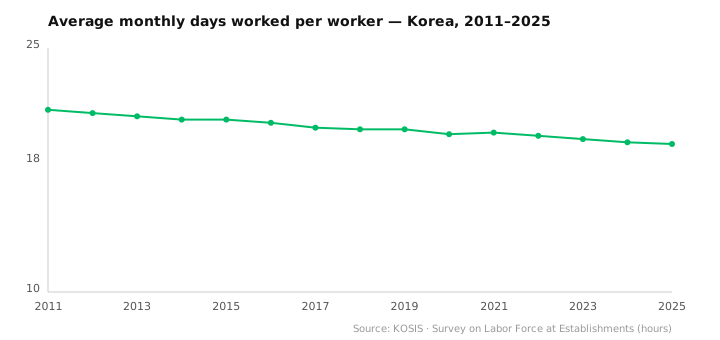
Two numbers from the same survey, side by side:
| Year | Days / month | Hours / month | Hours per working day |
|---|---|---|---|
| 2011 | 21.2 | 176.6 | 8.33 |
| 2016 | 20.4 | 169.3 | 8.30 |
| 2019 | 20.0 | 163.1 | 8.15 |
| 2025 | 19.1 | 153.8 | 8.05 |
Days per month dropped from 21.2 to 19.1 — about 2.1 fewer working days every month, a 9.9% fall. Total hours fell further, 12.9%. But divide one by the other and the length of an actual working day barely budges: 8.33 hours in 2011, 8.05 in 2025 — down just 3.4%.
What that means for reading the trend
The headline “Koreans work less than they used to” is true, but the shape matters. Almost all of the decline is fewer days on the calendar, not shorter days at the desk. A Korean who works still puts in close to the same eight-and-a-bit hours on a working day that they did over a decade ago — they just do it on two fewer days a month.
We are not going to say from this table why the days fell — holidays, part-time share, paid leave and industry mix all sit behind it, and the survey carries the counts, not the reasons. What it does say cleanly is the composition: Korea’s shorter working month is a story of fewer days, not shorter ones. It fits alongside the rest of the picture — overtime fell faster still, while real wages went flat after 2021.
Days and hours computed from KOSIS: Ministry of Employment and Labor establishment survey, per worker, annual averages of monthly figures. Free to reproduce with attribution — cite as SeoulMarkets (seoulmarkets.com) and link back.
Data & Verification Notes
- Data as of
- Sources
- Statistics Korea (KOSIS) — Ministry of Employment and Labor «Survey on Labor Force at Establishments» (사업체노동력조사) — KOSIS 118/DT_118N_MON041·051·054 — item 13103110311MD_4 (days worked) and MD_7 (hours worked), per worker, monthly, all industries, all sizes
- Cross-checks
- Days worked and hours worked per worker per month, all industries, establishments with one or more regular employees, full calendar years. Both series stitched across the same three table IDs; seam changes were small (days −4.5% and −3.0%, inside ordinary monthly swings)
- Days per month fell from 21.2 in 2011 to 19.1 in 2025, down 9.9% — about 2.1 fewer working days a month. Total hours fell further, from 176.6 to 153.8, down 12.9%
- Hours per working day = monthly hours ÷ monthly days. It moved only from 8.33 in 2011 to 8.05 in 2025 — a 3.4% fall. So the working day itself barely shortened; the month lost days
- Excluded figures
- Why days fell. The series carry days and hours, not causes — public holidays landing differently, more part-time and short-week arrangements, paid leave, and industry mix all move these lines, and we will not assign the cause from this table
- Whether fewer days means less output or less pay. That is a separate question this data does not answer
- Individual experience. This is the all-industry average per worker; a specific job can be far above or below it
- This is not investment advice
The full dataset behind these figures — every listed company, every row — is available to license. SeoulMarkets data for licence →
Not investment advice. SMarkets publishes data journalism for general information only. Nothing here is investment advice, a recommendation, or an offer to buy or sell any security — any investment you make is at your own risk and responsibility. Figures are derived from official public data sources and may be revised by the issuing agency. Verify independently before acting.
← More Macro