Korea CPI: mobile fee jumped 26.7%, rest flat
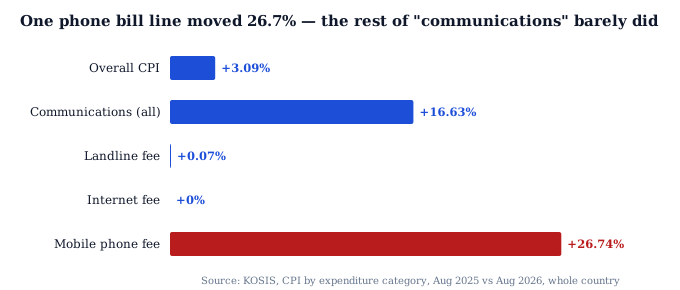
Korea's August CPI rose 3.09% year-on-year. The 'telecom base effect' two papers cited sits almost entirely in one line: the mobile phone fee index, up 26.74% — while landline and internet fees barely moved.
AI-assisted, human-reviewed sourcing. Figures are pulled programmatically from the official sources listed at the end of this article and checked by an editor before publication.
cpiinflationtelecomkoreabase effect
Korea’s August consumer price index rose 3.09% from a year earlier, matching the government’s published +3.1% headline almost exactly once we pulled the same series ourselves. Two newspapers explained the jump as a “telecom base effect” — last year’s mobile discount promotion dropping out of the comparison — and the finance ministry estimated that, without it, the real increase would be closer to 2.5%. We went to the primary KOSIS index to see exactly where that effect lives.
One line item, not a category
| Item | Aug 2025 | Aug 2026 | Change |
|---|---|---|---|
| Overall CPI | 116.45 | 120.05 | +3.09% |
| Communications (all) | 87.87 | 102.48 | +16.63% |
| — Telephone & fax services | 84.17 | 101.94 | +21.11% |
| — Landline fee | 100.30 | 100.37 | +0.07% |
| — Mobile phone fee | 80.52 | 102.05 | +26.74% |
| — Internet fee | 100.62 | 100.62 | 0.00% |
All index values and percentage changes are computed by us directly from KOSIS’s own monthly series (2020=100). We did not use any pre-computed year-on-year figure from KOSIS — each change above is (this year minus last year) divided by last year, from the raw index levels.
Where the “base effect” actually sits
The word “communications” covers landline, mobile, and internet fees together, and the category as a whole rose 16.63% — more than five times the headline rate. But splitting it apart shows the move is not spread across the category. Landline and internet fee indexes are essentially unchanged from a year ago, both under a tenth of a percentage point. The entire swing sits in the mobile phone fee index, which rose 26.74%.
That fits the base-effect explanation: a discount promotion pushed last August’s mobile index down to 80.52, and this August’s index of 102.05 is being compared against that unusually low base rather than against a normal month. The size of the move — one item moving 26.74% against two flat neighbors in the same official category — is what we can confirm directly from the data; we did not have to take either newspaper’s word for which line item was responsible.
What we can’t put a number on
We cannot tell you exactly how many of the 3.09 percentage points of headline inflation this one item accounts for. That requires the official item-weight table used to build the composite index, and we could not locate one on KOSIS with a usage license we could confirm was clear to use. So on that specific number, we cite the finance ministry’s own estimate — “about 2.5% with the base effect excluded” — as an attributed figure, not something we recomputed ourselves.
What we can say, from the index levels alone: the story is not “communications got more expensive.” It’s one item, out of three, doing all the moving. This is a measure of a published statistical index, not a forecast, and it is not investment advice.
The debate
A single sub-item moving 26.7% while its two neighbors sit flat, inside a category that gets reported as one number — how much should a headline inflation figure lean on an explanation like this? What do you think? This is a talking point, not a verdict — argue it out below.
Data & Verification Notes
- Data as of
- Sources
- KOSIS (Korea Statistical Information Service, 국가데이터처) — statisticsParameterData.do, table DT_1J22001 (Consumer Price Index by Purpose, 2020=100), national level (T10), monthly, August 2025 vs August 2026 — pulled and computed by us
- Ministry of Economy and Finance (Korea) — Press briefing on the 2 September 2026 CPI release, reported by domestic outlets, estimating CPI growth at 2.5% with the telecom base effect excluded — cited as the ministry's own figure, not recomputed by us
- Cross-checks
- Overall CPI: 116.45 (Aug 2025) → 120.05 (Aug 2026), +3.09% year-on-year — matches the published headline of +3.1%
- Communications category overall: 87.87 → 102.48, +16.63% — more than five times the headline rate
- Telephone & fax services sub-index: 84.17 → 101.94, +21.11%
- Mobile phone fee index: 80.52 → 102.05, +26.74% — the single largest mover we found in this category
- Landline fee index: 100.30 → 100.37, +0.07%; internet fee index: 100.62 → 100.62, +0.00% — both effectively flat
- Excluded figures
- The exact percentage-point contribution of the mobile fee item to the 3.09% headline — this needs a published item-weight table, and we could not locate one on KOSIS with a clear usage license. We cite the ministry's own '2.5% ex-base-effect' estimate instead of recomputing a contribution figure ourselves
- Why last year's mobile discount ended when it did, or any carrier-level pricing detail — KOSIS publishes one national aggregate index for the item, not carrier data, and the reason is outside what either dataset shows
- Any claim about future CPI prints — this is a backward-looking index comparison for two named months only
The full dataset behind these figures — every listed company, every row — is available to license. SeoulMarkets data for licence →
Not investment advice. SMarkets publishes data journalism for general information only. Nothing here is investment advice, a recommendation, or an offer to buy or sell any security — any investment you make is at your own risk and responsibility. Figures are derived from official public data sources and may be revised by the issuing agency. Verify independently before acting.
← More Macro