Korean overtime has fallen by nearly a third since 2011
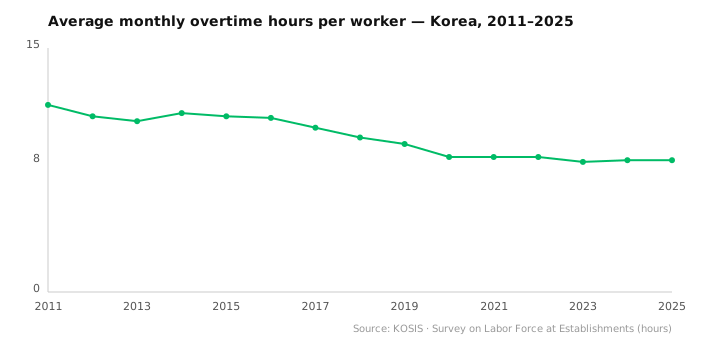
Average monthly overtime for a regular worker dropped from 11.5 hours in 2011 to 8.1 in 2025 — a 30% fall, on Korea's own establishment survey.
AI-assisted, human-reviewed sourcing. Figures are pulled programmatically from the official sources listed at the end of this article and checked by an editor before publication.
korea working hoursovertimelabouroverworkmacro
The long-hours reputation has a specific line inside it: overtime. On Korea’s own establishment survey, the average regular worker put in 11.5 hours of overtime a month in 2011 and 8.1 in 2025 — a fall of nearly a third, and most of it landed in a few years in the middle.
Down a third, fastest in the late 2010s
| Year | Overtime / month | Annualised |
|---|---|---|
| 2011 | 11.5 | ~138 |
| 2016 | 10.7 | ~128 |
| 2019 | 9.1 | ~109 |
| 2020 | 8.3 | ~100 |
| 2025 | 8.1 | ~97 |
The decline is not a straight slope. It was slow through the first half of the 2010s — 11.5 down to 10.7 by 2016 — then dropped faster: 10.1 hours in 2017 to 8.3 in 2020. Since 2020 it has sat near eight hours and barely moved. So the change is real and large, but it is concentrated in the late-2010s, not spread evenly across the fourteen years.
What we are not saying
It is tempting to draw a straight line from Korea’s 52-hour workweek, phased in from 2018, to the steepest part of this drop. The years do line up. But this table carries hours worked, not the reason they changed — a law, a slowing economy, a shift in which industries are hiring, and the spread of paid leave could each move the same line. We report the timing plainly and leave the cause to the reader, rather than assert one from a single series.
What the data does say, cleanly: recorded overtime for a Korean regular worker is down about 30% from 2011, the fall was sharpest in the late 2010s, and it has held near eight hours a month since 2020. It sits alongside the broader picture — total hours worked have fallen too, while real wages went flat after 2021.
Overtime computed from KOSIS: Ministry of Employment and Labor establishment survey, overtime hours per regular employee, annual averages of monthly figures. Free to reproduce with attribution — cite as SeoulMarkets (seoulmarkets.com) and link back.
Data & Verification Notes
- Data as of
- Sources
- Statistics Korea (KOSIS) — Ministry of Employment and Labor «Survey on Labor Force at Establishments» (사업체노동력조사) — KOSIS 118/DT_118N_MON041·051·054, item 13103110311MD_10 (overtime hours, regular employees, per worker, monthly), all industries, all sizes
- Cross-checks
- Overtime hours worked per regular employee per month, all industries, establishments with one or more regular employees. Three table IDs are stitched across two industry-classification revisions; at both seams the month-on-month change was small (−7.9% and −7.5%), inside ordinary monthly swings, so the join does not create the trend
- Full calendar years only. The annual average of monthly overtime fell from 11.5 hours in 2011 to 8.1 in 2025 — a 29.6% decline. Annualised, that is roughly 138 hours of overtime a year in 2011 and 97 in 2025
- The fall was not even across the span: it was gentle to 2016 (11.5 to 10.7), then dropped faster to 2020 (10.1 in 2017 to 8.3 in 2020), then flattened near 8 hours
- Excluded figures
- Why overtime fell. Korea phased in a statutory 52-hour week from 2018, and the fastest part of this decline sits around those years — but this series carries hours, not causes, and we will not assert from an hours table that the law, the business cycle, or the industry mix did it. The timing is stated; the cause is left to the reader
- Total hours versus overtime. This is the overtime component only. Total hours worked are a separate, larger series
- Unpaid or unrecorded overtime. The survey counts what employers report; hours worked off the books are outside it, and we do not estimate them
- This is not investment advice
The full dataset behind these figures — every listed company, every row — is available to license. SeoulMarkets data for licence →
Not investment advice. SMarkets publishes data journalism for general information only. Nothing here is investment advice, a recommendation, or an offer to buy or sell any security — any investment you make is at your own risk and responsibility. Figures are derived from official public data sources and may be revised by the issuing agency. Verify independently before acting.
← More Macro