Korea's youth unemployment has quietly fallen since 2016
Korea's youth (15–29) jobless rate peaked at 9.8% in 2016 and fell to 6.1% by 2025 — about twice the national rate. But a falling rate is not only good news.
AI-assisted, human-reviewed sourcing. Figures are pulled programmatically from the official sources listed at the end of this article and checked by an editor before publication.
korea youthunemploymentlabourjobsmacro
Korea is about to spend heavily on its young: the government’s 2027 budget earmarks tens of trillions of won for youth jobs, housing, education and asset-building. It is worth asking, first, what the headline labour number has actually been doing. The answer is not the one the spending implies.
Down by a third from the 2016 peak
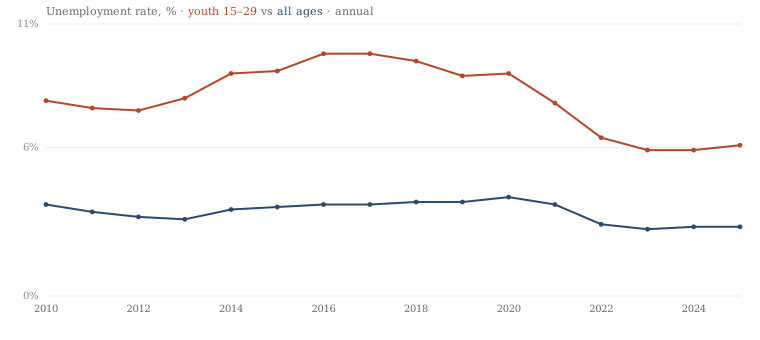
The unemployment rate for Koreans aged 15–29 climbed through the early 2010s to a peak of 9.8% in 2016 and 2017. Then it fell — to 7.8% in 2021, 6.4% in 2022, 5.9% in 2023, and 6.1% in 2025. From the peak, that is a drop of more than a third.
| Year | Youth (15–29) | All ages | Youth ÷ all |
|---|---|---|---|
| 2010 | 7.9% | 3.7% | 2.1× |
| 2016 | 9.8% | 3.7% | 2.6× |
| 2020 | 9.0% | 4.0% | 2.3× |
| 2023 | 5.9% | 2.7% | 2.2× |
| 2025 | 6.1% | 2.8% | 2.2× |
Two things are true across the whole period. The youth rate fell, clearly and not just for one year. And the youth rate is always about twice the national one — young workers are roughly twice as likely to be unemployed as the workforce as a whole, in the bad years and the better ones alike. That gap is the structural part; the fall is the news.
The catch, and it is a big one
A lower unemployment rate sounds like an unambiguous win. It is not, because of how the rate is built. Unemployment counts only people who are both jobless and actively looking for work. Anyone who stops looking — who studies longer, prepares for exams, or simply rests — is not unemployed by this definition. They leave the denominator, and the rate falls without a single job being added.
That matters here because the number of young Koreans who are neither working nor looking has grown. Part of the decline from 9.8% to 6% is genuinely fewer jobless youth; part of it is youth who have left the count altogether. The rate does not distinguish the two, and anyone who tells you the youth job market simply “got a third better” is reading only the half of the picture the rate shows.
So the honest reading is narrower than the headline and more useful: the measured youth unemployment rate has fallen well below its mid-2010s peak — while a growing group of young people has stepped outside the measure entirely. Both facts are why a government writes a youth budget in a year when the unemployment line is near its lowest in over a decade — and when, for those who do work, real wages have gone flat since 2021.
Youth unemployment computed from KOSIS: Statistics Korea’s Economically Active Population Survey, annual averages, ages 15–29. Free to reproduce with attribution — cite as SeoulMarkets (seoulmarkets.com) and link back.
Data & Verification Notes
- Data as of
- Sources
- Statistics Korea (KOSIS) — Economically Active Population Survey (경제활동인구조사) — KOSIS 101/DT_1DA7102S — unemployment rate by sex and age, annual averages
- Cross-checks
- Annual averages, not single months, to cancel the graduation-season spike each February–March. Youth here is ages 15–29, the band Korea's own statistics office uses for its youth figures
- The youth (15–29) unemployment rate: 7.9% in 2010, a peak of 9.8% in 2016 and 2017, then a fall to 5.9% in 2023 and 6.1% in 2025. Across the whole span the youth rate runs about twice the all-ages rate — 6.1% against 2.8% in 2025, a ratio of 2.18
- The all-ages unemployment rate over the same years stayed in a narrow 2.7–4.0% band, so the youth move is not just the whole labour market moving together — the youth line falls further and faster than the national one
- Excluded figures
- Why it fell. The survey counts who is working and who is looking; it does not carry the reasons, and we are not going to assign them
- The 'resting' population. An unemployment rate counts only people who are both jobless and actively looking. Young people who stop looking — who rest, study longer, or drop out of the labour force — leave the denominator and pull the rate down without a single new job being created. That group has grown, so the falling rate overstates how much better things got. The rate is a real number; it is just not the whole story
- 2026 so far. Only partial-year months are in, and youth unemployment is highly seasonal around graduation, so we hold to full-year averages through 2025
- This is not investment advice
The full dataset behind these figures — every listed company, every row — is available to license. SeoulMarkets data for licence →
Not investment advice. SMarkets publishes data journalism for general information only. Nothing here is investment advice, a recommendation, or an offer to buy or sell any security — any investment you make is at your own risk and responsibility. Figures are derived from official public data sources and may be revised by the issuing agency. Verify independently before acting.
← More Macro