Korea is quietly moving onto floating rates — and companies are moving fastest
Over the year to June 2026 the fixed-rate share of won bank loans fell for every borrower: companies 39% to 31%, households 47% to 44%, mortgages 66% to 63%. More of the loan book now reprices when rates move. Not advice.
AI-assisted, human-reviewed sourcing. Figures are pulled programmatically from the official sources listed at the end of this article and checked by an editor before publication.
interest-ratesbank-loansfixed-vs-floatingbank-of-koreakorea
Ask who in Korea is exposed when interest rates move, and the answer has been changing — quietly, and in one direction. Over the year to June 2026 the share of outstanding won bank loans carrying a fixed rate fell for every kind of borrower. More of the country’s loan book now reprices whenever the policy rate does.
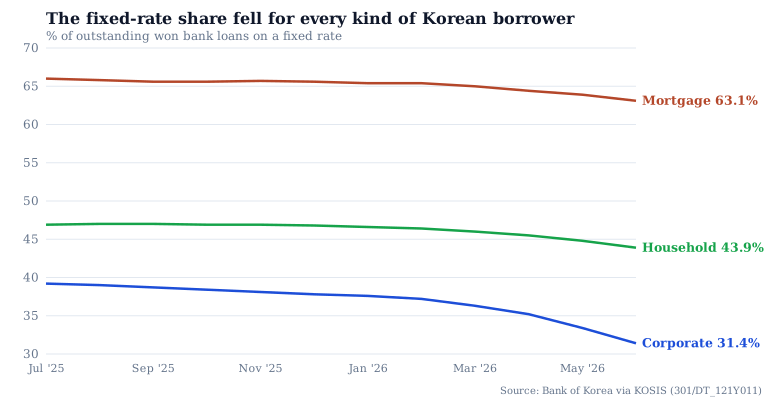
The floor gave way fastest for companies
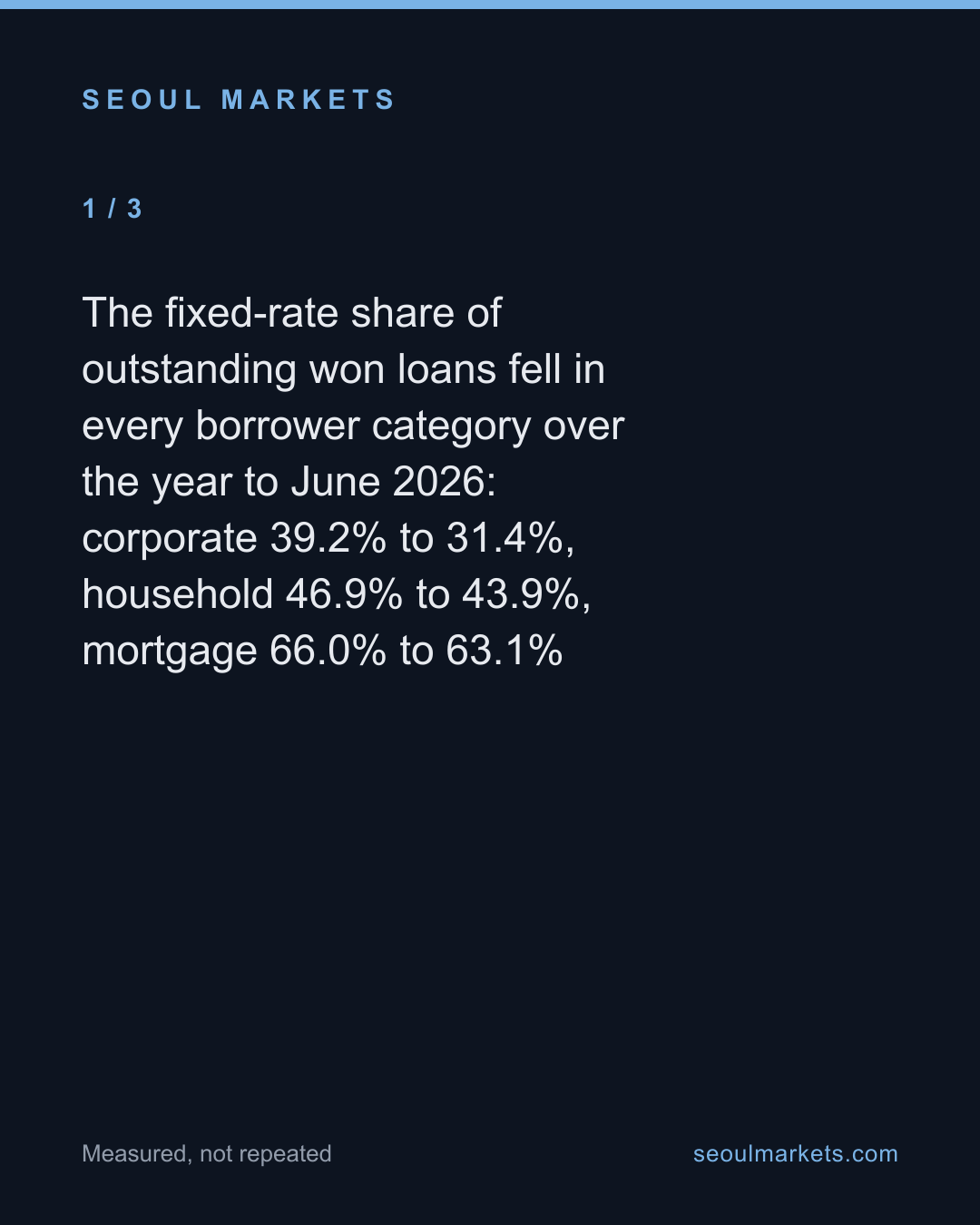
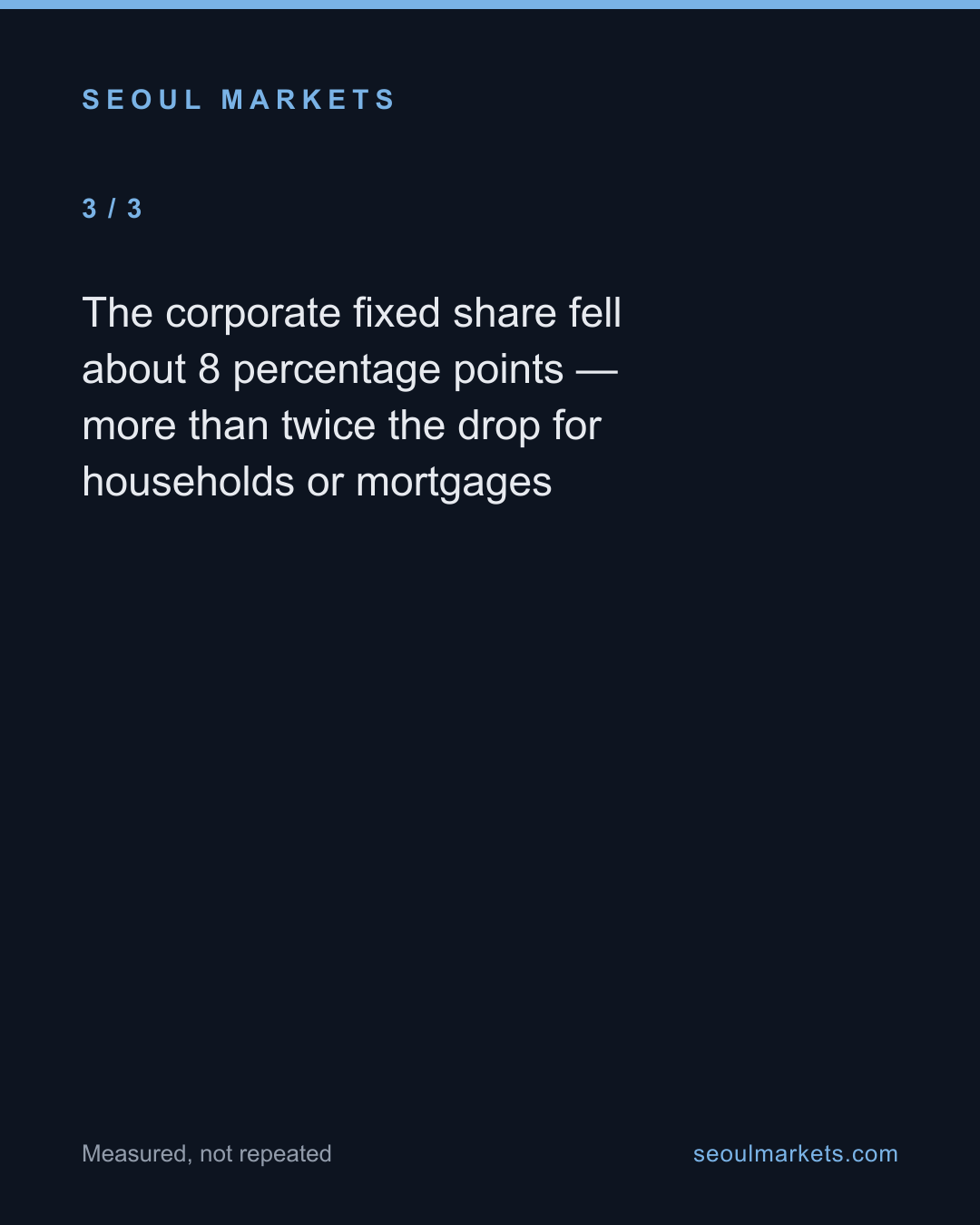
Twelve months ago 39.2% of corporate loan balances were fixed; by June it was 31.4% — a fall of about eight percentage points, more than twice the drop seen for households (46.9% → 43.9%) or mortgages (66.0% → 63.1%). Every line on the chart slopes down, but the corporate one slopes hardest, and it accelerated into the spring. Companies, in aggregate, spent the year letting their fixed-rate cover run off and not replacing it.
Where each borrower stands now
Take a single snapshot of June and the three groups look like three different attitudes to rate risk.
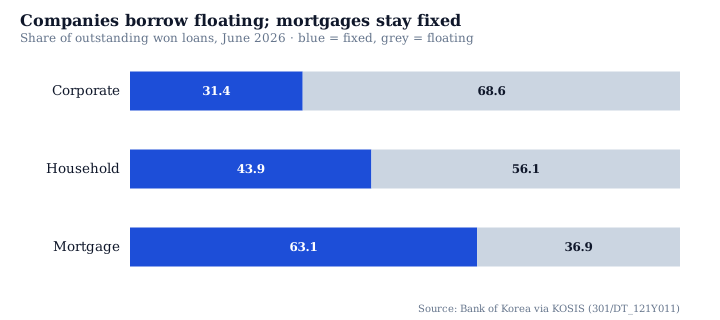
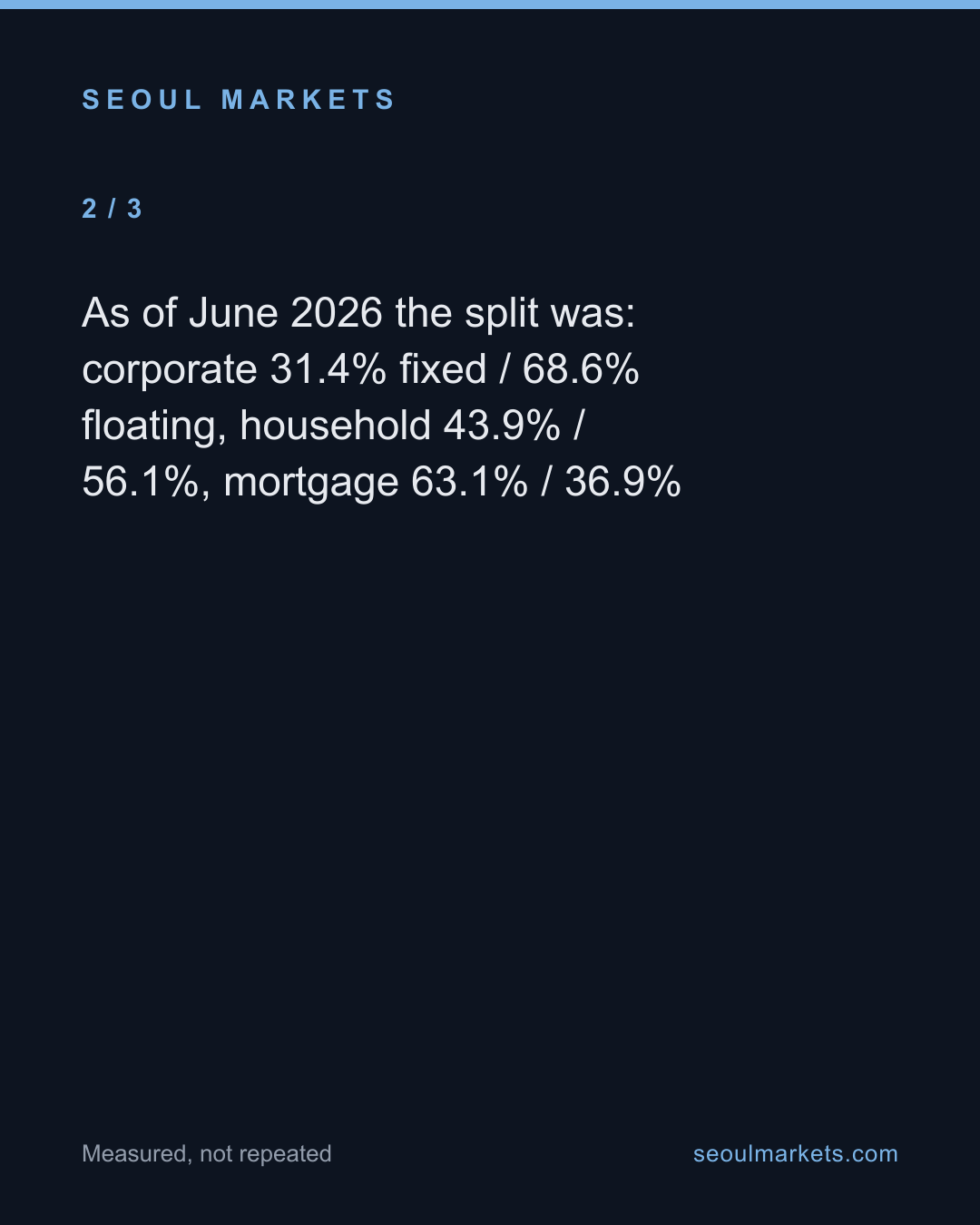
Companies are the most exposed: barely a third of their loan balances are fixed, so nearly seven won in ten reprice with the market. Mortgages sit at the other end — 63% fixed, the legacy of years of policy pushing households toward fixed-rate home loans. Households overall are in between at 44% fixed, pulled down by the non-mortgage borrowing around the edges.
What the shift is, and is not
Read plainly, a falling fixed share means one mechanical thing: more of the loan book reprices when rates change. That cuts both ways — it lightens the interest bill faster if rates fall, and it bites faster if they rise. It makes the economy’s response to the next policy move quicker and larger than it would have been a year ago. That much is arithmetic.
What the data does not tell us is why. A lower fixed share can mean borrowers expect rates to fall and want to ride them down; it can also mean floating-rate loans are simply pricing cheaper right now and borrowers are taking the cheaper coupon. Those are different stories with different implications, and this table cannot separate them — so we do not. This is the share on an outstanding-balance basis (the slow-moving stock, not the month’s new lending), it is a description of Korea’s loan book and not a forecast, and it is not investment advice. What it shows is simply this: Korea has been trading fixed-rate certainty for floating-rate exposure all year, and its companies led the way out.
Data & Verification Notes
- Data as of
- Sources
- Bank of Korea (via KOSIS) — Fixed- and floating-rate share of deposit-bank loans, outstanding-balance basis, table DT_121Y011 (org 301), monthly Jul 2025–Jun 2026
- Cross-checks
- The fixed-rate share of outstanding won loans fell in every borrower category over the year to June 2026: corporate 39.2% to 31.4%, household 46.9% to 43.9%, mortgage 66.0% to 63.1%
- As of June 2026 the split was: corporate 31.4% fixed / 68.6% floating, household 43.9% / 56.1%, mortgage 63.1% / 36.9%
- The corporate fixed share fell about 8 percentage points — more than twice the drop for households or mortgages
- Excluded figures
- This is the share of outstanding loan balances, not of new lending in the month — the stock moves more slowly than the flow
- Floating here bundles market-rate-linked, deposit-rate-linked and other-linked loans; the corporate book is dominated by market-rate-linked (about 64% of the total in June)
- We do not assert why the shift happened — a lower fixed share can reflect borrowers expecting rates to fall, or floating simply pricing cheaper now. This reports the shift, not its cause, and is not a forecast
- This is not investment advice
The full dataset behind these figures — every listed company, every row — is available to license. SeoulMarkets data for licence →
Not investment advice. SMarkets publishes data journalism for general information only. Nothing here is investment advice, a recommendation, or an offer to buy or sell any security — any investment you make is at your own risk and responsibility. Figures are derived from official public data sources and may be revised by the issuing agency. Verify independently before acting.
Take this away — 5 cards
The figures in this article, as images. Free to repost with the address on them.